
THE APEX TIMES
49ers likely won’t assign Deommodore Lenoir to shadow Jaxon Smith-Njigba
With Seattle’s Jaxon Smith-Njigba posting a fast start, San Francisco faces a coverage problem that is more about team structure and route details than locking one receiver in man-to-man.
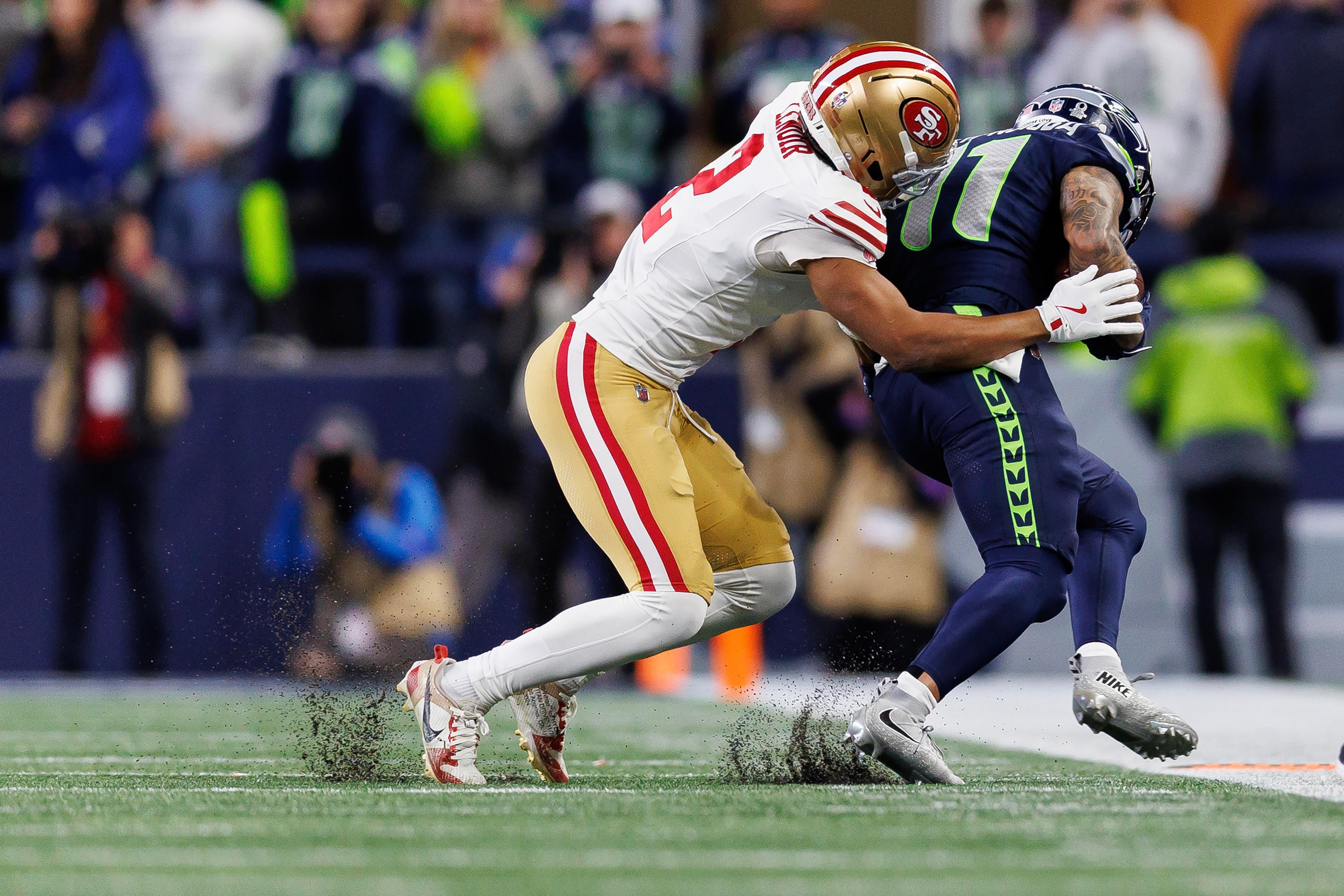
The San Francisco 49ers are preparing for a key matchup challenge involving Seattle Seahawks wide receiver Jaxon Smith-Njigba, and a major storyline is how they will handle him. A recent preview from Yahoo Sports suggests the 49ers are unlikely to put cornerback Deommodore Lenoir in a strict shadow role across Smith-Njigba’s route tree. Instead, the expectation is that San Francisco will seek answers through coverage rotation and scheme, rather than betting the game plan on one isolated matchup.
The attention is justified by Smith-Njigba’s early production. Through four games, he has 32 catches for 481 yards and six touchdowns, a pace that places him among the league’s most productive passing targets during the season’s early stretch. Those numbers are the reason the matchup can quickly become more than a one-receiver assignment. When a receiver is both high-volume and high-impact, defenses often have to account for him at multiple depths of the field and in different coverage shells.
In a typical “shadow” scenario, a defense leans on one player to follow a receiver’s movements, attempt to limit separation, and change the offense’s comfort level by reducing its route options. Yahoo Sports’ preview indicates that San Francisco may not believe Lenoir is the best way to solve Smith-Njigba, either because of how Seattle distributes responsibilities or because the 49ers want more flexibility to respond to motion, formations, and underneath routes.
That matters because Smith-Njigba’s value, as reflected in the production totals, is not limited to a single type of target. A receiver with 32 catches in the first four games is typically involved across early downs and multiple play types. If the 49ers do not shadow him, they have to prevent the most damaging outcomes: sustained chains, yards after the catch, and scoring opportunities that come when timing routes hit quickly in rhythm.
The 49ers, for their part, are not just choosing between man coverage and zone coverage. They are also deciding how to use their front and their support defenders to keep the underneath and intermediate areas from turning into easy windows. Even if Lenoir is not assigned to “follow” Smith-Njigba everywhere, his presence can still shape the routes Seattle feels comfortable running, but the coverage burden shifts to the supporting cast to communicate route leverage and anticipate breaks at speed.
Going into the game, the most reliable way to watch the coverage plan is to track whether Seattle can consistently find Smith-Njigba on the same types of plays that have produced his season line. If San Francisco’s approach works, Seattle’s target volume may stay high, but efficiency should dip, with more throws into traffic, fewer explosive gains, and less frequent red-zone payoff. If it does not, the Seahawks will keep building drives around the receiver who has already proven he can convert touches into touchdowns.
For this matchup, the key is that coverage schemes are often tested by how offenses respond, not just by what they draw up. San Francisco’s decision not to shadow Smith-Njigba would be consistent with a philosophy that prioritizes collective coverage responsibilities. Either way, with a receiver producing at that rate, the 49ers cannot treat him like a single matchup problem. They have to win the details across the entire route, from the snap to the finish.
Why It Matters
- A receiver with Smith-Njigba’s early numbers can change how a defense plays every down, forcing more conservative underneath coverage and tighter intermediate windows.
- If San Francisco avoids shadow coverage, the performance of its communication and support defenders becomes more important than any single cornerback matchup.
- How well the 49ers limit Smith-Njigba’s efficiency could influence Seattle’s ability to sustain drives and convert targets into red-zone scoring.
- The game plan also functions as a stress test for San Francisco’s overall coverage structure when an offense’s primary weapon is producing at a high volume.
Key Facts
- Yahoo Sports reports the 49ers are unlikely to use Deommodore Lenoir in a strict shadow role on Seattle’s Jaxon Smith-Njigba.
- Smith-Njigba has 32 catches for 481 yards and six touchdowns through four games.
- The core issue for San Francisco is how to cover a high-production receiver without relying on one constant one-on-one matchup.
- The matchup is framed as a team-coverage and scheme challenge rather than a simple assignment.