
THE APEX TIMES
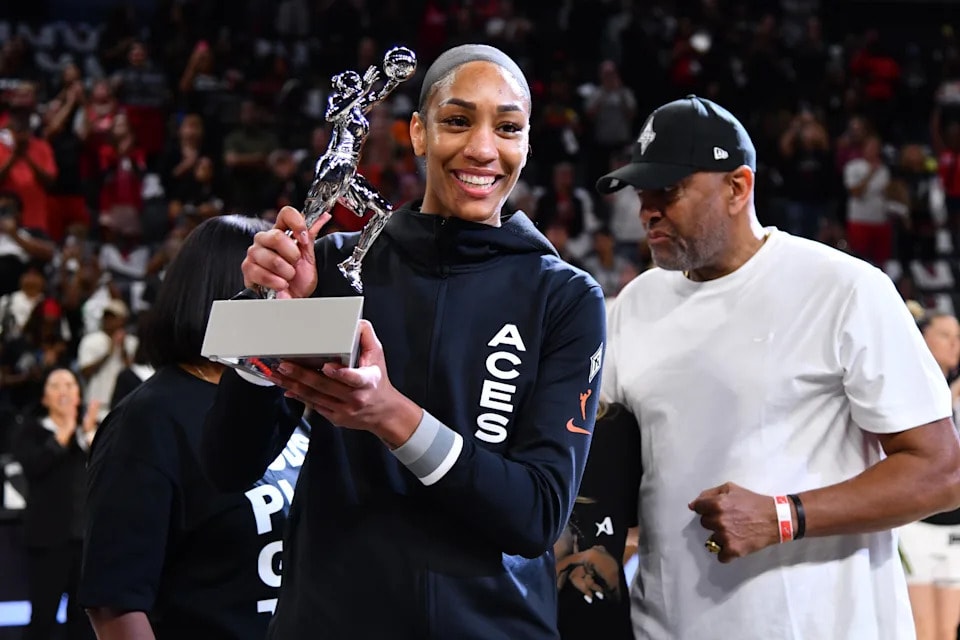
A’ja Wilson’s fifth MVP would cement her legacy, but a rookie “Liv” storyline threatens to rewrite it
With A’ja Wilson already owning the WNBA’s rarest MVP milestones, the league’s next award debate is shaping up as a choice between sustaining an all-time pace or crowning a first-time MVP. Either way, the outcome would land in the sport’s history books.
The latest WNBA MVP conversation has narrowed into a single question with huge legacy implications: would it be A’ja Wilson adding a fifth MVP to an already unmatched résumé, or would a rookie identified as “Liv” doing something only one player has ever done, winning it in her first season? The framing matters because Wilson’s career achievements have become not just dominant, but historically specific. According to the discussion, she is coming off a season in which she became the first four-time MVP in WNBA history and then became only the second player to win back-to-back MVP awards, joining an extremely small club that spans generations rather than years.
Wilson’s back-to-back MVP status ties her to the only earlier comp that really fits the moment. The comparison goes back to Cynthia Cooper, the league’s early-era standard-bearer, who accomplished the back-to-back MVP feat 27 years earlier during the WNBA’s first two seasons. That kind of historical distance is part of why this year’s debate carries a “who goes down in history” edge. It is not only about being the best player in a given year. It is about whether the award becomes the kind of reference point that later eras build their own accomplishments around.
The other side of the debate, “Liv,” represents the opposite narrative arc: not sustained dominance over multiple seasons, but a first-time jump that would imply instant impact at the highest level. MVP voting, as a general matter, tends to reward players who combine individual value with team results, but it also sometimes becomes a forum for what a standout rookie proves about readiness and adaptation. In that sense, a rookie MVP would not just be a personal breakthrough. It would be a statement about how quickly the league’s incoming class can reshape the competitive landscape.
Wilson’s case, meanwhile, is built on the rarest form of consistency. The argument for her “fifth” MVP would be that her accomplishments are not a one-season peak, but a continuing standard that forces her to be evaluated against the league’s all-time benchmarks rather than against that year’s field. When a player already holds records like the first four-time MVP distinction, the marginal value of another award is measured differently: voters are essentially deciding whether the next vote should function as recognition and validation, or as a historical stamp that confirms how far above the field a player truly is.
The most important caveat in any MVP discussion like this is that the award is always a product of vote totals, and the league’s top storyline is rarely determined by one factor alone. “Liv’s” emergence as a possible first-time MVP contender suggests the season has produced at least one player whose impact is difficult to ignore. At the same time, Wilson’s established resume indicates that voters do not have to stretch very far conceptually to justify another MVP if her body of work again reads as the clearest value in the league.
What to watch next is not just who wins, but how the decision gets discussed afterward. If Wilson captures the award, the post-MVP conversation will likely be about whether she becomes the unquestionable reference for “most valuable” greatness in the modern era, given the already-claimed back-to-back milestone and the historical Cooper comparison. If “Liv” wins instead, the focus will shift to the kind of immediate transformation that a rookie can deliver, and whether that changes how future classes are evaluated in the MVP conversation. Either way, the outcome would do more than fill a trophy case, it would lock into the WNBA’s lineage of legacies.
The larger takeaway is that this debate is happening at the intersection of two kinds of greatness. Wilson represents sustained excellence across multiple awards, which is hard enough to earn, let alone stack. “Liv” represents what happens when a newcomer forces voters to reconsider what “MVP level” can look like on a timeline measured in months instead of seasons. The league will get its answer when the MVP voting results crystallize, but the historical language already being used suggests voters understand the stakes: this will not be a quiet award.
If you are following along for the legacy angle, keep one question in mind as the discussion continues. Which path is more historically resonant, the one that extends a record-setting career further, or the one that crowns an instant legend in a first season? The WNBA has seen all-time greats before, including Cooper in the league’s earliest years, but only one outcome can write the next chapter.
Why It Matters
- An additional MVP for Wilson would extend a record-setting career and deepen an already rare historical match-up.
- A rookie MVP for “Liv” would create a contrasting legacy arc, indicating how quickly new talent can dominate MVP-level impact.
- The Cooper comparison underscores how voters may treat this award as more than annual performance, but as a placement in WNBA history.
- The outcome will shape how future MVP debates weigh sustained dominance versus immediate, first-season value.
Key Facts
- A’ja Wilson is described as having become the first four-time MVP in WNBA history last year.
- The same discussion says Wilson became only the second player to win back-to-back MVP awards.
- The back-to-back MVP comparison in the discussion is Cynthia Cooper, who did it 27 years earlier in the WNBA’s first two seasons.
- The current MVP conversation is framed as a choice between Wilson adding an additional MVP and a rookie identified as “Liv” winning a first MVP.
- The discussion emphasizes legacy, specifically who would “go down in history” based on the eventual MVP winner.