
THE APEX TIMES
Alabama reportedly turned to custom VR drills to help Ryan Coleman-Williams’ drop issues
A report connected to ESPN’s football coverage says the Crimson Tide implemented specialized virtual-reality work designed to correct catching reliability for the receiver, underscoring how modern training seeks to turn repetition into game-ready hands.
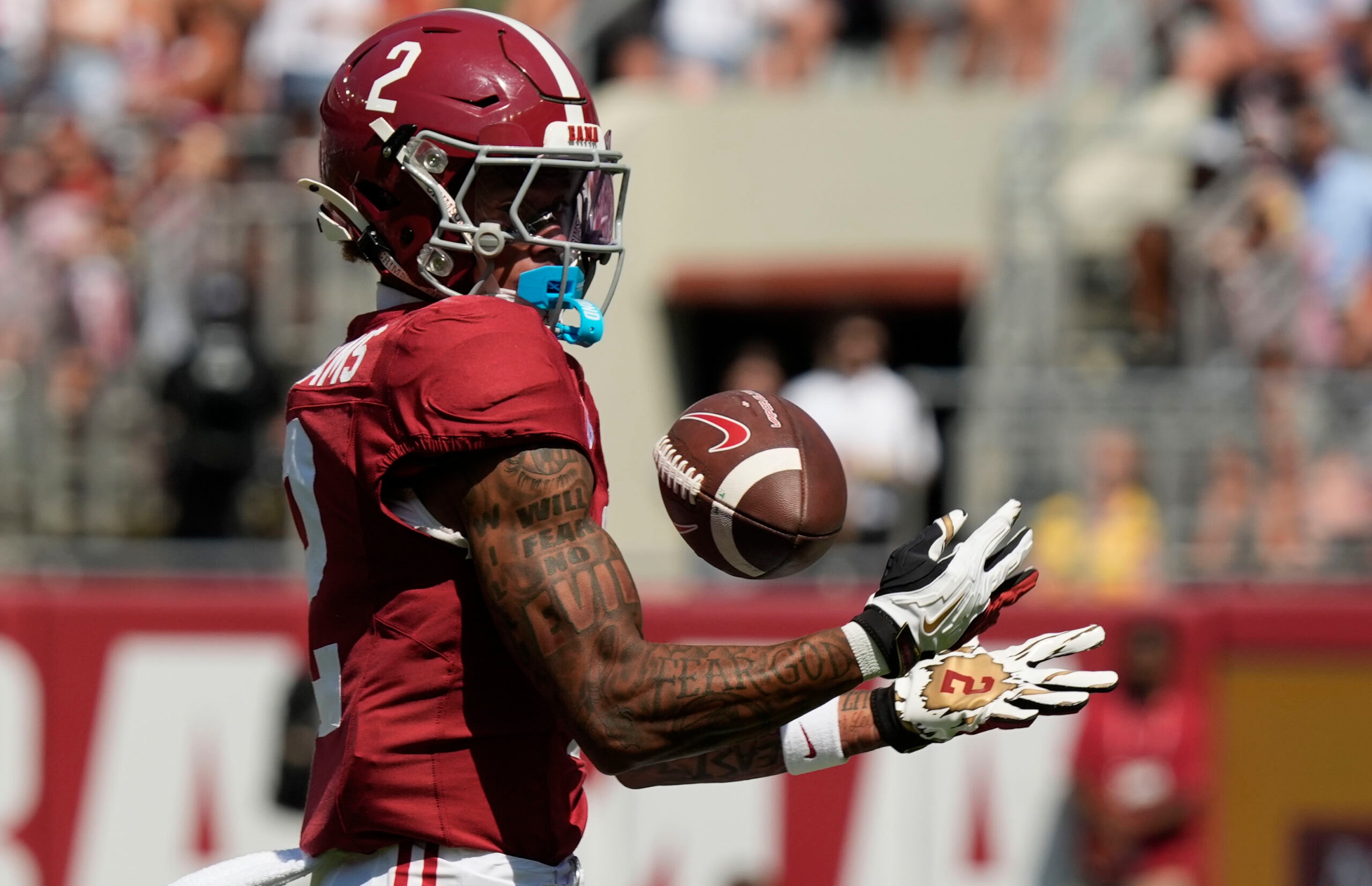
Alabama has reportedly leaned into a novel training approach to address reliability issues for receiver Ryan Coleman-Williams, with ESPN insider coverage cited by Saturday Down South indicating the Crimson Tide used custom virtual-reality exercises to help improve his catching on plays that involve difficult ball placement and timing.
The report frames Coleman-Williams as an important part of Alabama’s passing game, describing him as a star pass catcher and focusing specifically on “drop issues” that coaches wanted to reduce. In that context, the purpose of the reported VR work is straightforward: it is meant to create high-quality reps that mimic real coverage looks and ball situations, while allowing players to rehearse the same catch mechanics under controlled conditions.
VR training in football generally aims at one of two outcomes, situational recognition and movement repetition. For a receiver, that often means spending time on the “micro” details that lead to clean hands: tracking the ball from the moment it leaves the quarterback’s hand, arriving with the proper body position, and completing the catch through contact without taking the ball into the body too early or too far away. Even when the broader scheme is the same, those timing and hand-placement decisions can change dramatically as coverage rotates and routes distort.
What makes the report notable is the implication that Alabama was willing to invest in a technology-driven correction plan rather than relying only on conventional catching drills. Traditional passing-game practice can be effective, but it is limited by repetition constraints, inconsistent ball placement, and the difficulty of recreating the exact speed and angle of game throws. Custom VR exercises, if implemented the way the report suggests, are designed to narrow those variables and target a specific problem area.
For Alabama, the strategic value is immediate. A drop is a lost opportunity on third down and a momentum swing earlier in the drive, and it can also affect play-calling. When a team believes a receiver can secure the ball through contact and tighter windows, the offense can trust more routes and more targets in timing-sensitive sequences, especially when defenses disguise leverage and attempt to force the catch into traffic.
There is also a development component for Coleman-Williams himself. Receiver growth is rarely just about route-running talent; it is also about consistency under pressure. If the Crimson Tide’s reported goal was to alleviate drop issues, the VR work would function as an attempt to build muscle memory for the catching phase so that, over time, the hands respond correctly even when the play speeds up in live action.
As with any report based on insider information, the key caveat is confirmation. Saturday Down South presents the detail as something “reportedly” used by Alabama, and it does not provide additional primary confirmation in the form of a coach statement or a team training release. Still, the storyline fits the broader trend in college football toward individualized performance planning, where teams combine film study, skill-specific reps, and technology to chase small but critical execution gaps.
The most important question now is whether the approach shows up in Coleman-Williams’ game-to-game consistency. Watch for cleaner completions on contested balls and catch-through-contact moments, along with whether his role expands as the coaching staff gains confidence in secure hands. Even if VR is just one part of a larger plan, the reported focus on drops suggests Alabama is aiming at reliability that can widen the offense’s playbook in the weeks ahead.
Why It Matters
- Receiver drops can directly affect third-down efficiency and the reliability of timing-based passing plays.
- A technology-driven approach indicates Alabama is focused on individualized execution, not only team-wide scheme work.
- Improving catch consistency can expand a quarterback’s trust in tight-window routes and contested-ball targets.
- If the effort works, Coleman-Williams’ usage could become steadier as coaches weigh risk versus reward in-game.
Sources
Key Facts
- Saturday Down South reported that ESPN insider coverage indicated Alabama used custom VR exercises tied to correcting Ryan Coleman-Williams’ drop issues.
- The report describes Coleman-Williams as a star pass catcher for the Crimson Tide.
- The emphasis in the coverage is specifically on catching reliability rather than route-running or schematic changes.
- The report does not provide a direct Alabama official statement within the published post.
- The detail is framed as “reportedly,” meaning it is not presented as confirmed by a primary team source in the available material.