
THE APEX TIMES
Browns report a long runway for Deshaun Watson, banking on a first 2-0 start since 1993
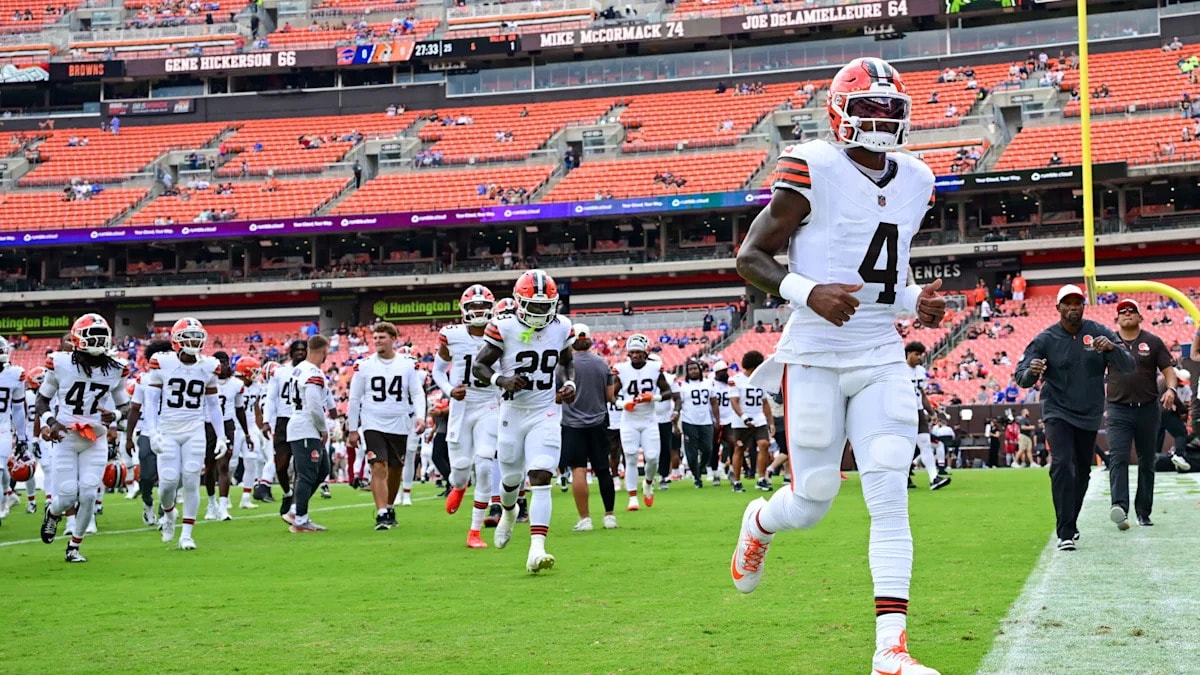
Cleveland’s plan, at least for the early season, is straightforward: give quarterback Deshaun Watson the chance to steer the Browns to a 2-0 start, a milestone the franchise has not reached in the same stretch since the early 1990s. The decision also sets expectations for the team’s first key home stretch, including matchups with Carolina and Pittsburgh.
The Browns have made a clear internal call on their quarterback situation, committing to Deshaun Watson as the leader of the offense for the season’s early stretch. According to Yahoo Sports, the organization is prepared to “give Watson a chance to lead the team to its first 2-0 start since 1993,” framing the beginning of the schedule as a barometer for how quickly the Browns can establish offensive rhythm and game control.
That 2-0 start matters not just as trivia, but as a measure of stability for a team that has spent years trying to translate quarterback play into sustained results. Cleveland has not managed to open the season with back-to-back wins since 1993, a drought that now becomes part of the team’s public-facing narrative around the quarterback position. In practical terms, a 2-0 start would reduce the pressure on every subsequent decision, from play-calling patterns to how the coaching staff weighs risk early in games.
Yahoo Sports also tied the organization’s patience to what comes next on the calendar. The report indicates that if the Browns do not reach that 2-0 threshold, it becomes difficult to imagine Watson still being the starter for the Browns’ Sunday-Thursday home stretch that includes the Panthers in Week 3 and the Steelers in Week 4. Those two divisional and conference-style tests are early enough to define momentum, and they arrive soon after the opening weeks, leaving little room for extended experimentation at the quarterback spot.
The situation puts Watson’s role into sharper focus as the Browns move through the preseason-to-regular-season transition. Even without publicly detailing every internal contingency, the emphasis on a specific season milestone suggests the Browns are not treating his start as a week-to-week audition. Instead, the organization appears to be using the first two games as the proving ground for whether their passing game can carry the weight of early-season expectations.
For fans and observers, the key question is what “a chance” means in terms of how the Browns respond if things start slowly. The report’s logic is conditional, pointing to an inflection point rather than a guaranteed leash through the entire month. That makes the next two games especially consequential, because they do not merely affect standings on a single Sunday, they also influence the quarterback decision-making for the weeks that follow.
Heading into those Week 3 and Week 4 home games, the Browns’ early-season approach will likely be judged by more than the quarterback’s stat line. The team’s ability to sustain drives, protect against negative plays, and keep games from turning into low-structure shootouts will matter, because those outcomes change how coaches view the quarterback’s decision-making. If Cleveland reaches 2-0, it buys time, continuity, and a chance for the offense to build patterns against stronger opposition. If it does not, the quarterback debate could become the central storyline almost immediately.
In the short term, the Browns’ messaging around Watson is as much about managing uncertainty as it is about predicting performance. The franchise is using the earliest part of the schedule to answer whether Watson can deliver early wins, and whether Cleveland can keep a steady identity long enough to avoid another early-season scramble. The next two games will be the most direct test of that plan, with the Panthers and Steelers looming as quick reminders of how quickly the NFL can turn a season.
For now, the most verifiable takeaway is the Browns’ commitment to Watson as the season’s starter through at least the initial runway, centered on the possibility of opening 2-0 for the first time since 1993. Everything beyond that is conditional and dependent on results, but the early-September stakes are already clear: Cleveland’s quarterback decision will be a function of early outcomes, not prolonged patience alone.
Why It Matters
- A 2-0 start changes how quickly the Browns can stabilize the offense, rather than forcing midstream adjustments at quarterback.
- The early home stretch against Carolina and Pittsburgh can quickly turn coaching and quarterback decisions into dominant storylines.
- Divisional and early-season momentum affects how teams manage risk, play-calling, and game-management choices.
- For Watson, the plan emphasizes immediate results, increasing the pressure on execution in the first two games of the season.
Key Facts
- The Browns have decided to give quarterback Deshaun Watson a chance to lead the team to a first 2-0 start since 1993.
- Yahoo Sports reports the Browns are framing the quarterback plan around reaching that 2-0 start.
- If Cleveland does not reach 2-0, it would be difficult for Watson to remain the starter for the Browns’ Week 3 and Week 4 home games.
- The Week 3 home opponent is the Panthers.
- The Week 4 home opponent is the Steelers.
- The report describes this early stretch as a key decision period for the Browns’ quarterback situation.