
THE APEX TIMES
Buccaneers Training Camp Focus Turns to Numbers 80-89, With Cade Otton a Central Piece of the TE Mix
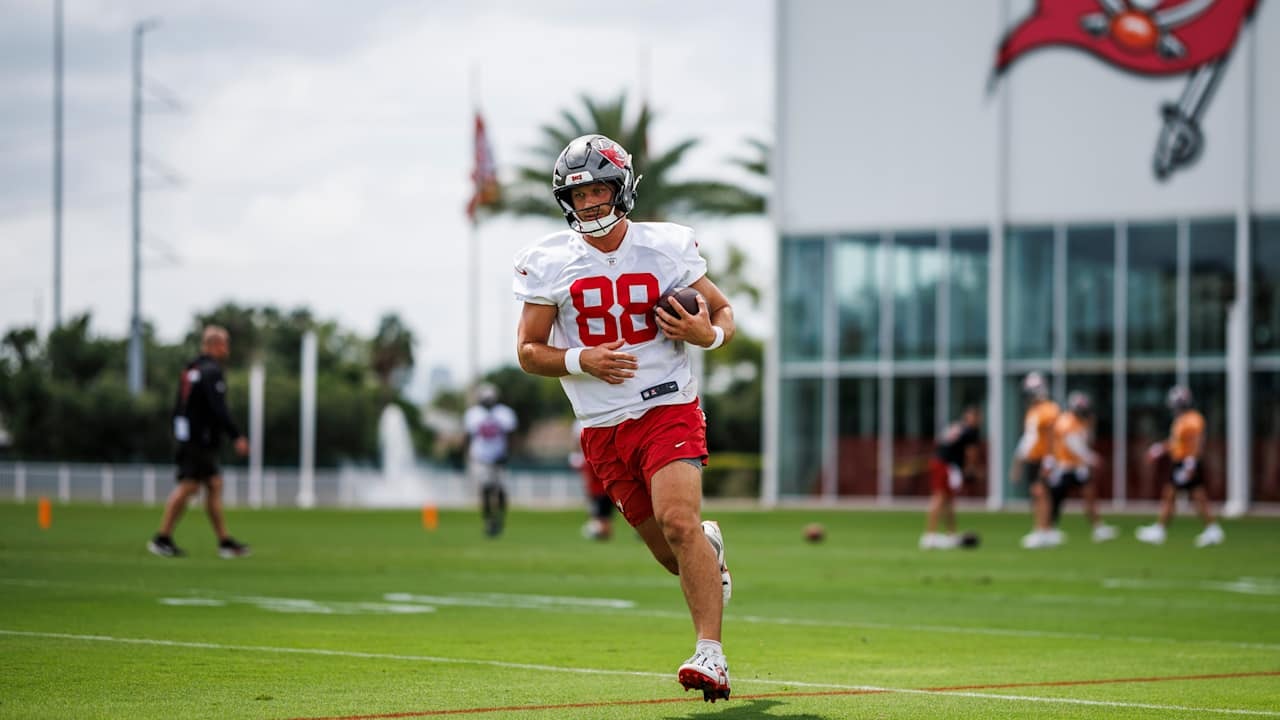
As Tampa Bay’s 2026 training camp gets underway, the Buccaneers’ organizational attention settles on the 80-89 jersey range, a group built largely around receivers and tight ends and likely to feature a tight contest for depth-chart roles.
The Tampa Bay Buccaneers are framing part of their 2026 training camp emphasis around jersey numbers in the 80-89 range, a grouping that typically indicates tight end and receiver responsibilities. In the team’s own look at this stretch of roster identity, the organization points to how camp work can clarify roles, especially in positions where schemes can place multiple players on the field at once.
Within that number band, the Buccaneers identify tight end Cade Otton as a key figure and refer to him as an “iron man,” underscoring that even during a period devoted to competition, the tight end room has a baseline anchor. For teams, a player who has already established reliability becomes a reference point for younger options and for any mid-depth challengers trying to earn increased snaps.
The broader point of the Buccaneers’ campaign, according to their release, is that the 80-89 group is not one-size-fits-all. Many teams see this band as a proving ground where a cluster of players can be trying to become the “next man up,” whether the need comes in the passing game, in red-zone packages, or in formations that demand tight end and receiver skill sets.
The Buccaneers also highlight, in the same context, that the 80-89 range can contain multiple players battling for similar roles and roster spots. That matters because training camp rarely settles depth charts on its own, and it is especially relevant in the early part of summer when teams are still separating veteran usage from roles that may expand later in the season.
The team’s framing implies a practical internal exercise for camp evaluation. By focusing attention on a defined number range, the coaching staff and performance group can observe how players in adjacent roles handle overlapping tasks, including route execution, pre-snap clarity, and run-and-pass decision-making within the same group of formations.
Still, the release functions more as a guide to the team’s structure than as a roster announcement. It does not, in what was provided here, specify who is in direct contention beyond naming Cade Otton, and it does not enumerate any concrete winners in the competition for the depth chart.
For fans trying to track the Buccaneers’ 2026 build, the 80-89 window is a reasonable place to watch how the tight end and receiver groups sort out their pecking order. If Tampa Bay’s camp work reflects its own emphasis, the snaps and practice trust that develop within this range could shape how the offense deploys playmakers as preseason moves into later stages.
Why It Matters
- Jersey-based evaluation often mirrors how coaching staffs organize practice reps, especially in skill positions that share scheming responsibilities.
- Tight end and receiver depth can determine how many viable personnel groups a team can use consistently, including in red-zone and third-down packages.
- Competition in this roster slice can reveal which players are trusted with timing-dependent routes and formation-specific assignments.
- If Otton is used as an “iron man” baseline, the camp battle may become most consequential for the next tier of tight ends and receiving options.
Key Facts
- The Buccaneers released a 2026 training camp goals piece focused on jersey numbers 80-89.
- The 80-89 range is described as consisting mostly of receivers and tight ends.
- Tight end Cade Otton is specifically highlighted as a central player within the group.
- The team describes the segment as featuring multiple players potentially battling for similar depth-chart spots.
- The content is organized as part of Tampa Bay’s internal camp emphasis leading into 2026.