
THE APEX TIMES
Caleb Rogers frames progress on the Raiders O-line as a shared lift, not a one-man turnaround
In a Raiders team story built around Caleb Rogers and the group’s offensive line improvements, the message is collective: better communication, cleaner technique, and a unit mindset that starts every day in practice.
Caleb Rogers’ latest emphasis is about more than his own development. In a Raiders-organized feature released Tuesday, Rogers is portrayed as one piece of a larger offensive line lift, with the central idea that the line’s progress must be earned as a group rather than measured by any single player’s highlight reel.
The story ties that approach to Rogers’ time playing college football at Texas Tech. Rogers is described thumbing through a printed bio of his earlier playing days, then shaking his head. The point of the moment, as the feature presents it, is that growth is continual, and that what matters now is how the current group operates together: the same standards, but applied with more urgency, more precision, and more shared responsibility.
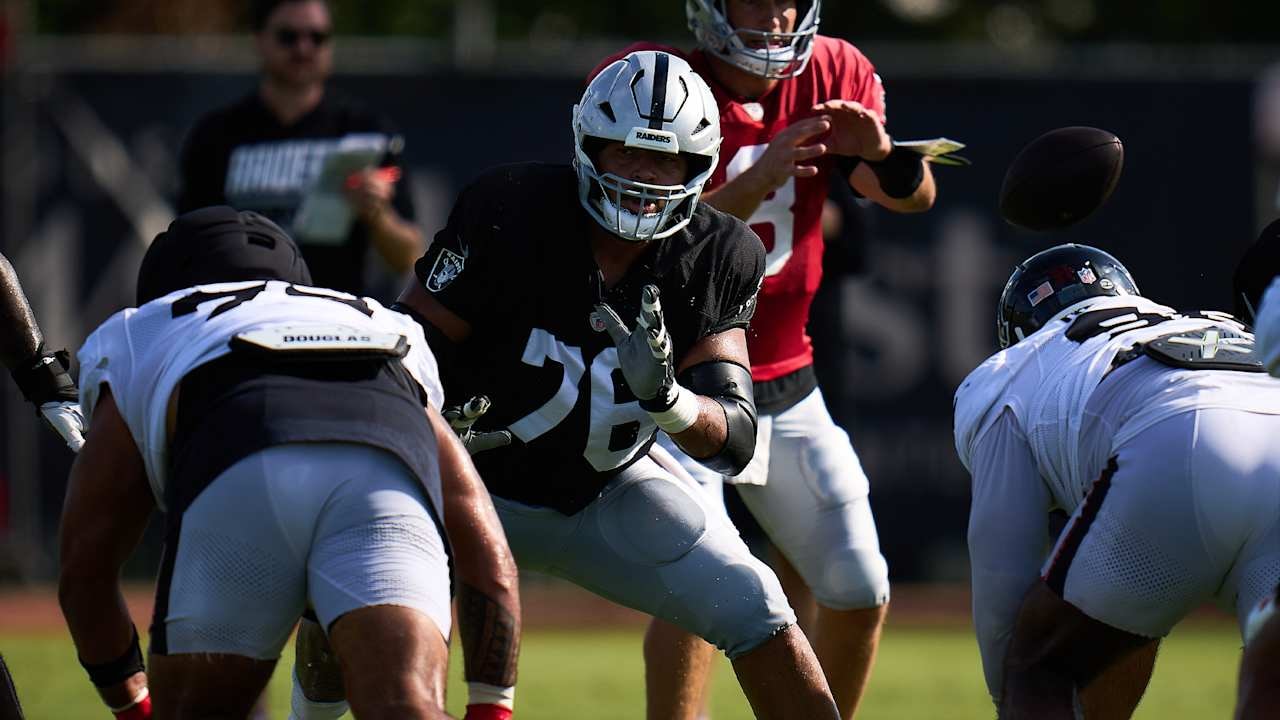
Within the Raiders’ framing, the “collective O-line lift” is presented as a process built on repeatable details. That includes communication at the line of scrimmage, recognition work that helps the group adjust in real time, and technique fundamentals that reduce the small breakdowns that can snowball into missed assignments. Rogers’ role, as described, is to help drive those habits forward while fitting into the unit’s shared identity.
The feature also underscores that line play is often invisible when it goes right. A protection that holds long enough for a route to finish, a run lane that stays open because multiple blockers win their matchups, or a stunt that is picked up cleanly are the kind of outcomes an offense needs, and those outcomes depend on coordinated execution. Rogers’ comments in the story, while focused on self-improvement, are ultimately used to reinforce that the offense line’s success belongs to the whole group.
For Raiders fans, the practical takeaway is how the team is trying to create stability up front. Offensive line cohesion becomes especially important as players build timing with one another and as the offensive staff tries to install and refine schemes. When a team talks about “collective” improvements, it usually indicates an internal priority: fewer mental errors, clearer responsibilities, and more consistent unit performance across practices.
The next thing to watch is whether that emphasis shows up in the way the Raiders protect and generate movement in team settings. Because the story is a development-focused piece, it does not replace the need to see the unit’s cohesion under game-speed conditions. Still, the message is clear: Rogers’ personal growth is being treated as part of a broader group standard, and the Raiders appear to believe that standard is what will determine how well the offense functions.
Why It Matters
- Offensive line cohesion is often the difference between an offense that can execute its plan and one that must improvise because protections or assignments break down.
- When a team frames improvement as collective, it suggests the Raiders want consistent habits that carry across opponents, not just one-off flashes.
- Line play can strongly influence playcalling freedom by affecting time in pass protection and consistency in run blocking.
- Rogers’ role as a contributor to the unit’s standards may help set expectations for how the group communicates and adjusts at the line.
Key Facts
- The Raiders published a feature describing Caleb Rogers’ progress as part of a shared offensive line improvement effort.
- The story references Rogers reviewing a printed bio of his college football-playing days at Texas Tech.
- Rogers is positioned as helping drive a collective unit mindset rather than acting as the sole driver of improvement.
- The feature centers on offensive line communication, recognition, and fundamentals as the foundation for better execution.
- The overall emphasis is on group coordination and accountability for outcomes that affect the entire offense.