
THE APEX TIMES
Carmelo Anthony revisits his Oklahoma City exit, describing contract sacrifice and “whispers” that derailed a stay with Westbrook and Paul George
In a new reflection, the longtime scorer says he was prepared to cut his own pay to remain in Oklahoma City with Russell Westbrook and Paul George, before internal front-office “whispers” made the deal unravel.
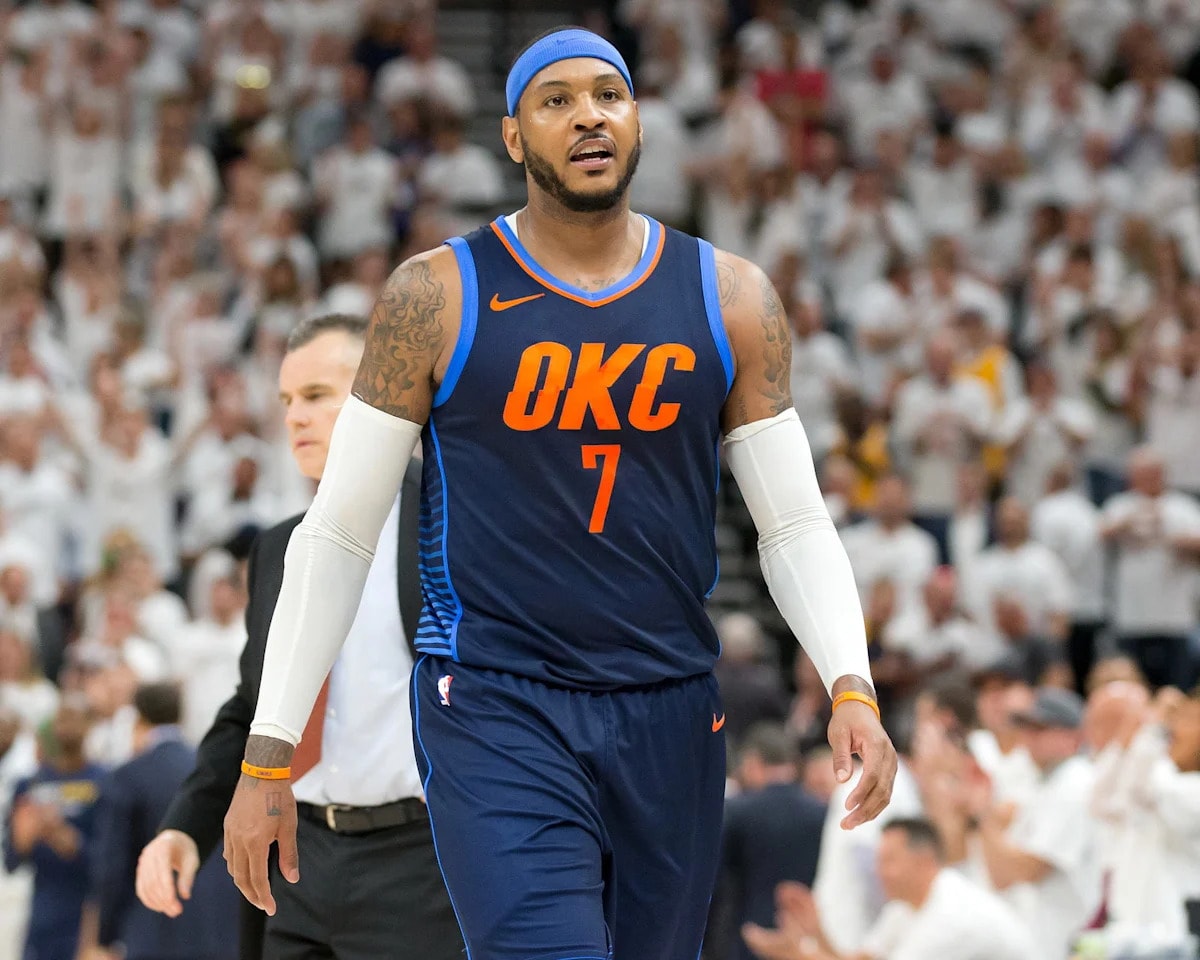
Carmelo Anthony has returned to one of the more complicated stop-and-start chapters of his NBA career, explaining that his willingness to absorb real financial loss was part of his pitch to stay in Oklahoma City with Russell Westbrook and Paul George. In an interview reported by Yahoo Sports, Anthony described being ready to slash his $28 million salary in order to keep playing alongside the Thunder’s star-heavy core, only to suggest that unnamed front-office communication ultimately turned the situation against him.
The context matters because Anthony’s time with Oklahoma City was never just a standard addition. His presence came during a roster-building moment when the Thunder were trying to align a veteran scoring profile with a high-usage, high-pace backcourt and an All-NBA wing. Westbrook and Paul George were already established pillars, and Anthony’s value was not simply points, but spacing and shot-making that could be plugged into the Thunder’s offensive structure.
Anthony’s account, as presented in the Yahoo report, frames the deciding factor as less about the on-court fit and more about what he characterized as “whispers” inside the organization. The implication is that even if the playing time and role had been negotiable, the team’s internal direction shifted enough to take the potential continuation off the table. Anthony described the contrast between his own readiness to restructure his contract situation and the outcome that led to his trade.
That kind of behind-the-scenes friction is difficult to verify from box scores, because it is usually expressed through staff decisions, player communication, and timing. Anthony’s recollection does not provide a paper trail in the report, but it does offer a new lens on why the Thunder’s plans with him may have moved faster than a long-term “stay together” storyline would suggest. For fans, it also revisits a broader question that often follows player movement: how much is determined by basketball arguments, and how much is driven by internal messaging about roster direction?
The players in the center of Anthony’s remarks add weight to the explanation. Westbrook and Paul George were not just prominent teammates, they were the Thunder’s offensive engine and defensive matchup base. Having Anthony willing to accept a significant salary reduction to remain with them suggests he believed the group’s ceiling could justify personal cost. If his perspective is accurate, then the break in the relationship was not a lack of desire on his side, but a mismatch between what he was prepared to do and what the organization ultimately indicated.
For the league, stories like this are reminders that roster construction is rarely linear, especially for veteran players with meaningful earning power. Anthony’s comments, tied to a willingness to cut $28 million and to what he called internal “whispers,” underline that front-office timelines and internal perceptions can reshape even seemingly rational fits. What to watch next is whether other parties from that period, whether team staff or teammates, offer additional context that clarifies how the communication played out and why a continuation was no longer possible.
In the absence of primary documentation in the available report, readers should treat Anthony’s statements as his personal account of events. Still, the details he chooses to emphasize, the specific pay figure, and the framing around internal messaging make the story consequential for how that era of Thunder roster-building is remembered, and how similar situations may be interpreted when veterans weigh role, money, and team chemistry.
Why It Matters
- Anthony’s explanation highlights how veteran contract leverage can intersect with team strategy, not just player performance.
- The remarks shed light on how roster alignment with Westbrook and Paul George can be treated as contingent on organizational messaging.
- For fans and analysts, the story reframes one of the Thunder’s transitional roster moments as more sensitive to internal decision-making than public reasoning alone.
- It underscores the broader NBA reality that “fit” can be trumped by timing, perception, and internal consensus.
Key Facts
- Carmelo Anthony said he was willing to slash his $28 million salary to try to remain with the Oklahoma City Thunder.
- Anthony described the decision process as being affected by front-office “whispers,” according to a Yahoo Sports report.
- The stay scenario referenced Anthony playing alongside Russell Westbrook and Paul George in Oklahoma City.
- The interview revisits the circumstances that led to Anthony being traded from the Thunder, emphasizing the role of organizational communication rather than only on-court fit.