
THE APEX TIMES
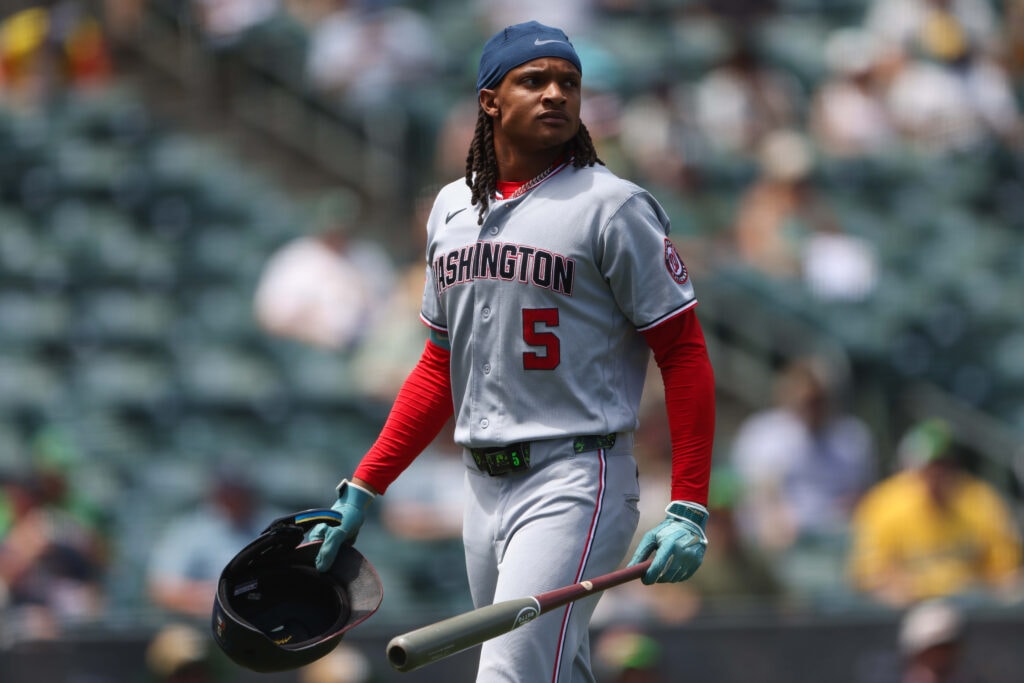
CJ Abrams’ surge puts Nationals’ shortstop at the center of an August decision
With CJ Abrams producing at an advanced level for an everyday position, the question for Washington is whether to build around its lead option at shortstop or monetize the value in the trade market.
CJ Abrams is back in the conversation as a player who can change what a roster is supposed to do. In a league landscape where shortstop defense and controllable offense can be difficult to combine, the Nationals’ everyday option has drawn attention for the quality of his production this year and, more importantly, what that production could mean for Washington’s plans in the coming months.
Abrams, 25, is currently framed as one of the better hitters in the majors at his position. MLB Trade Rumors pointed to a batting line of.287/.359/.544, paired with 28 home runs and 22 stolen bases. The same report highlighted a 144 wRC+, which is presented as a measure of his overall offensive contribution relative to league average, and it connects that output to a profile that mixes power and speed without ignoring plate discipline.
The underlying approach, as described in the same preview, also matters to how teams would evaluate trade value. Abrams’ strikeout rate is cited at 22.9% and his walk rate at 8.4%, both described as roughly average. The implication is that his production is not being propped up by an unsustainable outlier in contact rate or walk volume. Instead, his value is portrayed as a blend: enough patience to avoid excessive free outs, enough power to drive runs, and enough aggression to make his speed a consistent threat.
That is why the central question in the discussion is not whether Abrams is good, but what kind of roster decision the Nationals should make around him. MLB Trade Rumors asked a direct version of the offseason dilemma: should Washington build around him, treating him as a cornerstone at shortstop, or should it put him on the trade block if the team’s broader competitive timeline suggests otherwise.
In MLB terms, the distinction is substantial. Building around a star or near-star at premium defense and a premium spot in the batting order changes how quickly the organization can shift payroll, how it structures the rest of the infield, and how it shapes its development priorities. Trading him, on the other hand, would turn his current production into an asset stream, ideally for younger controllable pieces that match whatever Washington decides its next competitive window should be.
At the same time, trade-market decisions for players like Abrams are rarely driven by a single stat line. Even when a hitter is producing at a high level, the final calculus typically includes health, availability, defensive value, contract structure, and how the team’s other positions line up with a potential new direction. Because the reporting available here is primarily evaluative rather than a confirmed transaction update, the most accurate takeaway is the status of Abrams as a high-leverage name in the Nationals’ organizational planning conversation.
What to watch next is straightforward: whether Washington’s posture in the rest of the season and into the next offseason aligns with a “build” plan or a “convert current value” plan. Abrams’ combination of power and stolen-base production, along with the reported above-average overall offensive contribution, ensures that any decision involving him would be one of the more consequential ones Washington could make if it chooses to explore the trade market.
Why It Matters
- A decision on whether Washington builds around Abrams affects the team’s identity, infield construction, and offseason roster planning.
- If the Nationals choose to trade, Abrams becomes a potential centerpiece asset given his blend of power and speed from a premium position.
- If the Nationals choose to build, Abrams’ production sets a performance benchmark for other additions and for how the team evaluates the next wave of development.
Key Facts
- CJ Abrams is 25 and plays everyday shortstop for the Washington Nationals.
- The report describes his current batting line as.287/.359/.544.
- He is credited with 28 home runs and 22 stolen bases.
- His reported 22.9% strikeout rate and 8.4% walk rate are characterized as roughly average.
- His reported 144 wRC+ is presented as a sign of offensive value well above league average.