
THE APEX TIMES
Cole Payton’s late surge for the Eagles highlights a quiet preseason opener
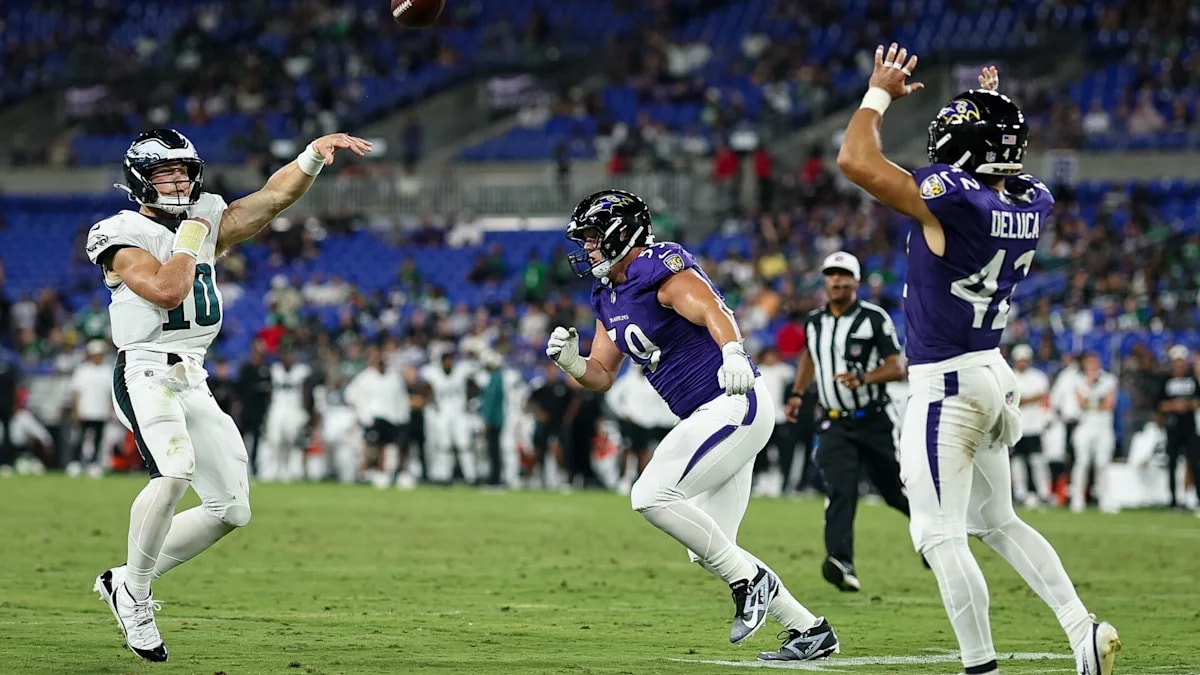
A fourth-quarter appearance by rookie quarterback Cole Payton sparked the only Eagles scoring drive in a 24-7 loss to the Ravens, giving Philadelphia a brief glimpse of what a deeper group can do.
The Eagles’ preseason opener opened like many starters-light games do: tempo without traction. With the first wave largely held out, the backup units struggled to sustain drives against Baltimore’s defense, leaving Philadelphia largely stuck in neutral for much of the matchup. The game’s tone changed only after fourth-string rookie quarterback Cole Payton entered in the fourth quarter.
Once Payton took over, the offense started moving. According to the game report, he finished with the highest totals for the Eagles in both passing yards and rushing yards, a notable split because it suggests the offense’s improvement was not limited to a single facet of the play. For a team searching for reasons to feel better about its quarterback depth, that dual production matters even in a preseason setting.
Payton’s biggest impact came in the scoring column. The report says he engineered the Eagles’ only scoring drive of the game, a late push that trimmed the margin and offered a clearer picture of what the coaching staff can build on with the lower tiers of the roster. In a 24-7 final, that one drive stands out as the most tangible offensive output for Philadelphia.
Baltimore, meanwhile, did what more established preseason offenses often do, especially when they can create favorable starting field position and keep the opponent off balance. The Eagles’ difficulty moving the ball early also created a familiar preseason reality: when the first look is minimal and the backup work is thin, every sustained drive becomes harder to manufacture.
The performance also raises the typical preseason evaluation question: how much should be read into one quarter? Payton’s showing was enough to make him the most productive player on the Eagles in the game, but preseason games do not cleanly separate quarterback skill from situational context, including opponent personnel and defensive game-plan choices. Still, a quarterback who both moves the offense through the air and contributes with his legs provides a flexible problem for defenses, particularly when teams are limiting their own risk.
For the Eagles, the next step is practical. If Payton’s late surge translated from practice to real reps, the Eagles will look to see whether his command and decision-making carry across additional offensive series in later preseason games, and whether the supporting cast can create comparable opportunities. If the coaching staff can pair quarterback development with more consistent run-pass rhythm, Philadelphia’s preseason depth evaluation will become more than a talking point.
For the Ravens, the takeaway is that their defense did enough to keep the game in hand while Baltimore remained on schedule. That can be useful for a team that wants continuity even in exhibition games, but it also means Baltimore’s staff will want to see whether the same control appears when the opponent counters with other quarterback and skill combinations.
Why It Matters
- Payton’s dual passing-and-rushing production gives the Eagles a concrete reference point for quarterback depth evaluation.
- In a lopsided scoring total, the late touchdown drive becomes a rare positive offensive data set for Philadelphia’s coaching staff.
- The performance could influence how the Eagles distribute reps in subsequent preseason sessions among their lower quarterback groups.
Sources
Key Facts
- The Eagles lost to the Ravens 24-7 in their preseason opener.
- Philadelphia’s starters were largely not involved, and the backups struggled to move the ball early.
- Rookie quarterback Cole Payton entered the game in the fourth quarter.
- Payton led the Eagles in both passing yards and rushing yards for the game.
- Payton engineered the Eagles’ only scoring drive.