
THE APEX TIMES
College football bowl projections return to the spotlight, but the College Football Playoff picture is still a moving target
With the season approaching, forecasts for the postseason and the 12-team College Football Playoff field generate plenty of early clarity, and even more room for surprises.
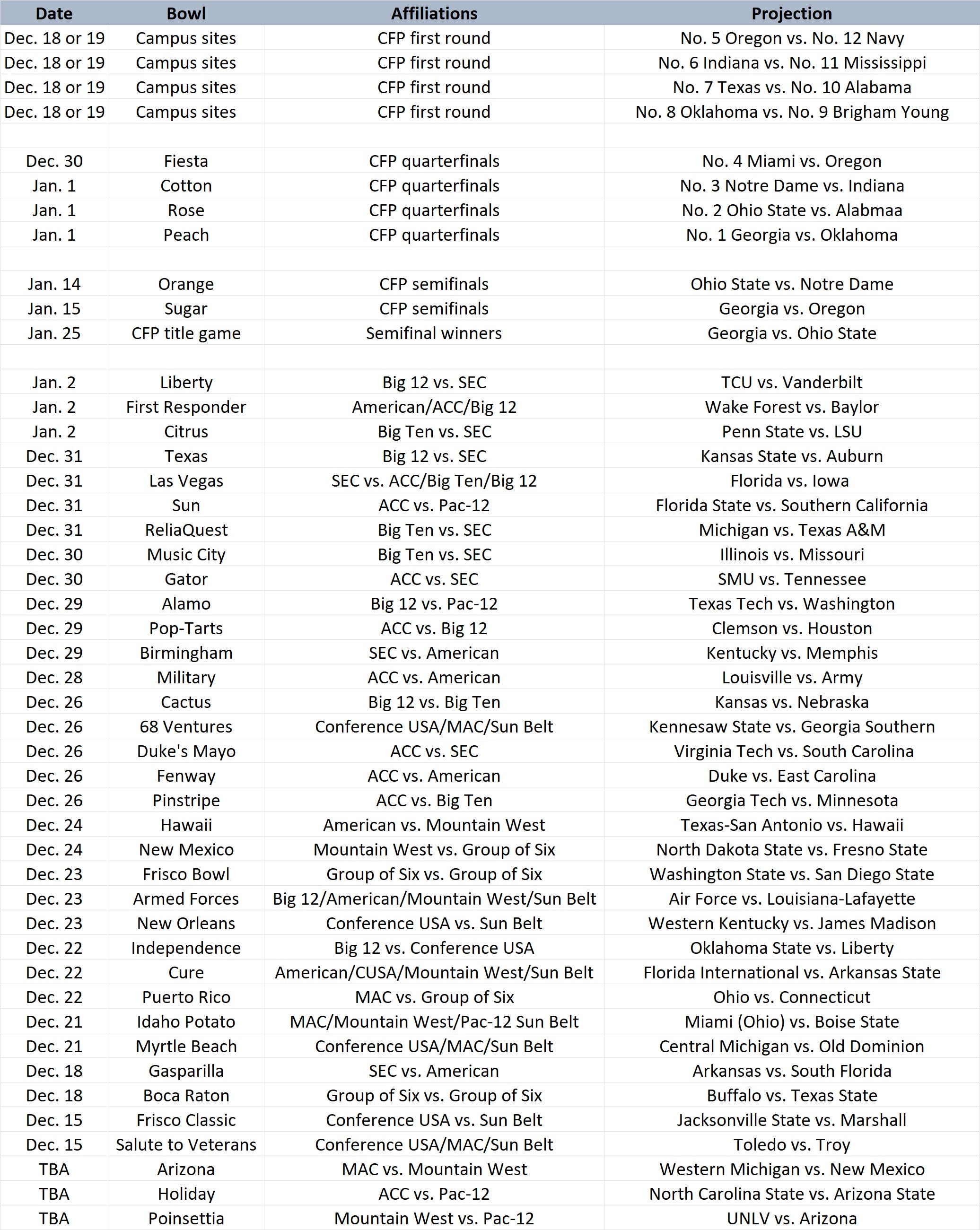
College football has a familiar rhythm every fall: preseason optimism, midseason reality checks, and then late-season chaos that reshapes every postseason projection. On Monday, Yahoo Sports published a forecasting look at the bowl matchups and a predicted College Football Playoff field, framing the exercise as an exercise in managing uncertainty rather than eliminating it.
The central premise is that even the best models are working with shifting variables. Injuries, suspensions (when they occur), quarterback play, defensive adjustments, and late-schedule fatigue can all change a team’s profile quickly. Forecasting postseason outcomes, the way bracketology does in NCAA men’s basketball, becomes a version of guessing the right winners and the right timing at the same time.
Unlike single-elimination tournaments where upsets are common but the structure is fixed, college football’s postseason path depends on league standings, head-to-head results, strength of schedule, and the way teams cluster near the playoff threshold. Those factors mean a team can move from “inside the bracket” to “sweating eligibility” with one result, then rebound with a strong follow-up. Bowl positioning can also be affected by conference allocations, overall record, and travel considerations that do not show up in purely statistical projections.
A projection column, by design, offers a snapshot. It provides a way for fans to organize the season’s storylines before they arrive. In that sense, the value is less about calling exact outcomes and more about identifying what types of performances tend to matter when selection becomes active, and where teams are likely to gain or lose ground based on their schedule structure.
That is especially true for a 12-team playoff landscape, which compresses the margin for error. Compared with smaller playoff fields, more teams can remain “in play” deep into the season, which can keep matchups higher leverage longer. At the same time, that makes forecasting feel even more fragile, because there are more combinations of outcomes that produce different “last-in” results. A few swing games, in either direction, can reshuffle the final lineup.
For coaches and players, early bowl and playoff chatter does not change the next practice or the next game plan. What it does affect is the public narrative, which can influence recruiting conversations, media pressure, and how fans interpret weekly results. When projections are wrong, it is often not because the underlying team quality was misread, but because the season’s course found a different quarterback, a different injury timeline, or a different late-season matchup advantage.
Why It Matters
- Early projections can shape how fans and media track teams near the playoff threshold throughout the season.
- A 12-team playoff format increases the number of plausible “last-in” scenarios, making late-season outcomes particularly consequential.
- Bowl positioning can serve as a narrative benchmark for teams evaluating progress and recruiting momentum.
Sources
Key Facts
- Yahoo Sports published a postseason forecasting piece focused on bowl projections and a predicted College Football Playoff field.
- The article emphasizes college football’s unpredictability and likens CFP forecasting to predicting an entire first round of NCAA men’s basketball.
- The piece frames forecasting as a method to organize likely outcomes, not a guarantee of exact matchups.
- Postseason projections in college football are inherently influenced by variables such as game-by-game results and schedule context.