
THE APEX TIMES
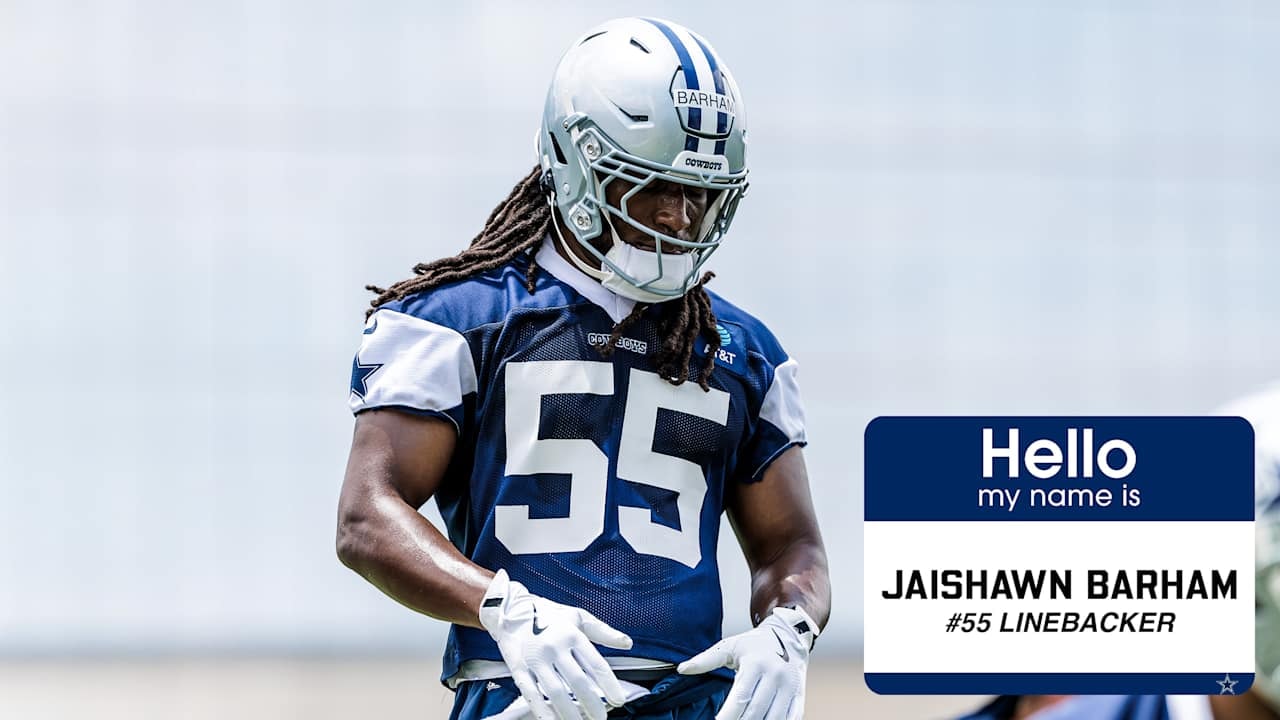
Cowboys’ Jaishawn Barham begins transition plan as a linebacker with edge versatility
Dallas’ third-round pick arrives with a two-position profile, and the early development message is clear: learn linebacker fundamentals first, then expand the pass-rush responsibilities as he grows into the role.
The Dallas Cowboys are framing Jaishawn Barham’s first NFL offseason work around a linebacker foundation, even as they acknowledge his experience lining up on the edge as a pass rusher. In a training-camp “role call” feature, the team’s development plan is presented as a staged approach: start him at linebacker, teach the unit’s cues and responsibilities, and use his versatility to expand his impact over time.
Barham comes to Dallas after a college career split between two Big Ten programs. He spent his first two collegiate seasons at Maryland before transferring to Michigan for his final two years, giving him exposure to multiple defensive environments before the pro adjustment. The Cowboys’ write-up emphasizes that, during his time at Michigan, his usage evolved, with most of his snaps coming at inside linebacker before he closed out his last season seeing significant action on the EDGE as a pass rusher.
The team ties that split usage to what it sees as his fit in Dallas’ defense. Cowboys head coach Brian Schottenheimer is described as saying the organization will begin working Barham as a linebacker, while pointing to his ability to handle multiple responsibilities as a positive. In the Cowboys’ telling, the key is not just where Barham has played, but how quickly he can absorb linebacker work before the pass-rush assignment becomes a larger piece of his weekly role.
Dallas also underscored the physical profile it believes can translate to linebacker play in Christian Parker’s system. Parker, now serving as the defensive coordinator for the Cowboys, is portrayed as wanting a defense that plays with force. The team’s feature cites Barham’s listed size of 6-foot-2 and 240 pounds as part of the “mold” it wants to see, connecting his frame to the idea of a physical, downhill presence in the middle of the defense.
The learning curve is acknowledged. The Cowboys say “some molding” will be required, specifically because Barham is expected to develop as both a true linebacker and as a pass rusher. Even with the transition underway, the team indicates that early snaps could include special teams as Barham continues to accumulate experience. That approach suggests Dallas views development as a process of exposure and repetition, not a single, instant role change.
Barham was selected by the Cowboys in the 2026 NFL Draft, taken with the 92nd overall pick in the third round. The organization’s current message is that the early plan is linebacker-first, with edge tools added as the season moves forward. As training camp continues, the practical question will be how rapidly Barham can master the linebacker portion of the playbook while keeping his athleticism available for pressure packages.
As a complement to Dallas’ internal plan, at least one external scouting write-up describes Barham as having made a late switch to full-time edge responsibilities in his senior year and frames him as an explosive, contact-oriented defender with speed-to-power traits. Those evaluations align with the Cowboys’ decision to begin him at linebacker while still preparing to exploit his ability to impact the passer. The next step, for Cowboys fans, will be watching how coaching staff balance responsibilities across linebacker reads, edge rush reps, and situational assignments as Barham’s comfort grows.
Why It Matters
- Barham’s position transition affects how the Cowboys distribute snaps early on, especially at linebacker where responsibilities are tied to coverage and run fits.
- The linebacker-first approach suggests Dallas is prioritizing scheme understanding before expanding his edge duties, which can shape his first-season ceiling.
- His dual role potential matters for the defense’s flexibility, allowing Dallas to stress offenses with defenders who can move between coverage responsibilities and pass-rush moments.
- Because this development plan is tied to the defensive coordinator’s physical identity, it also reflects how Parker wants his front to play the game.
- How quickly Barham earns reps across linebacker, edge, and special teams could influence how the Cowboys build depth and competition in camp.
Sources
Key Facts
- The Cowboys’ “role call” series presents an early development plan for rookie linebacker Jaishawn Barham focused on linebacker work first, with edge responsibilities to follow.
- Barham was selected in the 2026 NFL Draft with the 92nd overall pick in the third round.
- The team describes Barham’s college path as two years at Maryland followed by two years at Michigan.
- At Michigan, Barham spent most of his time at inside linebacker and closed his final season with significant EDGE snaps as a pass rusher.
- Dallas lists Barham at 6-foot-2 and 240 pounds and links his size to the physical style Christian Parker wants defensively.
- The Cowboys acknowledge coaching and adjustment will be needed for Barham to handle both linebacker and pass-rushing roles, with the possibility of early special teams snaps.