
THE APEX TIMES
Devin Lloyd keeps prying the ball loose in Panthers practice drills
In a 7-on-7 setting, the linebacker’s pressure and ball-hunting show up in the details, underscoring how Charlotte is emphasizing ball security and creating turnovers from the first week of work.
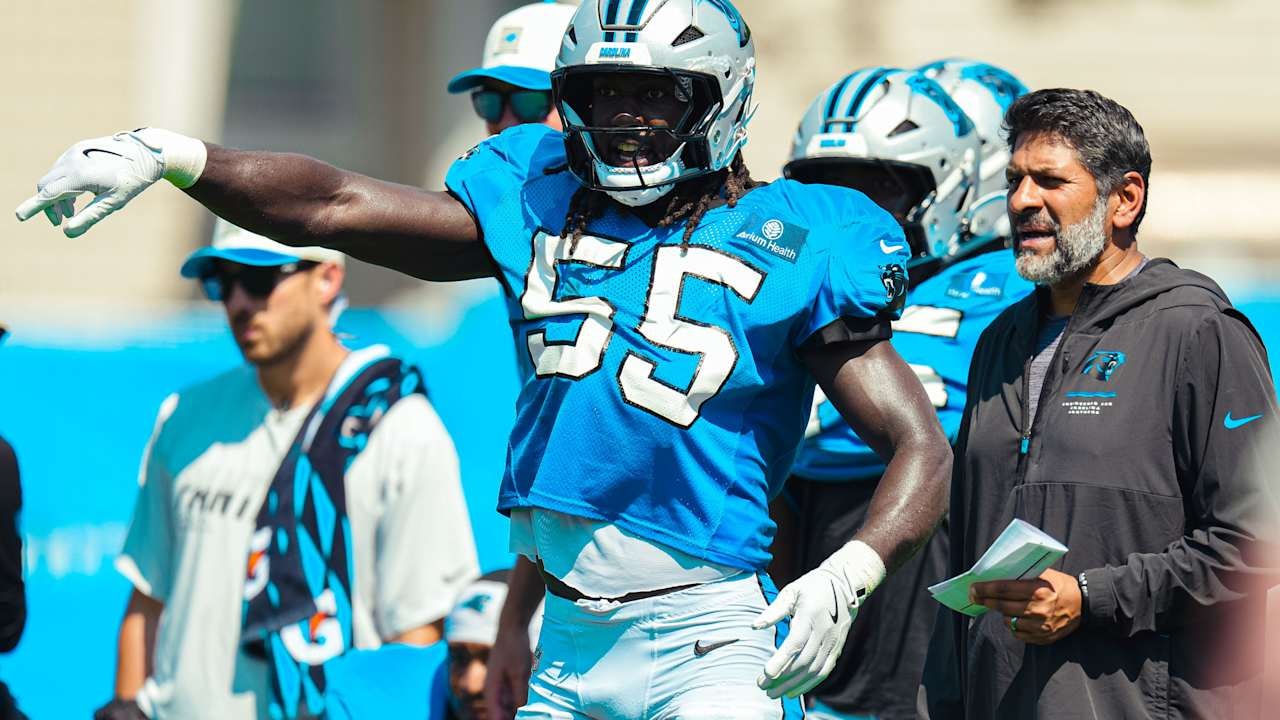
The first lesson from Monday’s Panthers practice was not about the highlight-reel plays the preseason often produces, but about what happens right before the ball ever leaves a hand. During 7-on-7 work, linebacker Devin Lloyd forced a fumble, a reminder that his impact is not confined to the stat sheet. In practice, where the offense and defense are allowed to move at speed, small disruptions can still change possessions, and Lloyd has been insisting on being that disruption.
The moment also ties into what Charlotte’s coaching staff is trying to strengthen across the board. Before practice began, wide receivers coach Rob Moore was preparing drills aimed at improving receiver ball security during plays. Moore’s focus, described by the team as an “underrated but crucial” part of the position, reflects a broader truth of the game: receiver mistakes can start with how the ball is secured through contact, not just whether it is caught cleanly.
In 7-on-7 sessions, the defense is still searching for ways to affect the play without relying on full-contact scenarios. Forced fumbles in this setting can come from timing, leverage, and relentless effort at the point of the catch. Lloyd’s role is built around those habits. Even when the play is quicker and contact rules are tighter, the linebacker’s pursuit can force a late adjustment, pulling the ball free from the path the offense expects.
The Panthers’ choice to spotlight Lloyd’s play in the team’s practice recap suggests the emphasis is deliberate. Teams rarely highlight individual moments from controlled drills unless they fit an identity they are working to reinforce. Lloyd’s ability to keep pressure on opponents, including in a segment of practice designed to simulate the passing game, becomes a reference point for what the defense wants from him as the season approaches.
For the offense, the practice detail matters because catching and securing the ball is not a one-time skill. Moore’s work with receivers indicates Charlotte is treating ball security as a process, not an outcome. Receivers face imperfect throws, off-balance routes, and coverage that changes the angle of the catch. Coaching points that tighten how hands and body manage the football through those situations are the kind that can reduce turnovers that otherwise flip field position.
There is also a relationship between defense pressure and receiver mechanics. When a linebacker or safety is consistently in the space where a catch can be challenged, receivers do not just compete for the ball, they compete for how long it stays theirs after the catch. That pressure can be subtle in practice, but the objective is clear: force the offense to treat every possession as a ball-securement problem, not simply a route-completion problem.
The practical takeaway for fans is simple: the Panthers are already building their early-season storyline around two connected themes, the defense’s insistence on forcing chaos and the offense’s need to protect the football through contact-like scenarios. As camp continues, the key to watch will be whether those turnover habits carry beyond one standout drill, showing up repeatedly in team periods and in how receivers respond to pressure during real routing and timing.
Why It Matters
- Turnovers begin with ball security and ball pressure, and this practice moment connects the Panthers’ defensive identity to the offense’s risk management.
- Forced fumbles in early drills are often a report of preparation, especially when contact rules limit traditional tackling outcomes.
- Emphasizing receiver security can reduce the kinds of errors that swing preseason reps and regular-season possessions.
Key Facts
- In 7-on-7 drills, Panthers linebacker Devin Lloyd forced a fumble during practice.
- The team highlighted the play as an example of Lloyd keeping pressure on opponents even in a controlled setting.
- Before practice began, wide receivers coach Rob Moore prepared drills focused on receiver ball security.
- The team characterized receiver ball security as a crucial but sometimes overlooked part of the game.