
THE APEX TIMES
Dodgers’ corner outfield production under scrutiny as offensive output lags among peers
A FanGraphs-based look at outfielders with significant plate appearances puts pressure on Los Angeles to find more consistent value from its corner spots, with the team’s broader results leaving room for improvement.
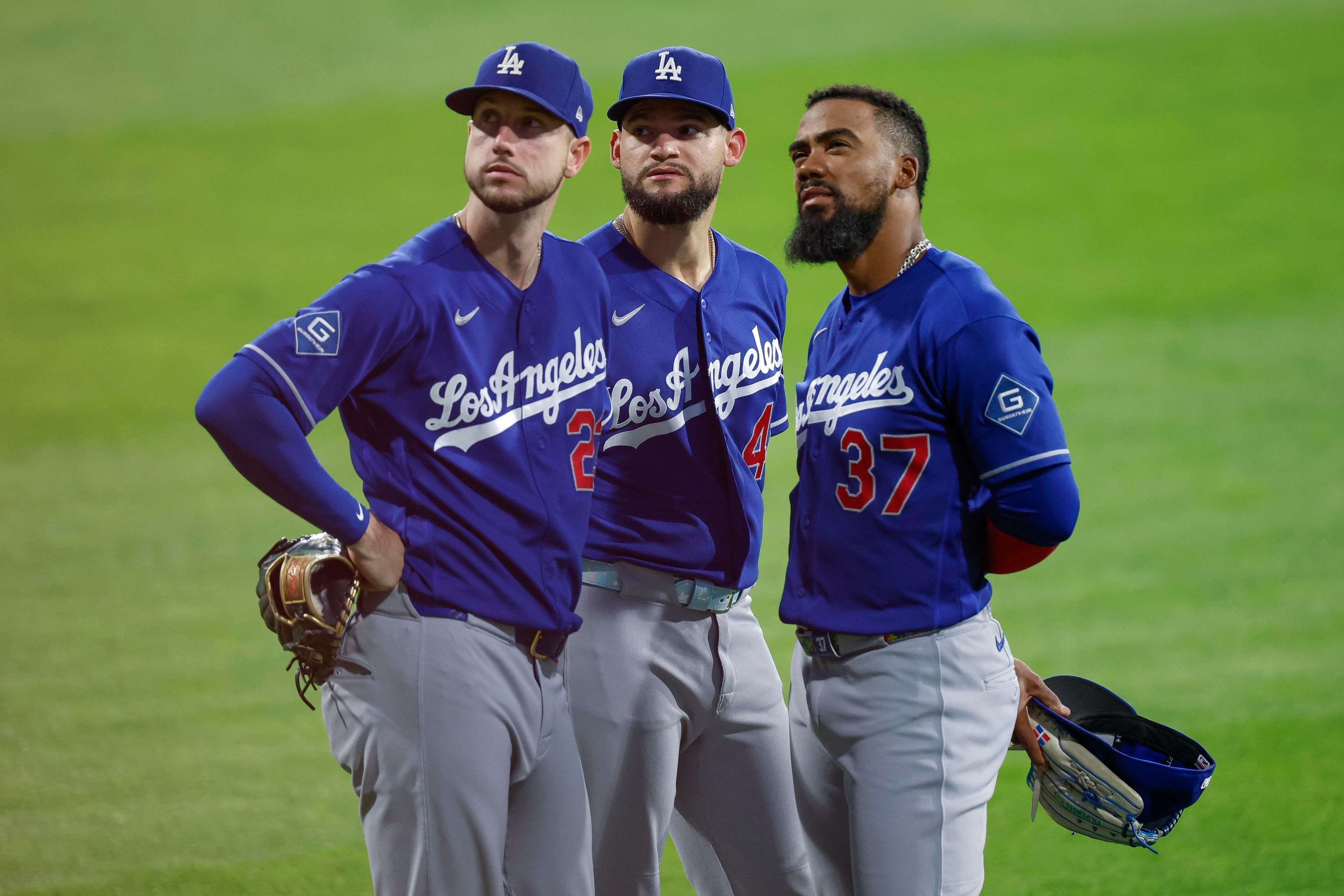
The Los Angeles Dodgers are facing renewed questions about how much offense and overall value they are getting from their corner outfield positions. A recent analysis from Yahoo Sports highlighted that the Dodgers’ production in those spots this season has not matched what teams at the top of Major League Baseball typically need for sustained run prevention and scoring efficiency.
The central issue is not that corner outfielders are unimportant. It is that corner outfield outcomes tend to swing a lineup, both by generating runs and by stabilizing defense against right- and left-handed power. When those positions lag, the burden often shifts to middle-of-the-order bats and up the defensive ladder, which can narrow a contender’s margin in close games.
FanGraphs WAR comparisons add specificity to the concern. The Yahoo Sports piece pointed to two player baselines from across the league to illustrate how far below peer production the relevant Dodgers output has drifted. It noted that Teoscar Hernández, among MLB outfielders with at least 200 plate appearances entering Friday, ranked 87th in FanGraphs WAR with a.250/.313/.401 line and 97 wRC+ alongside 0.4 fWAR. It also cited Kyle Tucker, ranked 94th, at.232/.327/.368 with 95 wRC+ and 0.3 fWAR.
Those rank placements matter because they provide a reference point for what “average to below-average” offensive production looks like in the context of run creation and overall value. Even though Hernández and Tucker are established impact bats, the piece frames them as examples of how the corner-outfield market can be sorted by performance tiers. In that light, the Dodgers’ need becomes less about finding a single star and more about closing the gap from the corner spots to the levels expected from teams pursuing October baseball.
Yahoo Sports also characterized the Dodgers’ corner outfield this season as yielding limited results offensively and defensively. That combination is especially concerning because defensive shortcomings in the outfield can inflate pitching difficulty, turning routine at-bats into higher-leverage chances and raising the cost of every additional baserunner.
What to watch next is how Los Angeles responds to the underlying problem: whether the organization leans into internal lineup adjustments, role shifts, or personnel changes to bring more consistent production to the corners. Because the issue is framed as both offensive and defensive, any solution likely needs to address more than batting outcomes alone.
For Dodgers fans, the immediate takeaway is that corner-outfield output is a measurable lever, not a vague scouting concern. If the team can move those positions closer to the middle of the league’s production distribution, it can widen the lineup’s run-scoring floor and reduce the defensive drag that can show up in late innings. If it does not, the Dodgers may keep relying on other parts of the roster to cover the shortfall, which can be costly over a full regular season.
From here, the most practical evaluation is to monitor corner-outfield contributions in both run production (plate-appearance-heavy batting metrics) and fielding value, then compare them to league baselines rather than single-game streaks. As the season progresses, the question is whether the Dodgers can turn the corner-outfield gap from an analytical critique into a corrected team-building priority.
Why It Matters
- Corner outfielders often carry outsized responsibility for both run creation and defensive stability, affecting how a team’s pitching performs in real time.
- If the Dodgers cannot raise their corner-outfield output to peer levels, they may be forced to compensate elsewhere, tightening lineup and defensive flexibility.
- Because the evaluation is based on season-to-date performance and league rankings, the pressure on roster construction tends to increase as October approaches.
- Improving corner-outfield production can widen the team’s margin in one-run games, where marginal differences in both offense and defense become decisive.
Key Facts
- Yahoo Sports reported that the Dodgers are getting limited production offensively and defensively from their corner outfield spots this season.
- The analysis used FanGraphs WAR and other batting context to frame corner-outfield performance among qualifying outfielders.
- Teoscar Hernández ranked 87th in FanGraphs WAR among outfielders with at least 200 plate appearances, with a.250/.313/.401 batting line, 97 wRC+, and 0.4 fWAR.
- Kyle Tucker ranked 94th in FanGraphs WAR among qualifying outfielders, with a.232/.327/.368 batting line, 95 wRC+, and 0.3 fWAR.
- The central theme is the importance of corner-outfield value for teams pursuing postseason results in MLB.