
THE APEX TIMES
Fantasy football lens on 2025 NFL offenses: where teams scored points, and what it suggests for 2026
A new analysis by Yahoo Sports fantasy writer Joel Smyth breaks down which offensive units produced the most fantasy value in 2025, then maps those patterns to how roster building could play out for the 2026 season.
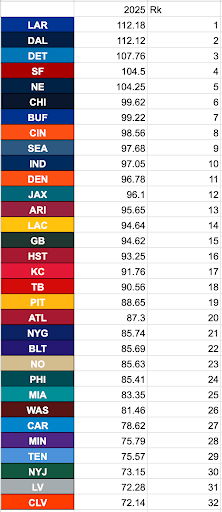
Fantasy football managers often talk about quarterbacks and skill-position stars, but an analysis published June 30 by Yahoo Sports fantasy writer Joel Smyth argues that the biggest swings in fantasy scoring can come from entire offensive ecosystems. By reviewing 2025 fantasy production by team, Smyth focused on which offenses accumulated the most roster points, and more importantly, where that value originated inside the playmaking structure.
Smyth’s framework looks at the “points” offenses generate in fantasy terms and treats those points as a clue to what to expect when the calendar flips to 2026. The central takeaway is straightforward: for players who are entering drafts or changing teams, the most reliable fantasy roster pieces frequently align with the offenses that were already producing at a high level.
A second theme in the analysis is movement. Smyth highlights that some players entering the 2026 season are doing so under new organizational contexts, including those joining new franchises and those leaving previously strong fantasy offenses. In practice, that matters because fantasy value depends not only on talent, but also on opportunity, schematic fit, and target volume. When an offense’s scoring source changes, the fantasy output for individual positions can shift with it.
The study also flags the coaching carousel as a factor worth treating as more than background noise. When offensive coaching changes, the route trees, play-calling tendencies, and game script dynamics can all be reweighted. Smyth’s argument is that these transitions can affect how quickly fantasy-relevant production is redistributed, especially among the pass-catching roles and the players most likely to see consistent touches.
While the article is built around 2025 team outcomes, the “so what” is aimed at the next offseason cycle. Smyth’s takeaways are framed around what can be inferred from last season’s fantasy distribution: if a team’s fantasy scoring is concentrated in certain positions, then players tied to that concentration may carry stronger baseline expectations. Conversely, if fantasy points were broadly dispersed, then the value may be more available across multiple roster spots depending on how the new season’s usage pattern settles.
For fantasy drafters, Smyth’s work is essentially an attempt to separate raw offensive performance from fantasy-specific translation. Quarterbacks can drive volume and efficiency, but a high-scoring offense does not automatically mean the same fantasy positions will remain the primary beneficiaries. The analysis emphasizes that fantasy managers should pay attention to where the points came from, because that helps predict which players might benefit from the next round of roster construction and scheme adjustments.
In the weeks leading up to training camp and preseason evaluations, the most useful way to apply this type of research is to treat it as a checklist rather than a promise. Coaching changes, offseason personnel edits, and the natural regression or improvement that comes with year-to-year play calling can alter outcomes. Still, Smyth’s breakdown suggests that the teams that were most productive in fantasy terms in 2025 provide a starting point for assessing which offensive profiles are more likely to generate weekly roster-friendly performances in 2026.
At a minimum, the analysis points to a clear watch list: offenses that produced the most fantasy points in 2025, players moving into those environments, and roles that could be affected by coaching changes. Even without assuming identical results, the underlying concept is that fantasy scoring tends to follow systems, and systems tend to leave measurable fingerprints from one season to the next.
Why It Matters
- Fantasy scoring is driven by usage patterns that often reflect team-level offensive structure, not just individual talent.
- Offseason player movement can change who benefits from the same offensive system, affecting positional value.
- Coaching changes can quickly alter how targets, touches, and play-calling tendencies distribute across skill positions.
- Using 2025 team-level fantasy production as context can help managers build expectations for 2026 roster composition.
Sources
Key Facts
- Yahoo Sports fantasy writer Joel Smyth analyzed 2025 NFL offenses through a fantasy football lens.
- The analysis centers on which team offenses produced the most fantasy roster points in 2025.
- Smyth’s takeaways focus on where fantasy value came from within those offenses, not just overall scoring.
- The piece connects 2025 offensive production to how players entering 2026 could be affected by changing teams and roles.
- Coaching-carousel dynamics are presented as a meaningful variable for anticipating fantasy output shifts in 2026.