
THE APEX TIMES
Film breakdown highlights Texas A&M QB Marcel Reed’s path back to a true dual-threat role
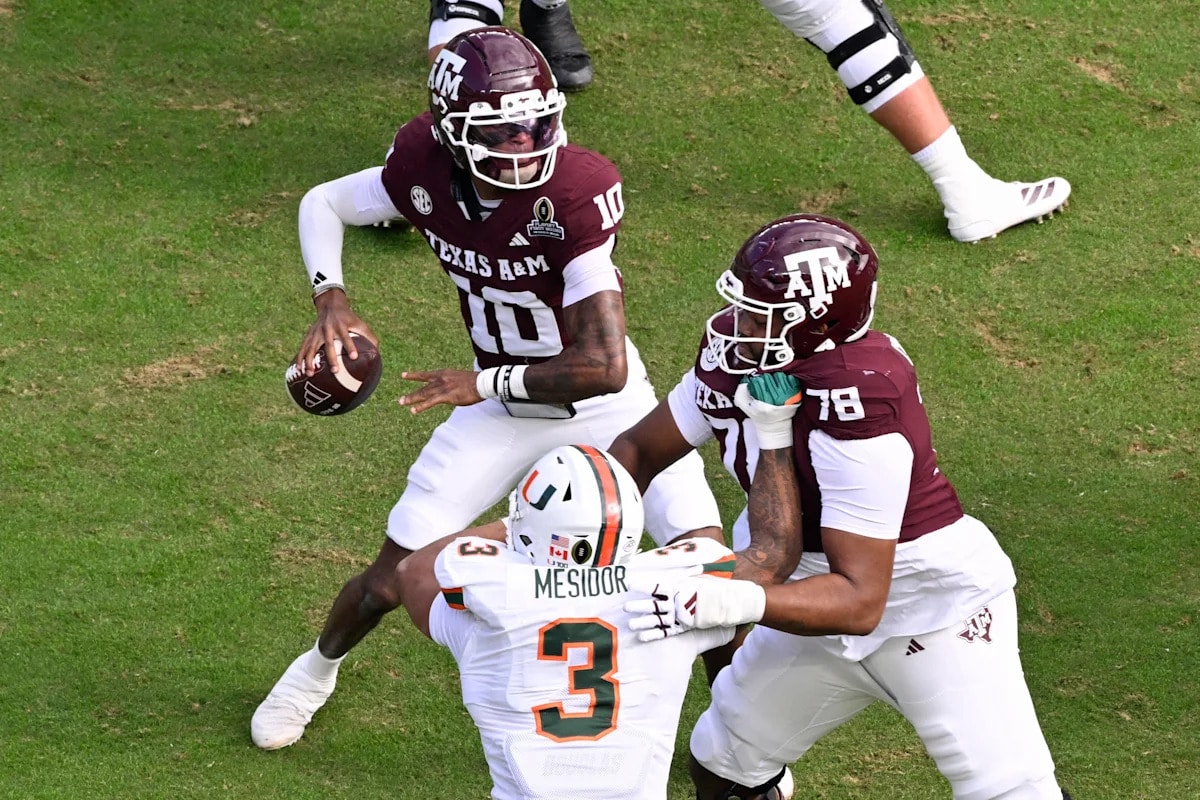
As Texas A&M moves toward its 2026 opener, the Aggies’ development focus is centering on quarterback Marcel Reed’s ability to make more of his running and decision-making, a theme reinforced by CFB analyst Brooks Austin’s latest breakdown.
Texas A&M is entering the 2026 season with an offseason-to-fall storyline that revolves around its quarterback fit. Ahead of the Aggies’ Sept. 5 opener against Missouri State, a new film-focused breakdown by CFB analyst Brooks Austin zeroes in on Marcel Reed’s need to consistently play the way a true dual-threat quarterback is expected to, not just in isolated moments but as an ongoing threat within the offense.
Austin’s analysis is framed around how Reed’s game can translate when the play design and the read progression put him in situations to create on the ground and extend plays with his eyes, not only his arm. The emphasis matters because Texas A&M’s coaching structure has shifted this offseason, with first-year offensive coordinator Holmon Wiggins now steering the unit. Under that transition, the quarterback’s role becomes more than execution, it becomes the fulcrum that determines how versatile the Aggies can be on any given series.
The context for that focus is Reed’s recent production, which includes a notable uptick in passing output last season. According to the report that accompanies Austin’s breakdown, Reed threw for a career-high 3,169 yards with 25 touchdowns and 12 interceptions in his previous full starting season. Those numbers provide evidence that the passing component is capable of sustaining drives, but Austin’s central point is that Reed’s overall value rises when the offense can reliably capitalize on his dual-threat traits.
In the same preview, Texas A&M is described as having completed nine preseason practices. That detail places the discussion in the practical timeline of fall camp, when staffs evaluate how quarterbacks operate under repeated coverage looks, how quickly they incorporate coaching points, and whether the planned identity shows up in live reps. For a quarterback entering a second full starting season, those practices become a bridge between “potential flashes” and a repeatable baseline.
Austin’s breakdown also implicitly addresses how quarterback development is measured in college football. A dual-threat quarterback is not simply one who can run, it is one whose presence affects linebacker leverage, secondary angles, and defensive game plans. If Reed can return to a style that forces defenses to account for both run and pass outcomes, the Aggies can open up more space for intermediate passing and schemed quarterback runs, while also improving third-down conversion chances through scramble value and extended-play windows.
The presence of a first-year offensive coordinator adds additional emphasis to the quarterback learning curve. New coordinators often install system habits that take time to become automatic, from cadence and protections to the specifics of run-pass options and designed reads. If Reed’s “dual-threat” usage is a point of coaching priority, the early-season games become a referendum on whether the staff can integrate those concepts quickly enough to create offense that looks cohesive and dynamic rather than reactive.
What to watch next is how quickly Texas A&M’s game plan reflects the kind of quarterback responsibilities Austin highlights. The Sept. 5 matchup against Missouri State may not settle every development question, but it will show whether Reed’s decision-making and movement choices translate into consistent, game-speed production. The broader takeaway is clear: with a new coordinator in place and a quarterback entering his second full starting season, the Aggies’ offensive identity may hinge on how effectively Marcel Reed turns his dual-threat capability into a dependable feature of every week’s preparation.
Why It Matters
- Reed’s ability to sustain a dual-threat presence can change defensive coverage angles and leverage, affecting the entire offensive rhythm.
- A first-year offensive coordinator increases the importance of quarterback buy-in, since system details often depend on quarterback read-and-run instincts.
- If Reed’s running and extended-play decision-making show up early, Texas A&M’s offense can be harder to prepare for each week.
Key Facts
- Texas A&M is scheduled to open the 2026 season on Sept. 5 against Missouri State.
- The team is described as having completed nine preseason practices.
- Holmon Wiggins is serving as Texas A&M’s first-year offensive coordinator in 2026.
- CFB analyst Brooks Austin’s breakdown centers on Marcel Reed playing closer to a true dual-threat quarterback role.
- The report cites Reed’s prior-season passing production of 3,169 yards, 25 touchdowns, and 12 interceptions.