
THE APEX TIMES
Hayden Winks maps 2026 fantasy draft strategy using “best vs. worst” trends from Underdog data
A new fantasy football column pulls pick-by-pick evidence from paid-only leagues dating to 2020, then translates it into a framework for how managers may want to think about draft timing, especially around running backs.
Fantasy managers obsess over “value,” but the most repeatable edge often comes from when you take a player, not just which player you take. In a new Yahoo Sports fantasy column, Hayden Winks argues that late-round “feel” can be improved by looking backward at what the best and worst fantasy teams did across thousands of drafts, then using those patterns to shape how teams approach the 2026 draft season.
The method Winks highlights is explicitly data-driven. He points to pick-by-pick information from paid-only leagues on Underdog, with records dating back to 2020. Rather than treating every draft as a one-off outcome, the column groups results by performance level, using the best teams’ draft behaviors as a proxy for what tends to work and the worst teams’ behaviors as a proxy for what tends to fail.
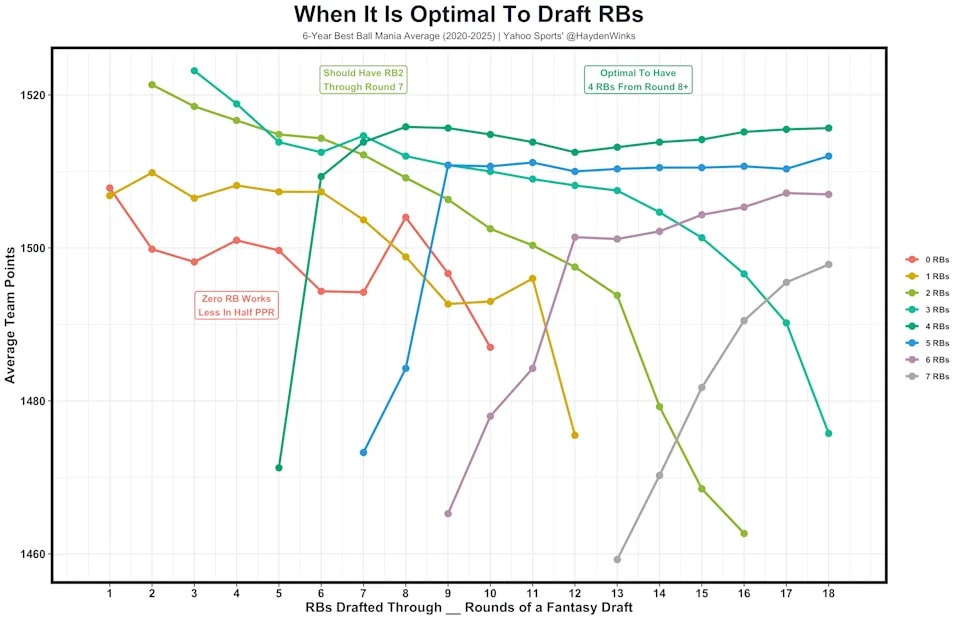
A key part of the analysis is positional timing. The column’s visuals and framing focus on running backs, with the central idea that teams can gain an advantage by identifying windows in which rookies, second-year players, or established backs are typically selected at more efficient points relative to production. In other words, even if two managers both draft running backs, the earlier manager may be buying low opportunity cost, while the later manager can be paying a premium for a similar statistical profile.
Winks’ larger point is that drafting “best” is not the same as drafting “most expensive.” In fantasy, the roster construction challenge is that every choice trades against another. By comparing the best and worst teams in the same ecosystem of paid league drafts, the column attempts to isolate which roster decisions are more resilient, especially at the positions where volatility is highest. It is also a reminder that fantasy outcomes can swing hard with injury luck, role changes, and game-script variation, which is why looking at draft patterns across multiple years can matter more than focusing on a single season narrative.
Even with the analytical approach, the data still has caveats. Paid-only league environments can reflect sharper behavior than casual leagues, but managers’ league settings and scoring formats still vary. Also, a pick-by-pick record can show correlation without proving causation. A “good” draft timing pattern might reflect a manager’s overall skill and risk management, not only the positional value itself, and the opposite can be true for “bad” drafts. The column therefore should be read as a guide to how managers might think, not as a guarantee of outcomes.
For 2026, the practical takeaway is to treat draft strategy as something you can iterate. If the best teams are repeatedly pulling certain types of players at similar points in the draft, then managers can rehearse those decisions, plan for alternative scenarios if their targets disappear, and avoid overreacting when the room’s draft tempo changes. The next watch item for fantasy players is whether these timing trends remain stable year-to-year as roles and offensive philosophies shift across the NFL, and whether managers who rely more heavily on data can reduce the gap between their process and their final results.
Why It Matters
- Fantasy draft value is often about timing and opportunity cost, not just player identity.
- Using “best vs. worst” patterns can help managers avoid repeating historically unproductive draft behaviors.
- The approach reinforces that fantasy strategy should be tested across multiple seasons, not built on one-year assumptions.
- Running back draft timing remains a central lever because roles and week-to-week workload can be volatile.
Key Facts
- The column is by Hayden Winks and is published by Yahoo Sports on August 7, 2026.
- It uses pick-by-pick data from paid-only fantasy leagues on Underdog dating back to 2020.
- The analysis compares behaviors of the best fantasy teams against the worst fantasy teams from a drafting-efficiency perspective.
- The story emphasizes applying positional timing trends, with running backs as the primary example.