
THE APEX TIMES
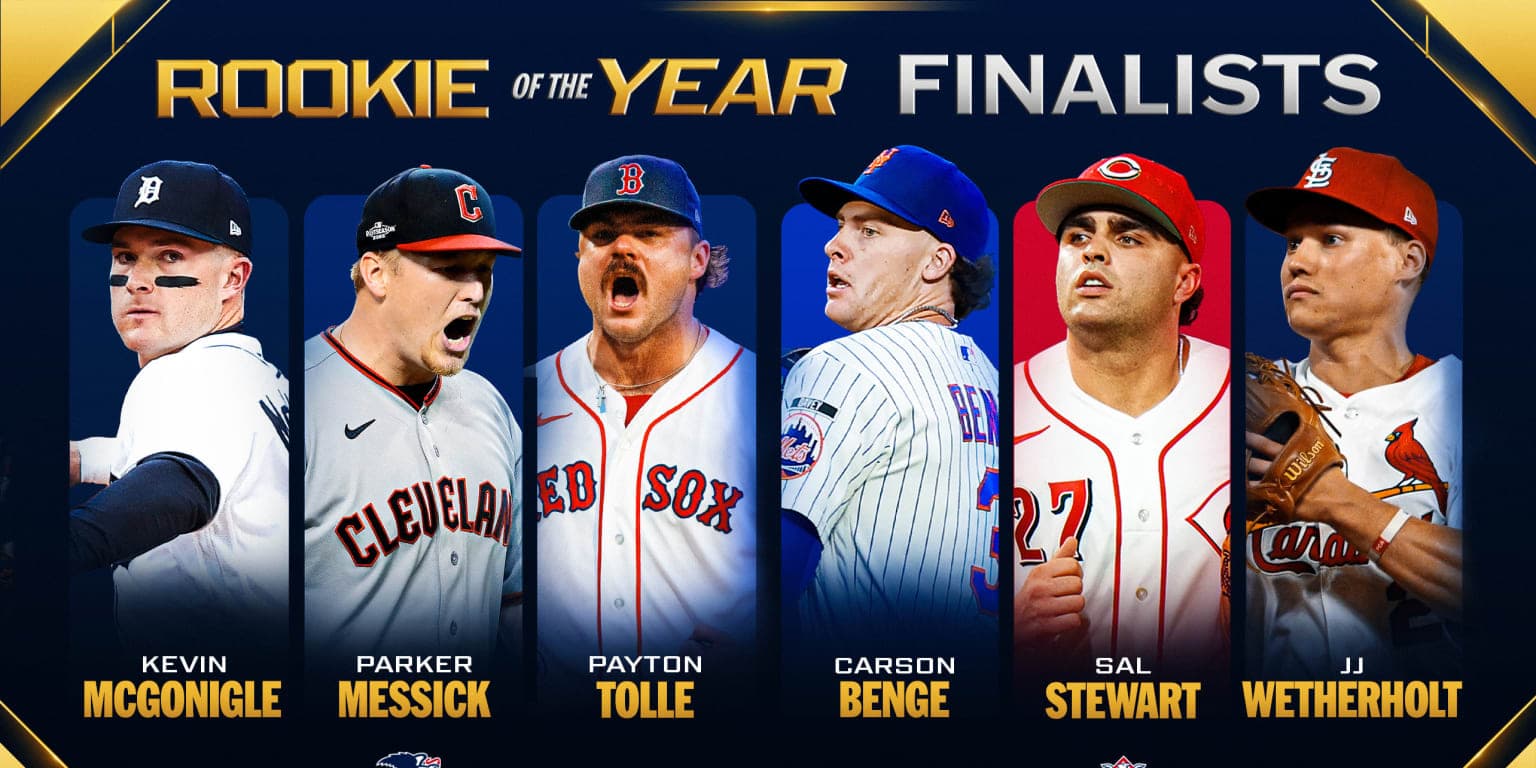
Tigers infielder Kevin McGonigle, Guardians starter Parker Messick and Red Sox lefty Payton Tolle represent the American League. Mets outfielder Carson Benge, Reds slugger Sal Stewart and Cardinals second baseman JJ Wetherholt make up the National League finalists.
Baseball’s Rookie of the Year awards will be announced Monday at 7 p.m. ET on MLB Network and MLB+, and each finalist’s argument centers on a specific blend of impact and historical weight. In the American League, the competition runs through a power-hitting middle infielder, a strikeout-driven rookie starter and a fast-rising left-handed ace-in-waiting.
Kevin McGonigle, the Tigers’ 2B, made the jump past Triple-A to open on the Tigers’ Opening Day roster. MLB’s case for him is built around production across the full offensive profile, where he led all AL players (not just rookies) with 7.1 bWAR and posted a season line described as 97 runs, 28 doubles, 18 home runs, 72 RBIs and 95 walks. The coverage also ties his workload to rarity, including a streak of getting on base safely at least 266 times as a rookie, along with baserunning and defense framed as integral to keeping him on the field.
Parker Messick, the Guardians’ LHP, is positioned as the other distinct kind of ROY profile: an everyday starter who combined starter durability with high-end run prevention and strikeouts. MLB credited him with 32 starts, 186 1/3 innings, a 2.56 ERA and 193 strikeouts, plus 6.3 WAR (per Baseball Reference) that ranked second among AL rookies behind McGonigle. The story also adds franchise and league context, noting he was among the best rookie pitching performances in Cleveland history and describing a pitching-combine benchmark (at least 150 innings, 2.60 ERA or below, and a 9.0-plus K/9 rate) achieved by only a short list of rookies.
Payton Tolle, the Red Sox lefty, represents the American League’s third finalist and the rotation momentum angle. MLB’s case emphasizes how quickly he moved into the majors late in 2025, then became part of the rotation for the full 2026 season after his recall for a start against the Yankees at Fenway on April 23. MLB’s production snapshot includes that in his first 26 starts he allowed two earned runs or fewer 17 times, while also describing advanced indicators tied to better secondary pitch command and suppressed run environments for the left-hander.
The National League’s finalists each have a different style of dominance: one five-tool profile in the outfield, one historic power-and-RBI season from a Reds infielder, and one mix of elite second-base defense with productive hitting from the Cardinals.
Carson Benge, the Mets’ OF, is described by MLB as a true five-tool player whose season improved as it progressed. The coverage calls out NL-leading outfield instincts in the form of 10 outfield assists as a right fielder, along with a consistent batting profile over a large chunk of his early career that is summarized as a.302/.366/.462 slash line with 20 doubles, 18 homers and 16 stolen bases in 126 games. MLB’s comparison argument is that Benge delivered value across categories without the tradeoffs that can accompany specialists in one area.
Sal Stewart, the Reds INF, is framed around an offense milestone that matters in ROY voting because of how often it precedes the award. MLB credited him with a full 30-homer/100-RBI season, marking him as the first Reds rookie and the 15th rookie overall to reach those totals, and noted that each of the previous nine players to do it since the ROY Award began (1947) won Rookie of the Year. The coverage also highlights his rookie standing among NL rookies in home runs, RBIs, extra-base hits and total bases, alongside an overall season line described as.263 with a.787 OPS.
JJ Wetherholt, the Cardinals’ 2B, is presented as the NL finalist whose case rests most heavily on defense plus overall on-base and baserunning value. MLB cited a 4.6 fWAR number and described his second-base range and run prevention as leading among qualified NL second basemen, paired with an.801 OPS and strong expected batting metrics in multiple areas. The story also points to baserunning efficiency, including 14 steals in 15 attempts, as part of the ROY package for a player who produced high-level two-way value at a premium defensive position.
Comments
Community guidelines. Comments may be removed for violations.
Loading comments...