
THE APEX TIMES
Jack Pyburn earns legal path to return to college football as he weighs NFL future with Buccaneers
A Louisiana court granted temporary NCAA relief to 16 players, with former Florida and LSU edge rusher Jack Pyburn among them, reopening the possibility of a college football comeback while he remains in the NFL with the Tampa Bay Buccaneers.
Former Florida edge rusher Jack Pyburn is weighing his NFL future while keeping open a college football return after a Louisiana court granted temporary relief from NCAA restrictions to a group of players that includes him. The ruling changes the immediate calculus for Pyburn, who is still listed with the Tampa Bay Buccaneers and has not exited the professional track. For college football programs, the decision is another example of how eligibility litigation can ripple into roster planning.
According to the report, Pyburn is among 16 players granted temporary relief from the NCAA by a Louisiana court. In practical terms, that temporary permission creates a narrow window for athletes in Pyburn’s situation to consider returning to the collegiate game rather than staying solely on an NFL timeline. The same report frames the issue as a direct choice Pyburn is now evaluating, not just a theoretical eligibility change.
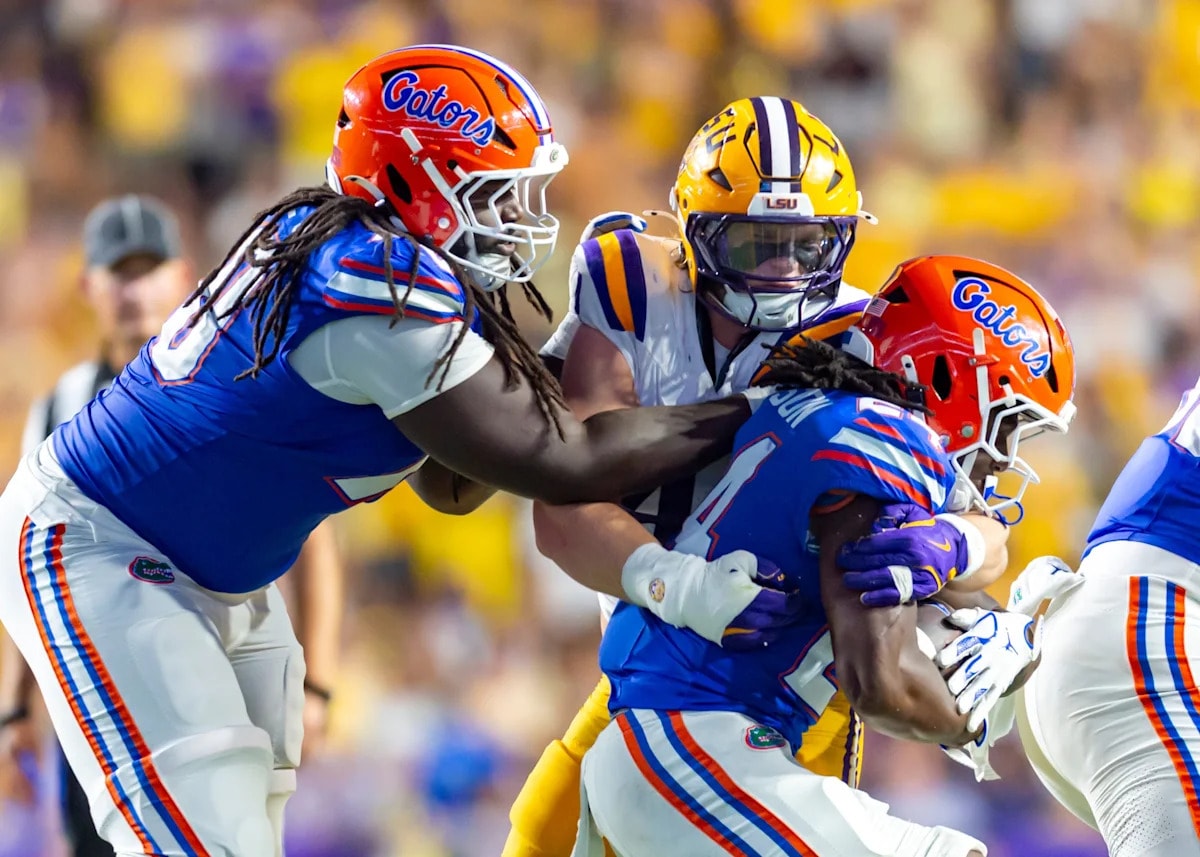
Pyburn’s background adds context to why his name carries weight with both fan bases and coaching staffs. He is identified as a former Florida and LSU pass rusher, making him a recognizable edge option for programs that prioritize experienced defenders and proven production in the Southeastern Conference pipeline. When players with that résumé get new eligibility flexibility, college staffs often treat the possibility as both a talent opportunity and a recruiting report to others in the class-to-class ecosystem.
At the same time, the report is clear that Pyburn remains with the Buccaneers. That detail matters because it positions his decision at the intersection of two timelines, professional development on one side and the short, finite nature of college seasons on the other. The court relief is described as temporary, which suggests the legal and eligibility status could change as the matter develops, potentially narrowing how far a college return can be planned with certainty.
From a broader college football perspective, the Louisiana court ruling underscores that NCAA eligibility rules are not always applied in a straight line. Temporary relief means the immediate impact may be more about options and leverage than final certainty. Teams that recruit or roster-build around potential edge additions may be forced to balance urgency with caution, especially if the relief is later limited or reversed.
For Pyburn himself, the next steps will likely be less about making one statement and more about timing and fit. If he chooses to return to college, the decision will need to account for program needs at the edge-rusher position, the roster stability at the schools he has ties to, and how quickly a new defensive system can be learned in time for the season’s rhythm. If he instead leans into the NFL, the court outcome still provides a fallback scenario, but it does not remove the reality that a professional path requires consistent performance and availability.
Watch next for clarification on the scope of the temporary relief and whether the eligibility permission is treated as a settled change or remains in flux. For college programs, the key question is whether more than a handful of players are able to translate legal permission into actual roster decisions. For Pyburn, the key question is whether his decision is ultimately guided by professional opportunity with Tampa Bay, the competitive and developmental value of a college edge role, or a combination of both given the temporary nature of the court action.
Why It Matters
- Eligibility litigation can quickly alter roster planning for colleges, especially for edge-rusher positions where experienced pass rushers are highly valued.
- The temporary nature of the relief suggests uncertainty for program planning, but it still can shift how aggressively schools pursue certain players.
- If Pyburn chooses college, it could affect defensive depth charts and game-to-game matchups in the next season.
- The case also reinforces how NIL-era pathways and NCAA enforcement are intersecting through the courts.
Key Facts
- Jack Pyburn remains connected to the Tampa Bay Buccaneers while evaluating his next steps.
- A Louisiana court granted temporary relief from NCAA restrictions to 16 players, including Pyburn.
- The ruling creates a legal path that could allow Pyburn to return to college football.
- The report describes Pyburn as a former Florida and LSU pass rusher.
- Pyburn’s decision is framed as weighing an NFL future versus a college return option.