
THE APEX TIMES
Jets QB coach Bill Musgrave offers early OTA perspective on Geno Smith and rookie Cade Klubnik
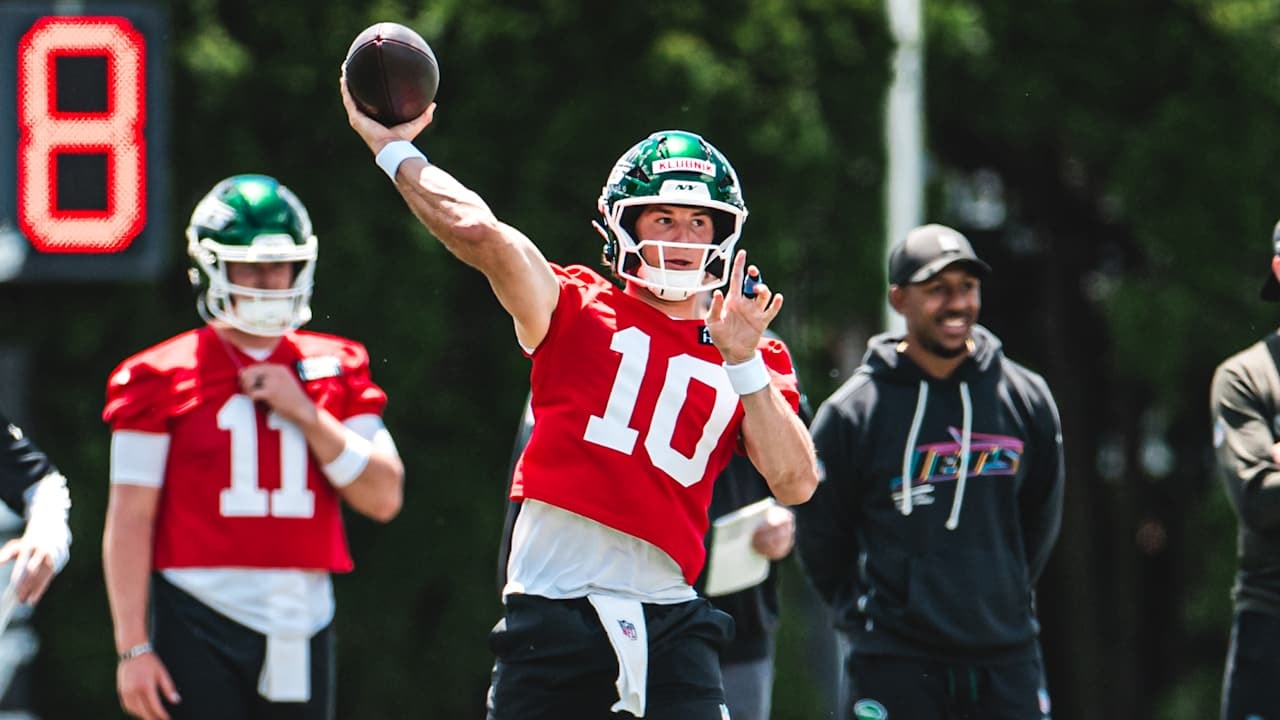
In a progress update during organized team activities, New York Jets quarterbacks coach Bill Musgrave cautioned against overreading spring practices while sharing what he has seen from Geno Smith as the established report-caller and Cade Klubnik as the team’s newcomer.
The New York Jets’ offseason work is in full swing, and quarterbacks coach Bill Musgrave used the team’s OTA progress report to set expectations for what those practices can and cannot tell you. Musgrave, speaking as the Jets prepare for the next stage of training leading into the season, framed the spring session as a small data set, but still one that can reveal how quarterbacks are processing the offense, communicating, and adapting to day-to-day coaching.
Musgrave specifically addressed Geno Smith, the Jets’ veteran quarterback, and the role he plays in the quarterback room. In an OTA setting, a starter’s job goes beyond execution. Musgrave’s comments emphasized the process side of quarterbacking, highlighting how a quarterback handles repetition, leadership demands, and the mental rhythm of working through the playbook with the rest of the first-team group.
With Smith, the key theme was likely continuity. Even though OTAs are not games and do not produce a full picture of performance under pressure, the Jets view the spring as a chance to refine timing and preparation habits. Musgrave’s perspective suggested that the established leader matters most in how he establishes standards during practice, helps the offense run smoothly, and reinforces how the team wants to carry itself as it moves toward training camp.
On the other side of the quarterback depth chart, Musgrave also discussed Cade Klubnik, the rookie newcomer joining the Jets’ developmental plan. While the playbook and mechanics often take the longest to settle for first-year players, Musgrave’s remarks acknowledged that Klubnik is still in the learning phase that begins as soon as the offseason program starts. In OTAs, coaches can look for fundamentals such as grasping concepts, building chemistry, and responding to feedback.
The Jets’ inclusion of Klubnik in this type of progress update also reflects how seriously the organization treats the first months of a quarterback’s development. The gap between college and the NFL is not just about reads and arm talent. It is also about tempo, protection and cadence communication, and the workload of being asked to do more than one thing at once. Musgrave’s comments, while delivered in the context of a limited spring sample, indicated that the coaching staff is paying close attention to how Klubnik is handling the details.
As with any OTA evaluation, the most important caveat is that the information is directional, not definitive. OTAs lack the full intensity of preseason and the consequences of regular-season execution, so a strong or shaky spring does not automatically translate into regular-season outcomes. Still, the Jets’ coaching staff uses the spring to stress-test the offense in controlled settings, measure progress in the quarterback exchange, and identify what still needs refinement before the competition picture becomes more tangible.
Looking ahead, Jets fans will likely watch whether Smith and Klubnik continue to show similar improvement curves as the offseason moves forward. For Smith, the focus will remain on command of the system and consistency with the timing demands of the offense. For Klubnik, the question is whether his adjustment accelerates as the program transitions from learning to sustained execution, especially once full-team practices and more live reps increase the difficulty of assignments. Musgrave’s update, framed by the reality of OTAs only being a small sample, points to what the Jets value most right now: the quarterback process, not instant results.
For now, the progress report functions as a status check for two different development tracks. Musgrave’s remarks place Smith and Klubnik into their respective roles, with Smith as the steadying presence and Klubnik as the newcomer still building the NFL foundation. The next stages of the offseason will determine whether the spring’s coaching emphasis turns into sharper rhythm, clearer decision-making, and more reliable practice-to-practice execution.
Why It Matters
- The spring program is often where NFL quarterbacks establish timing and communication habits that later show up in training camp.
- Musgrave’s comments help define how the Jets are balancing immediate leadership from Geno Smith with the developmental needs of Cade Klubnik.
- Because OTAs are a limited sample, the update is more about coaching direction and process than projecting regular-season performance.
- The Jets’ quarterback plan going forward will be shaped by how quickly Klubnik converts offseason learning into repeatable execution.
- The next offseason steps will clarify how much of Musgrave’s OTA observations carry into higher-intensity practice environments.
Key Facts
- Jets quarterbacks coach Bill Musgrave delivered an OTA progress update discussing both Geno Smith and Cade Klubnik.
- Musgrave said OTAs provide only a limited sample size for evaluating quarterback performance.
- Musgrave described the importance of the starter’s process and leadership role as spring practices unfold.
- Musgrave also discussed the rookie newcomer, emphasizing the learning and adjustment phase typical for a new quarterback.
- The Jets are using OTAs to assess how quarterbacks handle the offense, communication, and coaching feedback.