
THE APEX TIMES
John Calipari links Arkansas’s Jordan Smith Jr. to past work-ethic prototypes, naming Darius Acuff Jr. and Meleek Thomas
In a recruiting-style comparison that reads like a standards check, Arkansas coach John Calipari highlighted the effort mindset he associates with Jordan Smith Jr., drawing parallels to former Razorbacks Darius Acuff Jr. and Meleek Thomas.
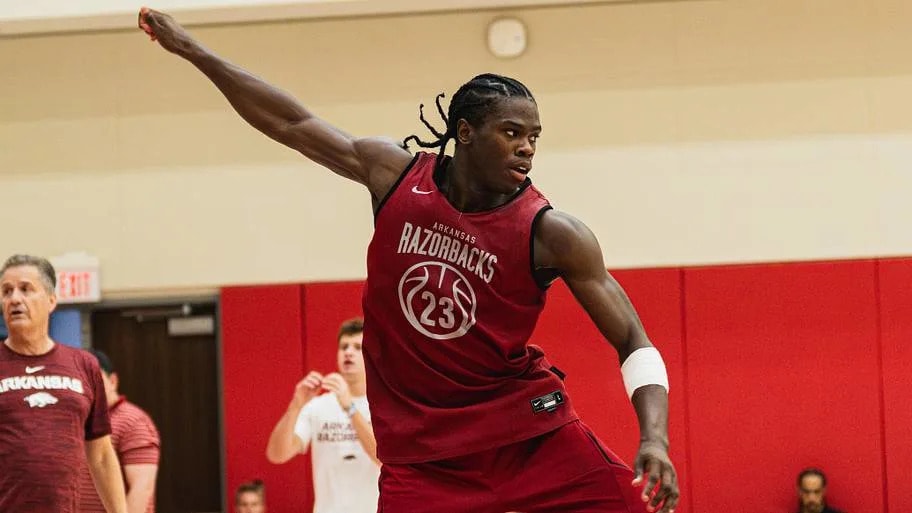
Arkansas guard Jordan Smith Jr. has become a name worth watching under head coach John Calipari, and the way Calipari has described his approach points to a familiar theme: work ethic. In a conversation reflected by Yahoo Sports on October 9, Calipari compared Smith to two Razorbacks who, in his telling, set a tone through effort and day-to-day discipline, naming Darius Acuff Jr. and Meleek Thomas as reference points.
Calipari’s comparison matters because it frames Smith less as a “flash” prospect and more as a process player. Smith is identified in the reporting context as a freshman point guard, which places him in the most detail-heavy role on a college basketball roster, where repetition and decision-making often separate promising guards from reliable ones. When a coach emphasizes effort publicly, it is usually a report that he wants his play to come from habits as much as talent.
The story also uses an on-the-ground image of that work ethic. The Yahoo Sports description points to a line that Calipari’s standards are so consistent that, if certain past players and Smith “happen to come back to the Natural State anytime soon,” they “wouldn’t have to pay for a meal.” While that phrasing is informal, the underlying point is straightforward: Calipari is associating these players with the kind of commitment that earns trust from the people around a program, including staff and community.
Darius Acuff Jr. and Meleek Thomas are both included in the comparison, tying Smith’s development to a prior Arkansas identity. That is an important context for fans trying to understand what Calipari believes he is building: teams that can play within instruction, repeat fundamentals, and sustain effort across practices and games, even when the opponent forces adjustments.
From a basketball standpoint, pointing to a point guard’s work ethic is also a reminder that playmaking at the college level is rarely only about natural reads. The lead guard’s job requires consistent preparation, physical conditioning that supports attention through possessions, and an ability to stay engaged during stretches when the offense stalls or the defense changes looks. If Calipari is selling Smith’s approach, it implies Smith is being judged on whether he shows up ready, not only whether he has a good highlight day.
Still, it is worth noting what this kind of comparison does and does not tell us. The Yahoo Sports item is not presented as a roster update, injury report, or transaction announcement. It is closer to an interpretive portrait of player identity, grounded in Calipari’s long-running emphasis on effort and standards, rather than a direct statement about immediate statistical production.
For what to watch next, the most practical read is to monitor how Arkansas integrates Smith’s role and decision-making during team play. In Calipari’s universe, work ethic often becomes visible in practice engagement, defensive effort, and the willingness to take coaching on command. If Smith matches the profile the coach is describing, Arkansas could be aiming to turn “development” into a stable on-court identity rather than a short-term adjustment.
The broader significance is that Arkansas is again leaning on Calipari’s model: recruit talent, then build a culture that treats preparation as a non-negotiable. By tying Jordan Smith Jr. to Acuff and Thomas, Calipari is effectively telling recruits and fans alike that he remembers who bought into that culture, and he expects that same kind of buy-in from the next wave of leaders.
Why It Matters
- Calipari’s public comparisons can shape how a young point guard is developed and judged in practice and in early-season responsibility.
- If Smith Jr. embodies the same effort standards Calipari associates with Acuff and Thomas, Arkansas’s guard play may be built more on consistency than on one-off moments.
- The emphasis on work ethic reflects Calipari’s team-building approach, which often prioritizes culture and habits as a foundation for on-court performance.
- Fans can use the comparison as a lens to watch for effort-based indicators such as defensive engagement and responsiveness to coaching.
Key Facts
- Yahoo Sports reported that Arkansas head coach John Calipari compared freshman point guard Jordan Smith Jr.’s work ethic to earlier Razorbacks Darius Acuff Jr. and Meleek Thomas.
- The comparison was presented as an indicator of standards and effort, rather than as a transaction or schedule-related update.
- The Yahoo Sports description included a casual remark about how those players would not need to “pay for a meal” if they returned to Arkansas, underscoring the effort-based reputation Calipari associates with them.
- The reporting context explicitly identifies Smith Jr. as a freshman point guard.
- The named players in the comparison are Jordan Smith Jr., Darius Acuff Jr., and Meleek Thomas.