
THE APEX TIMES
Kade Anderson is being grouped with the rarest kind of college pitching “aces” as MLB clocks start ticking
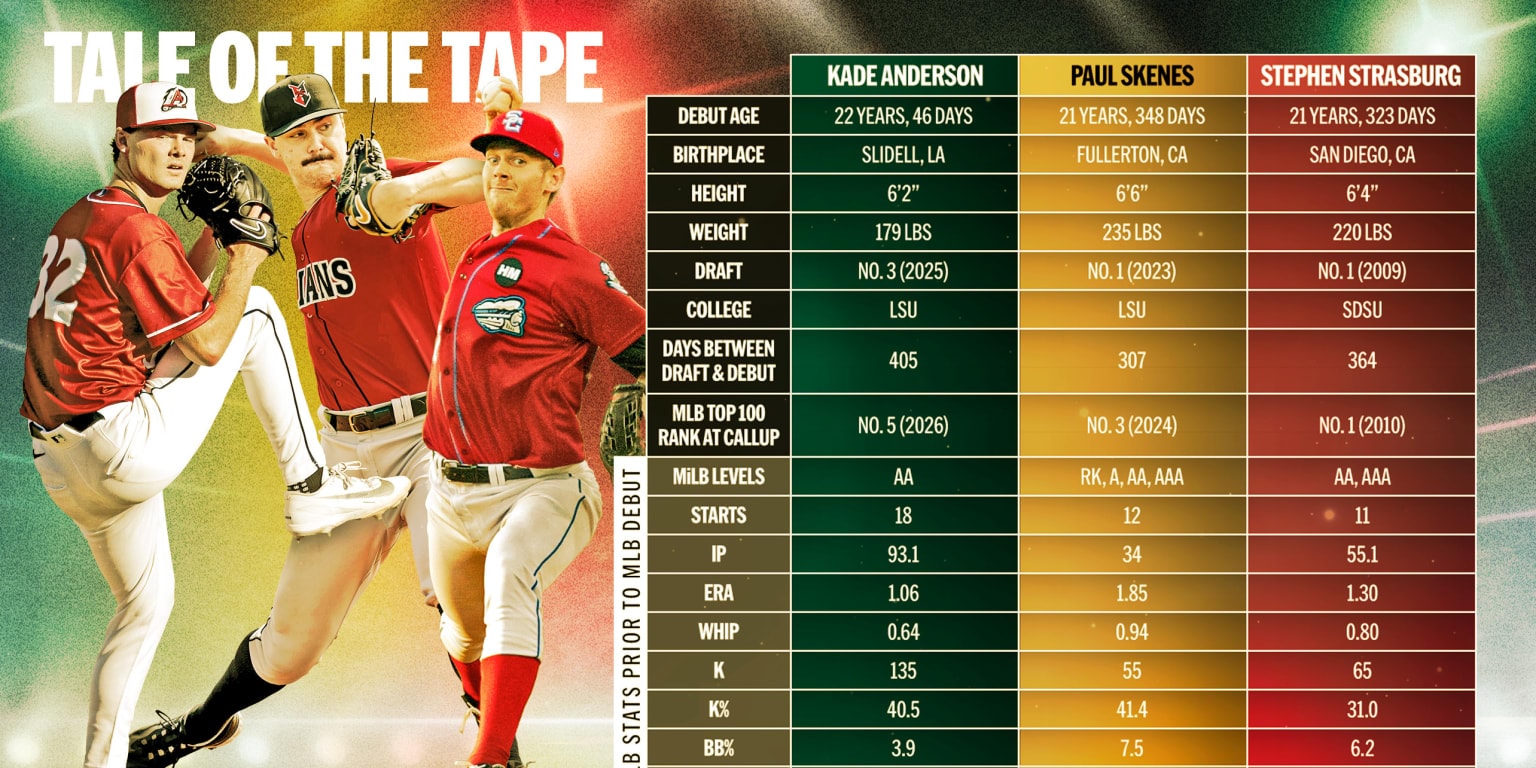
MLB’s prospect framing places Anderson in the same conversation as Paul Skenes and Stephen Strasburg, linking dominant college profiles to rapid pro expectations.
College baseball’s top pitching showcases have a way of accelerating the sport’s timelines, turning recruiting-season buzz into professional pressure quickly. In a recent look at the most striking pitching rises of the modern era, Kade Anderson was placed in the same category as Paul Skenes and Stephen Strasburg, with the common thread being how thoroughly these pitchers appeared to change the way their teams could operate on a week-to-week basis.
The comparison starts with Skenes, whose professional timetable is used as an example of how quickly elite college performance can compress the path to the majors. notes that when Skenes was taken as the No. 1 overall pick in the 2023 Draft, the “clock” for his Major League debut began immediately, and it suggests that it may have even started earlier during his junior season at Louisiana State, described as the most dominant pitching stretch college baseball had seen in a long time.
From there, the argument broadens from one player to a pattern, using Strasburg as another reference point for how a college pitcher’s impact can feel pre-encoded. The underlying idea is not that every top prospect should follow the same timeline, but that certain arms display a level of control, swing-and-miss projection, and competitiveness that makes the jump to higher-level hitters feel like an inevitable next chapter rather than a long developmental detour.
Within that framing, Anderson’s “meteoric rise” becomes the present-day match-up. ’s feature treats Anderson’s college emergence as something that, when it happens at the right level of dominance, reshapes expectations well beyond a single season. In practical terms, that means scouts and front offices begin planning as if a pitcher’s major-league relevance could arrive sooner than typical for a collegiate arm.
The most important caution is that “college ace” comparisons are inherently comparative, not predictive. Skenes’ No. 1 selection and the immediate pro spotlight are facts; however, the broader ranking of prospect trajectories is always a mix of projection and opportunity, including health, development, and how a pitcher’s workload and repertoire translate to pro hitters. A fast path is possible, but it is never guaranteed by college performance alone.
What to watch next is how Anderson’s college profile translates to the next step in the process, particularly whether the same qualities that earn him this historical grouping hold up against the best lineups and in the highest-leverage moments. If ’s broader premise is correct, Anderson is the kind of pitcher whose presence can influence more than just one outing, potentially shifting how his team manages games and how evaluators handle the “arrival” conversation.
For college baseball, these comparisons also matter because they help define what fans and programs treat as peak pitching identity. The Skenes and Strasburg benchmarks represent more than dominance on paper, they represent a perceived tipping point where college pitching starts looking like the majors in miniature. Anderson being placed alongside them is MLB’s way of saying the sport is again watching a rare trajectory form in real time, and the question now becomes how quickly the highest expectations can be converted into results at the next level.
Why It Matters
- When a college pitcher is framed alongside Skenes and Strasburg, it heightens the urgency of his development narrative and increases pressure around readiness for pro hitters.
- These “college ace” conversations affect recruiting and program-building priorities, pushing teams to identify and develop arms with immediate impact skills.
- For the prospect pipeline, the key storyline is translation: whether a college-dominant profile can maintain its edge against more advanced competition.
- The broader baseball calendar is shaped by how quickly top collegiate arms appear to be approaching major-league relevance.
Key Facts
- describes Kade Anderson as joining a list of rare college pitching “aces” and ties his rise to a faster pro expectation framework.
- says Paul Skenes was selected as the No. 1 overall pick in the 2023 Draft and that the clock for his Major League debut began immediately.
- suggests Skenes’ timeline may have started during his junior season at Louisiana State, described as the most dominant college pitching stretch in a long time.
- references Stephen Strasburg as another benchmark for college-to-pro pitching acceleration in the modern era.