
THE APEX TIMES
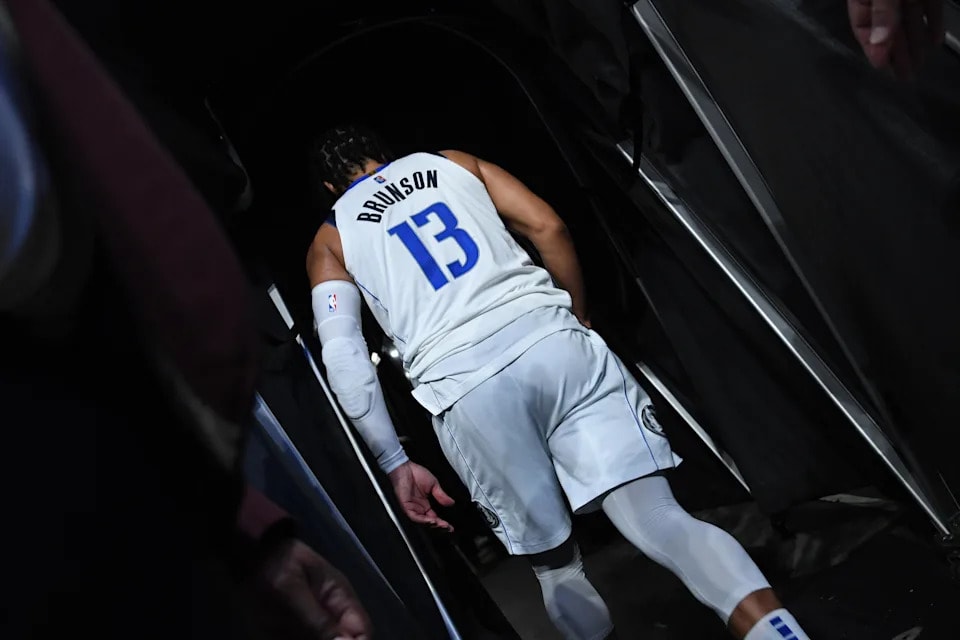
Knicks “domino effects” hypothetical: If Jalen Brunson had stayed in Dallas, New York’s path changes
A Yahoo Sports thought experiment revisits how one star decision can reshape roster planning, contention timing, and even the margins for future relevance.
Jalen Brunson’s career has become a reference point for how quickly one roster decision can alter an NBA team’s direction. In a new Yahoo Sports analysis published Aug. 31, the writer frames a counterfactual: in another life, Brunson remains with the Dallas Mavericks and, as a result, the Knicks never get the same leverage they built around “contending now” rather than “figure it out later.”
The premise is straightforward but the implications are not. Domino effects in team-building rarely announce themselves with a single headline move. They show up as downstream constraints, competing priorities, and the ripple impact of what a front office no longer has to chase. If New York’s foundation is not anchored by the player described in the series title as the “birthday boy,” the Knicks’ long-term hopes, in this scenario, lose a stabilizing center of gravity.
The article’s logic also ties the Brunson hypothetic directly to how the Knicks manage other uncertainty. The writer points to “Julius Randle’s injury” as an example of how one team timeline can be thrown off and then re-assembled around what remains. Under the alternative premise, the Knicks would have had a different set of answers for adjusting when performance swings, health becomes a factor, or playoff outcomes force new decisions.
Even the style of problem-solving shifts. In the same series framing, Yahoo notes it previously covered a “more niche” Kings saga and then pivoted to a less niche Randle injury element. The author’s method suggests that a counterfactual season is not just about swapping a single name on a roster. It is about imagining how a team would reweight risk, when it would seek stability, and which roster qualities it would prioritize if it did not have the same offensive engine or floor-raising profile.
This is not an argument that one player guarantees success. It is closer to an argument about timing and optionality, especially for a franchise trying to balance immediate playoff relevance with the long-term work of assembling a sustainable core. In the “Brunson stays in Dallas” scenario, the Knicks still operate in the same league with the same opponents and constraints, but the set of tools available to them at key decision points looks different, and that can be the difference between building momentum and living in the retooling cycle.
From a team perspective, the key question becomes what New York does when it lacks a certainty it could otherwise plan around. That can affect roster construction choices, including the types of complementary pieces that make a contender function on both ends, and how much the organization can afford to experiment with lineup combinations during stretches where other teams might be running clean, repeatable rotations.
For fans and observers, the “domino” lens is a useful way to evaluate roster identity. It encourages the same question every off-season: what is the most important lever the front office pulls, and what chain of consequences follows? With this counterfactual, Yahoo’s answer is clear enough to spark debate, even if the alternate timeline cannot be tested.
What to watch next is less about the hypothetical itself and more about how real-world Knicks roster-building choices continue to reveal the organization’s priorities. If New York stays committed to building around a ball-handler-driven offense, the contrast with the “what if he stayed” story becomes a measure of how central that decision has been to their planning and performance expectations. If the Knicks ever pivot their approach, that pivot can be interpreted, again through the domino lens, as an admission of a different kind of roster math.
Why It Matters
- The NBA is highly sensitive to team-building “hinge” moments, and a player decision can alter contention timing even without immediate, obvious changes.
- If the Knicks had not received the type of leadership/offensive stability implied in the series title, their path to playoff relevance would plausibly look different.
- Counterfactual analysis can clarify what a team values most, including whether it builds around repeatable offensive structure or broader experimentation.
- Understanding these domino chains helps fans evaluate future Knicks roster moves in a more cause-and-effect framework.
Key Facts
- Yahoo Sports published an Aug. 31 analysis framing a counterfactual NBA timeline in which Jalen Brunson stays with the Dallas Mavericks instead of leaving.
- The piece uses the idea of “domino effects” to argue that one decision can change downstream roster planning and long-term outlook.
- The article references how roster uncertainty can be compounded by events such as Julius Randle’s injury.
- It describes its counterfactual approach as part of an ongoing series that connects one team’s turning points to wider consequences.