
THE APEX TIMES
Luke Kuechly’s edge was built on paper: the Hall of Famer’s relentless note-taking habits
Long before fans noticed the reads and recognition, Luke Kuechly methodically mapped opponents with obsessive repetition, notebooks, and whiteboards, turning film study into muscle memory.
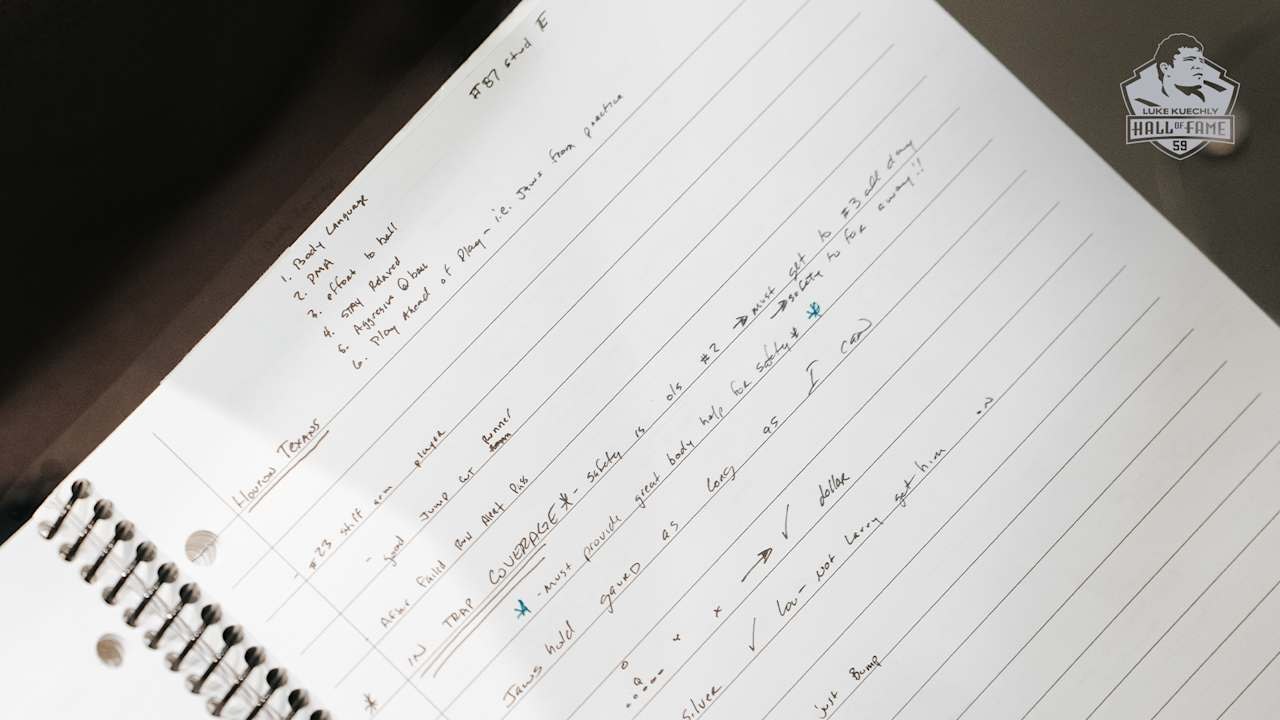
Luke Kuechly did not simply watch football. In the way he prepared, he also seemed to live in it, translating what he saw on tape into written instructions to himself that he could rehearse until the game slowed down. A new feature describing his approach portrays a Hall of Famer whose advantage came from discipline in the quiet minutes, the kind when elite instincts are usually assumed to be effortless rather than engineered.
According to the Panthers piece, Kuechly’s learning process was built around constant documentation. The article frames his preparation as both obsessive and practical, with him recording ideas repeatedly, filling notebooks and using whiteboards as tools for refinement. The goal was not just understanding a play in isolation, but internalizing patterns so they would surface quickly when an opponent presented the same concepts in motion.
The emphasis, as presented by Carolina’s team, is that Kuechly treated preparation like repetition with purpose. The story depicts him as running information through the same mental channels over and over, effectively using his own notes as prompts. It describes a routine that extended beyond film, reaching into the moments just before sleep, when attention and recall can be sharpened through repetition.
This method also helps explain what teammates and opponents saw: a defender who appeared early to the ball, who looked like he recognized routes and formations before the offense could fully sell them. The feature’s underlying theme is that recognition is not a single skill, but the product of many small decisions made consistently. In Kuechly’s case, writing things down was the mechanism that turned study into anticipation.
From a broader NFL perspective, the article underscores why intelligence can look like physical dominance in real time. Linebackers at the highest level spend every snap processing formations, protection schemes, and route concepts, often while calling adjustments. The better prepared a player is to simplify those inputs, the more confidently they can act within a fraction of a second.
There is also a cultural lesson here for modern football, where analytics, scouting, and advanced film tools can overwhelm athletes. The Kuechly model, as described by the Panthers, does not reject technology. Instead, it insists on personal systems and clarity, capturing key information in a form he could revisit and rehearse. That is the part that reads as timeless, even as the game evolves.
What to watch next, if you are studying preparation in the NFL, is how defenders build their own “information pipeline.” Kuechly’s story highlights an approach where the work before the work is as important as the performance itself. Even for current players, the takeaway is straightforward: the best instincts are often the result of preparation you can trace back to something tangible, whether that is a notebook, a whiteboard, or a repeatable set of cues.
Why It Matters
- For fans, it shifts the explanation of defensive dominance from instinct alone to an identifiable preparation method.
- For players and coaches, it offers a practical model of simplifying complex opponent information into repeatable cues.
- It reinforces that high-level linebacker performance depends on rapid recognition, not just athletic ability.
- It highlights how preparation habits can translate into faster, calmer decisions when plays break down.
Sources
Key Facts
- A feature examines how Luke Kuechly prepared by turning film study into written notes and repeated self-rehearsal.
- The story describes Kuechly using notebooks and whiteboards as tools to capture and refine what he learned from opponents.
- The article emphasizes repetition, portraying his process as more than one-time study, with ideas reviewed until they became automatic.
- Carolina’s feature portrays the routine as extending into the late moments before sleep, linking preparation to memory and recall.
- The piece frames the result as recognition and decision-making that shows up quickly during games, particularly in how a linebacker diagnoses what an offense intends to do.