
THE APEX TIMES
Michigan State’s late comeback attempt falls short in overtime loss to Illinois
The Spartans’ onside-kick spark came too late, and offensive inconsistency for much of the game carried into an overtime defeat to the Fighting Illini.
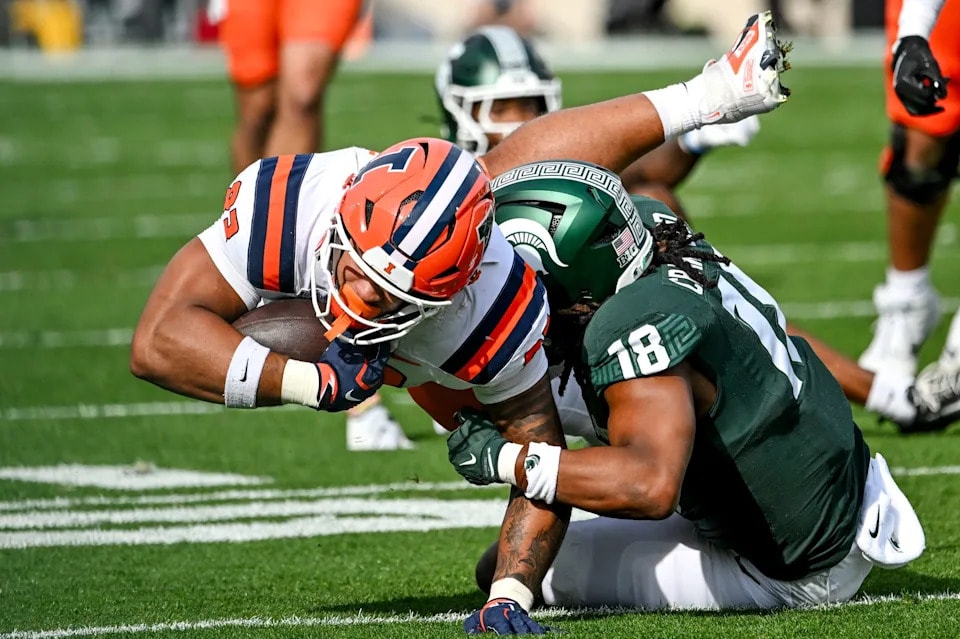
Michigan State’s evening at Spartan Stadium turned on a fourth-quarter swing, an onside kick that looked like it could erase three quarters of offensive stagnation. The recovery threat was ultimately blunted, and the Spartans came up short in overtime against Illinois. The defeat added another chapter to a difficult stretch for Michigan State, one marked by trouble manufacturing sustained offense and protecting leads when games tighten.
From early on, Michigan State struggled to establish rhythm against an Illinois defense that kept compressing space and forcing the Spartans into longer, less efficient drives. Even with occasional spurts, the Spartans could not consistently convert those drives into points for most of the game. According to the game report, the “malaise on offense” lasted roughly three quarters, setting up the late-game urgency that followed.
As the game moved into its closing phase, Michigan State pressed for possession and momentum. The onside kick in the fourth quarter reflected that urgency: it was a bid to flip field position and turn desperation into opportunity. But the momentum did not fully hold, and the Spartans were left to chase an answer they did not generate often enough during regulation.
The overtime period underscored how quickly a close contest can become about available bodies, especially for teams already dealing with strain. The report describes Michigan State’s injuries as spreading to the linebacker group, a development that can affect both play-calling and matchup planning, since linebackers are central to run fits, third-down coverage rotations, and boundary discipline.
Injuries at linebacker can ripple beyond the first player down. Defensive calls often depend on the speed and coverage responsibility a linebacker can handle, including how quickly the group can adjust to motion and how effectively it can stay square in space. When those options narrow, coordinators may simplify schemes, play more conservative coverages, or use different personnel packages that are less comfortable against an opponent’s predictable tendencies.
There is also a contextual layer for Michigan State’s season-building. Illinois entered as an opponent with a reputation for testing Big Ten teams in the mid-to-late phases, and Michigan State’s failure to consistently generate offense meant it could not neutralize that pressure early. When a team waits until the fourth quarter to create the plays it needs, it reduces the margin for error, especially in an overtime setting where one possession can determine the outcome.
What to watch next is whether Michigan State’s offensive approach changes in response to the extended period of inefficiency described in the report, and whether the linebacker injuries lead to more visible shifts in defensive packages. For Illinois, the takeaway is clearer: turning opponent adversity into a win, and forcing opponents to rely on late-game swings rather than sustained drive-by-drive control.
For readers looking at the broader title-picture implications: in the Big Ten, single results can compound quickly when a team is still searching for reliable production. While this game does not define a season by itself, it does help reveal whether Michigan State can stabilize both sides of the ball when games become short on time and long on consequences.
Why It Matters
- Late-game execution matters even more when a team cannot build sustained offensive drives, and Michigan State’s fourth-quarter swing did not fully connect.
- Injuries to linebackers can force defensive simplification, affecting run defense, third-down schemes, and coverage matching.
- For Big Ten opponents, the result reinforces how pressure and discipline can limit a struggling offense’s time to recover.
- The loss puts additional weight on Michigan State to find answers quickly, since overtime games often hinge on one or two possessions rather than larger trends.
Key Facts
- Michigan State lost to Illinois in overtime, according to the game report.
- The Spartans’ onside kick attempt in the fourth quarter was ultimately negated.
- The report describes Michigan State’s offensive production as lacking for about three quarters.
- The article says Michigan State’s injuries spread to the linebacker group during the game.
- The game was played at Spartan Stadium in East Lansing on Oct. 10, 2026.