
THE APEX TIMES
Minnesota Timberwolves Bench Takes Center Stage in Yahoo Sports’ Season-Long “Report Card” Project
A new Minnesota-focused installment shifts the spotlight from the starting group to the Wolves’ bench, using an advanced on/off-style metric called Estimated Plus/Minus (EPM) as a core grading tool.
Minnesota Timberwolves fans got a preview of what’s next in a season-long bench evaluation project, with Yahoo Sports framing its latest installment as a “report card” for the team’s reserves. The piece is presented as a continuation of a prior grading approach for the Wolves’ starters, but the emphasis now moves to how Minnesota’s lineup depth affects games when the rotation turns over.
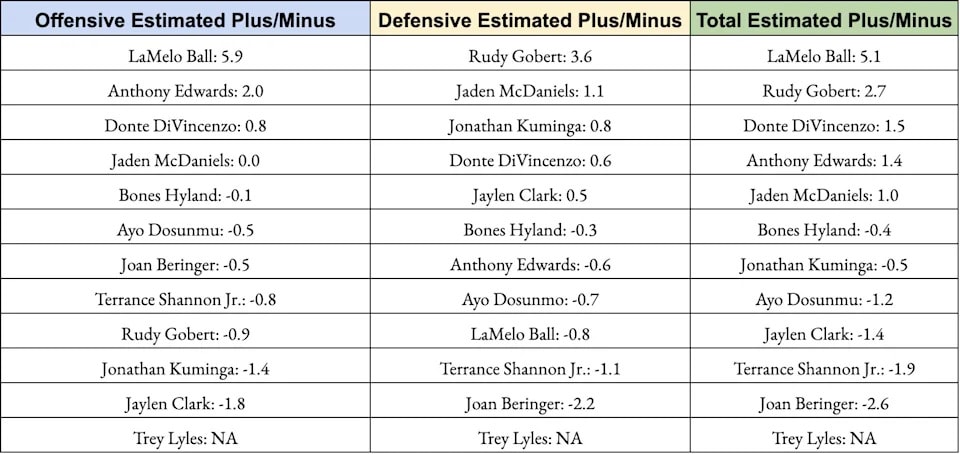
The author sets the methodology before diving into individual bench players, introducing Estimated Plus/Minus (EPM) as one of the statistical anchors for the project. In broad terms, EPM is designed to estimate how much a player (or unit) contributes to team performance, accounting for more than raw box-score totals. That matters for bench assessment because reserves can be tasked with multiple roles, such as stabilizing ball-handling, protecting the rim, spacing the floor, or absorbing matchups against another team’s second unit.
Rather than treating the bench as one monolithic group, the project is laid out to grade players through a repeatable structure, with the intent of tracking performance over the course of the season. The premise is that Minnesota’s wins and losses will depend not only on the starting lineup’s ceiling, but also on how effectively the Wolves maintain quality once starters rest.
The article also indicates that its grading curriculum will be more than a single spreadsheet. It explicitly ties EPM into a larger framework, with the goal of pairing “what the numbers suggest” with the context of role and rotation expectations. That approach is particularly relevant for the Wolves because bench minutes often determine how consistent the team’s defense and offensive spacing look across different stretches.
Still, this specific report-card preview is, as presented, a roadmap rather than a full set of finalized grades. It does not provide a complete statistical ledger or a game-by-game bench verdict within the visible portion of the material, so readers should expect the deeper evaluation of specific reserve players to arrive in later installments.
For Minnesota, the stakes of getting bench play right are straightforward. A strong second unit can reduce scoring droughts, lessen defensive breakdowns during lineup transitions, and give the coaching staff more flexibility with matchups. In a typical NBA season, those advantages tend to show up most in late-game margins, playoff rotation consistency, and how reliably a team can defend multiple styles without a noticeable drop-off.
The next question for the Wolves, and the core point of this “bench report card” concept, is whether Minnesota’s reserves can consistently impact games in the ways EPM is meant to capture. If the bench can hold up when opponents change personnel, it will not only justify deeper rotation trust, it will also shape how Minnesota structures its playoff roster usage. If the bench impact is inconsistent, the same framework will likely expose where the team needs more stability or role clarity as the season progresses.
Why It Matters
- Bench performance often determines how smoothly a team transitions between starting and reserve lineups, which can swing close games.
- Using EPM as a centerpiece suggests the project will emphasize impact on team performance rather than only traditional box-score output.
- A repeatable bench grading approach can help clarify which roles are producing stable results over time.
- For a playoff-bound team, second-unit consistency can shape rotation confidence and late-game lineup choices.
Key Facts
- Yahoo Sports published a Minnesota Timberwolves “Bench: Report Card Preview” installment, shifting focus from the starters to the reserves.
- The author describes a season-long grading project and previews the bench evaluation framework.
- Estimated Plus/Minus (EPM) is introduced as a key statistical component for the project.
- The preview frames EPM as part of a broader curriculum, with role and rotation context intended to matter alongside the metric.