
THE APEX TIMES
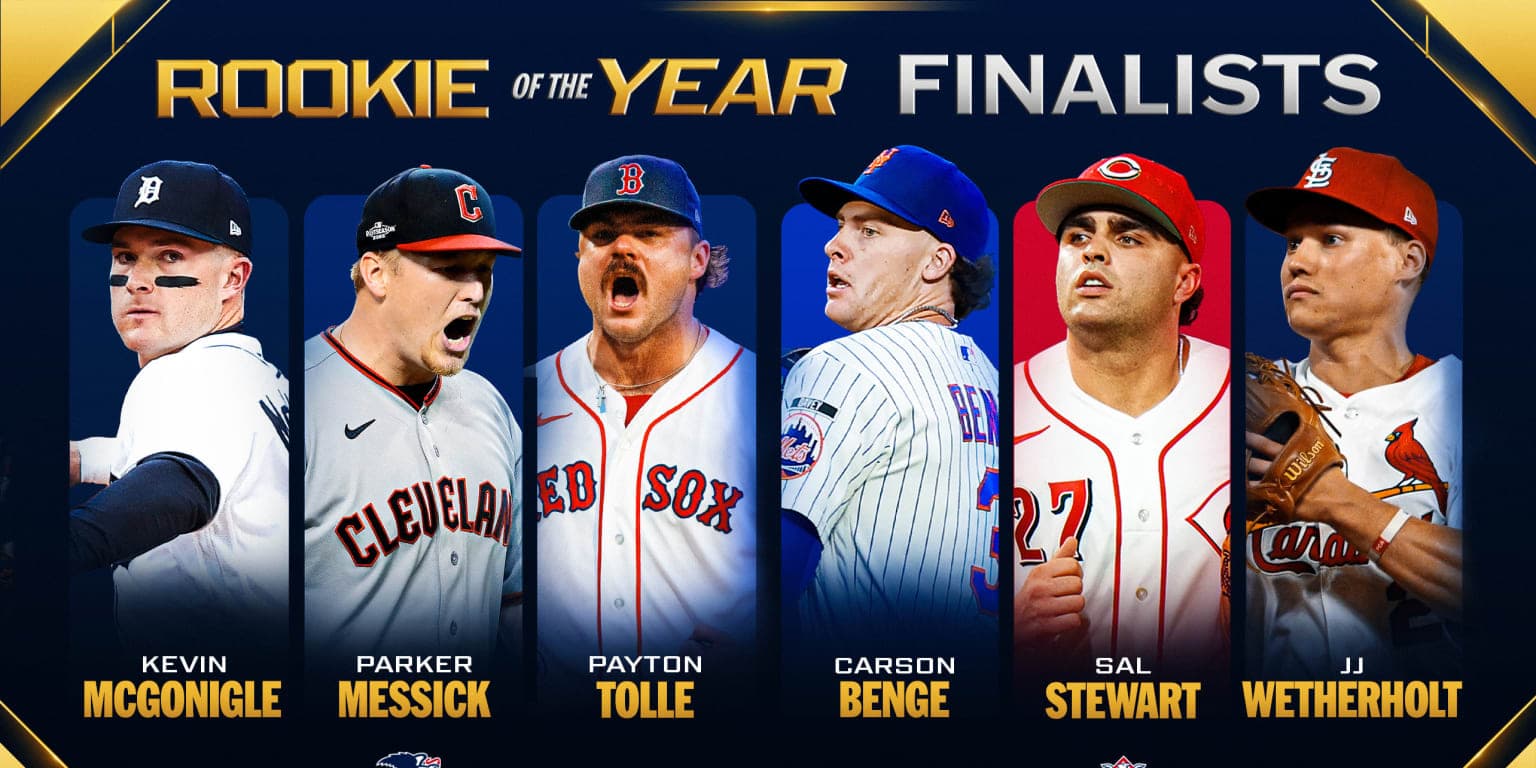
With the awards set to be announced Monday, here is what the top Rookie of the Year ballots in each league are built on, from a plate-discipline bWAR leader in the AL to a defense-first second baseman for the Cardinals in the NL.
The Baseball Writers’ Association of America’s Rookie of the Year award is designed to separate one-season impact from simple flashes. With the MLB Network and MLB+ broadcast scheduled for Monday night, MLB’s season recap points to two types of cases: everyday positioning players who reshaped offense and base-running, and rookie pitchers who were productive enough to be treated like full members of the rotation from the start.
In the American League, Kevin McGonigle’s case rests on both volume and efficiency. MLB’s write-up says he led all AL players, not just rookies, with 7.1 bWAR, producing a rookie season line that included at least 97 runs, 28 doubles, 18 home runs, 72 RBIs, and 95 walks. The same evidence package frames him as the kind of hitter who advanced baserunners and maintained a grinder-style approach, while also working through an everyday role change after being thrust into shortstop duties.
Still in the AL, Parker Messick’s argument is built around innings, results, and strikeout credibility. MLB’s rundown cites 32 starts, 186 1/3 innings, a 2.56 ERA (sixth among qualified AL starters), 193 strikeouts, and 6.3 WAR. It also places him in franchise and MLB rookie-pitching history, describing his season as strong enough to be compared with past top Cleveland rookie benchmarks and to meet a threshold of “starter-level” effectiveness for rookie pitchers.
The AL third finalist, Payton Tolle, is framed as a late-arrival breakout who seized a rotation job quickly and then sustained it. MLB’s evidence says he moved from a limited prior cameo into a full-season rotation role after a recall and stayed there for the rest of the year. The case emphasizes his command improvements and the statistical footprint MLB attributes to his pitch quality and run prevention, including the frequency with which he limited earned runs during his 26 starts.
In the National League, Carson Benge’s candidacy is presented as “complete-player” value. MLB’s piece describes him as a five-tool profile, highlighting that he led the NL with 10 outfield assists as a right fielder while also putting up a strong overall line after an early-career start-up phase, including 20 doubles, 18 home runs, and 16 stolen bases across 126 games. The argument is that he combined power, speed, contact, and defense rather than relying on one standout skill set.
Sal Stewart’s case in the NL is centered on impact production. MLB’s season recap says Stewart batted.263 with a.787 OPS, hit 32 home runs, and drove in 112 runs, and then notes milestone context: he became the first Reds rookie, and 15th rookie overall, to post a 30-homer/100-RBI season. It also credits him with leading NL rookies in several offensive categories, including homers, RBIs, extra-base hits, and total bases, plus making an All-Star Game.
For the Cardinals, JJ Wetherholt’s case is built on the combination of elite defensive metrics and productive hitting. MLB’s write-up credits him with a 4.6 fWAR and points to his 17 home runs from the plate, alongside “elite” second-base defense. The evidence package emphasizes outs above average and fielding run value at the position, then adds that his approach translated into measurable performance with runners in scoring position and a baserunning profile that included 14 steals on 15 attempts and a baserunning run value noted as well above league norms.
Taken together, the finalists’ cases map to different ROY archetypes, but each league’s trio is supported by the same standard MLB emphasizes: measurable season-long production rather than short stretches. The central question for voters is whether the winner will be the rookie who carried the most overall value on the stat sheet, or the one who most clearly delivered that value in the game’s “real roles” for position players and for innings-eating starting pitching.
As the Monday award announcement approaches, the most verifiable takeaway from MLB’s preview is not a predicted winner, but the specific statistical and historical pillars each finalist is being credited for: bWAR and on-base volume for McGonigle, rotation-level starter performance for Messick and sustained run prevention for Tolle, a complete tool profile for Benge, season-long middle-of-the-order power for Stewart, and defense-first value plus contact-and-power production for Wetherholt.
Comments
Community guidelines. Comments may be removed for violations.
Loading comments...