
THE APEX TIMES
Monday Rockpile: Rockies’ defensive questions return as the season’s margin tightens
Colorado’s back-end has again become a talking point after another rough night against the Cleveland Guardians, renewing debate about how much team defense is shaping the Rockies’ 2026 outcomes.
On Friday night, a lopsided result against the Cleveland Guardians sparked a familiar Monday conversation around the 2026 Colorado Rockies: if the pitching and baserunning are only part of the story, how much of the season’s frustration can be traced to defense. The specific game matters less than what the discussion represents, because defense is where outcomes compound quickly in baseball. Errors, misplays, and extended rallies change not just runs scored, but the number of pitches a bullpen must absorb and the leverage points a lineup faces over the long haul of a schedule.
This is not a one-off critique. The Rockies’ defensive profile has been a recurring offseason and in-season theme for analysts, and it has regularly been examined through catch-and-throw fundamentals (range, conversion rate, and ability to prevent extra bases) as well as through the way plays are recorded in official scoring. When those elements are inconsistent, opposing offenses can do two things at once: score more often on the balls in play, and also turn routine innings into multi-run threats. In that context, a “bad defense” narrative can become shorthand for an entire chain reaction of pitching strain and bullpen usage.
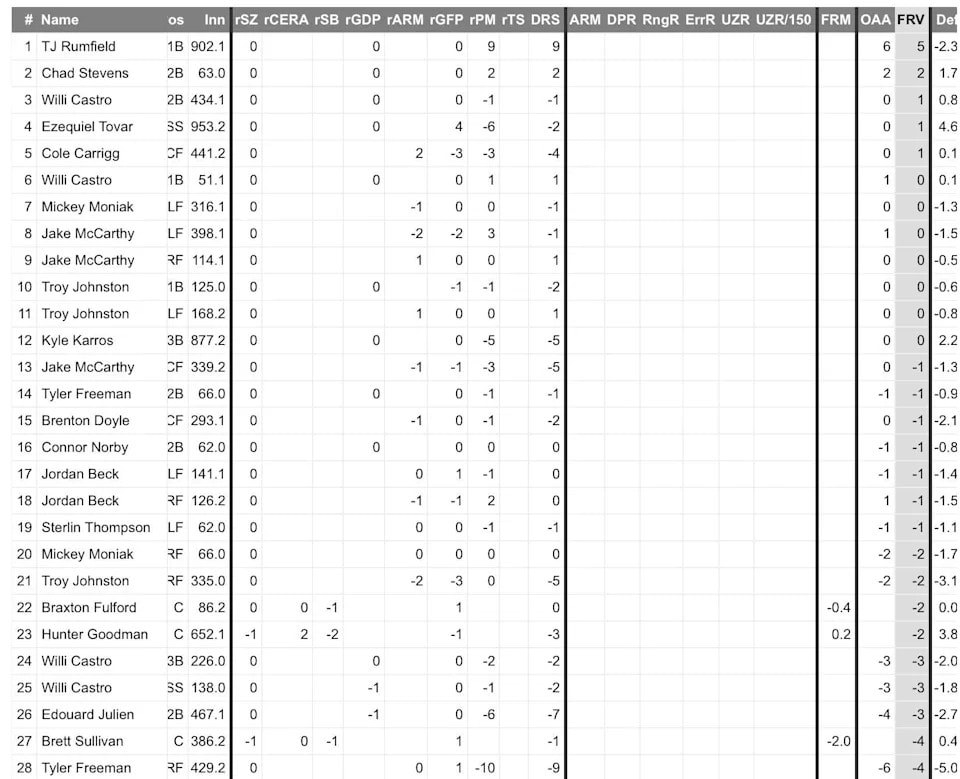
In the Monday Rockpile discussion, the question is framed directly, “How bad is the 2026 Colorado Rockies defense?” That wording indicates a desire to move beyond vibes and toward measurable impact. Defensive evaluation in modern baseball usually mixes fielding outcomes with context, including difficulty of chances, positioning, and the score state of plays. For a team that does not control the game through power alone, the baseline goal is to turn balls in play into outs with a repeatable success rate. When that baseline slips, even strong starts from the rotation can become hard to protect.
The Saturday-to-Monday conversation also reflects how quickly baseball fans and evaluators notice defense once a team is under pressure. A blown gap on a shallow fly, a misread off the bat, a throw that is late by a fraction, or a play that fails to prevent a runner from taking an extra base can all look minor in the moment, then loom large on the scoreboard once innings stretch. Against Cleveland, the reported nature of the discussion centers on the Rockies being “blown out,” which tends to magnify the perceived effect of every additional extended rally, regardless of whether the defensive plays are the only driver of the margin.
At the same time, it is important to separate correlation from cause. Defense can influence outcomes, but pitching quality, sequencing, and even the type of contact a team allows all affect run expectancy on any given night. A club might receive difficult liner after difficult liner, or it might generate innings where hitters force the defense to make long throws. Defensive breakdowns are not always the first domino, even if they are often the most visible one once a game swings.
Because the available reporting is focused on the broader debate rather than a statistical breakdown, this story stops short of declaring a specific rank or metric as the final answer. What is clear is that defense is central to how the Rockies are being evaluated in 2026, and that a heavy defeat against Cleveland was enough to push the issue back to the front of the sports page. In a season where the gap between playoff contention and elimination is measured in a relatively small number of games, teams cannot afford for any one phase to consistently underperform.
What to watch next is not just whether the Rockies “look sharper,” but whether the underlying defensive process shows evidence of improvement. That can include fewer extended rallies on balls in play, better conversion on routine chances, and less damage when the game state shifts. If those trends appear in subsequent games, the conversation will likely move from diagnosing a problem to tracking progress. If the same patterns reappear, the defensive debate may harden into a roster- and development-building question for Colorado’s front office.
For now, Monday Rockpile is less a verdict than a prompt. It asks fans and analysts to quantify how much Colorado’s fielding is costing the team. The next stretch of games will provide the clearest answer because defensive impact is not confined to one inning. It shows up across innings, across opponents, and across the steady accumulation of runs on which standings are ultimately decided.
Why It Matters
- Defense is a multiplier in baseball, affecting not only runs on the scoreboard but also pitch counts and bullpen pressure.
- If a team’s defensive outcomes consistently underperform, even average pitching can struggle to hold leads and keep games close.
- A defensive weakness can become a roster-construction priority, shaping offseason targets and in-season lineup decisions.
- In tight playoff races, the run prevention gap created by defense can be difficult to recover from late in the season.
Key Facts
- A Monday Rockpile column returned to the topic of how the 2026 Colorado Rockies defense is performing.
- The discussion was prompted by a Friday night game in which the Rockies were defeated by the Cleveland Guardians in a lopsided fashion.
- The central question is framed as an evaluation, asking how bad the Rockies defense is in 2026 rather than only describing it anecdotally.
- The debate reflects how defensive play can influence pitching workload, baserunner outcomes, and inning length in baseball.
- No specific defensive metric breakdown or ranking is provided in the accessible reporting for this story.