
THE APEX TIMES
NBA free agency’s richest deals draw backlash as analysts question fit, value and long-term risk
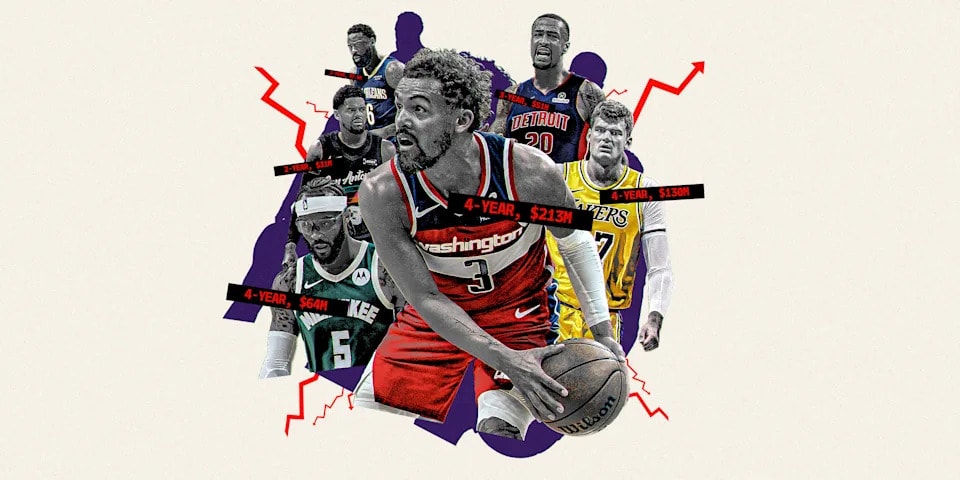
A new NBA free-agency review from Yahoo Sports argues that even when money is justified on paper, the wrong contract shape can become a roster constraint. The list includes scrutiny of Trae Young’s top-tier extension-level pay and criticism of a Lakers spending spree.
Free agency in the NBA has once again turned into a stress test for front offices, and Yahoo Sports’ latest NBA deep dive is less interested in whether star players are talented than whether certain deals could become liabilities. In its look at “the 6 worst contracts in NBA free agency,” the outlet frames the debate as a question of opportunity cost: what a team gives up when it commits maximum-level money and role certainty to a narrow set of players, even if those players are still productive on the court.
One of the deals receiving prominent mention is Atlanta’s Trae Young, described in the piece as “massive.” The broader point, as presented by Yahoo Sports, is that paying a primary engine of an offense is often necessary, but it can also reduce a team’s ability to surround that player with enough defensive structure, secondary creators, and reliable spacing. When payroll is concentrated at the top, other roster spots become both fewer and more expensive, especially if a team needs starters who can defend at the same speed as offensive schemes.
The article also highlights what it calls a “wild Lakers overpay,” an allusion to Los Angeles using free agency to push its financial commitments toward a star-heavy construction. From a basketball operations standpoint, the risk in that approach is not simply the existence of big contracts, but the way they limit flexibility in subsequent years. Even teams that plan to contend immediately can run into a second-order problem, where trades and roster adjustments become harder because contract terms and cap holds carry long shadows.
What makes the debate different from simple player criticism is the accounting of roster roles. A roster needs more than scoring, more than ball handling, and more than highlight-level offense. It needs defenders who can hold up when schemes break, decision-makers who can reduce turnovers against pressure, and floor spacing that protects star playmaking. Yahoo Sports’ framing suggests that the “worst contracts” are those that do not just overpay a player in isolation, but potentially overpay for a specific team need without leaving room for the rest of the build.
There is also a timing issue. Free agency is one moment, but the NBA is a multi-season league, and contracts often begin at their most attractive moment, when teams are projecting near-term peaks. Over time, player efficiency can fluctuate due to age curves, changing shot quality, coaching staff adjustments, and the evolving defensive attention that comes with being a centerpiece. A deal that appears sound early can become difficult if it coincides with roster needs that arise later, such as replacing a specific type of defender or rebalancing lineup chemistry.
Still, the Yahoo Sports list is an opinionated exercise rather than a league verdict, and the exact “worst” label depends on assumptions about performance trajectories, health, and how successfully teams can plug complementary pieces around the paid player. Without league-issued contract spreadsheets or team-by-team financial breakdowns in the public-facing portion of the story, readers should treat the list as a critique of roster risk, not a definitive claim that any contract is automatically doomed.
For the Lakers in particular, the question for the coming seasons is whether their free agency commitments translate into consistent lineup advantages on both ends. If the team’s heavy spending results in stable on-court identity, the contracts function as the foundation for contention. If not, the same payroll concentration can make midstream course correction more expensive, whether via trades, buyouts, or simply forcing tough decisions about who gets minutes when matchups demand versatility.
The practical takeaway is that “getting your money” in the NBA is rarely the problem. The problem, as Yahoo Sports illustrates, is when the distribution of that money constrains roster building enough that teams cannot fully meet the defensive and spacing requirements of modern playoff basketball. Watch how quickly these teams can assemble second units, sustain shooting consistency, and maintain defensive matchups against top-level opponents as the year develops.
Why It Matters
- Large, top-heavy NBA contracts can limit how teams fill the complementary roles required for playoff offenses and defenses.
- Spending “now” can create limited flexibility “later,” affecting trade options and roster experimentation.
- For contenders, the ability to combine star offense with defensive reliability often determines playoff outcomes.
- Analyses like Yahoo Sports’ can shape how fans interpret future roster moves and whether teams are taking cap-risk seriously enough.
Sources
Key Facts
- Yahoo Sports published an NBA free-agency evaluation that calls out six contracts as the “worst” moves of the offseason.
- The list includes scrutiny of a massive contract involving Trae Young.
- The list also includes criticism of a Los Angeles Lakers free-agency spending approach described as a “wild overpay.”
- The article’s central theme is assessing fit and long-term roster value rather than just star power.
- The piece is presented as an opinion-driven ranking, not an official league analysis.