
THE APEX TIMES
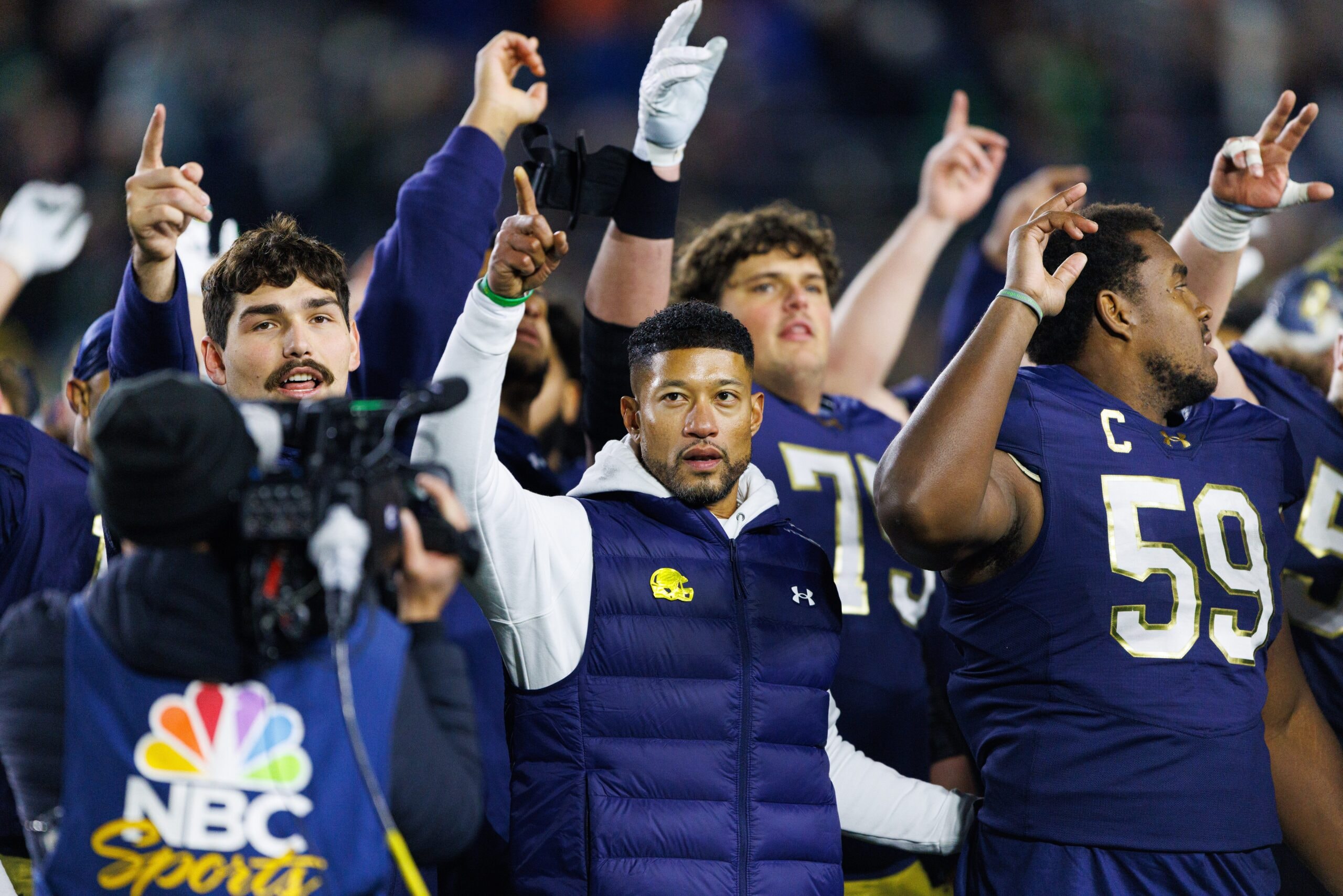
Notre Dame re-enters the College Football Playoff conversation as a No. 4 seed projection for 2026
After a 2025 snub that Notre Dame publicly resented, the Irish are being framed as a top-6 program in 2026, with the case built on quarterback continuity, returning receiving options, and elite projected defensive continuity.
Notre Dame’s path to the 2026 College Football Playoff is being drawn with a blunt standard attached. In a preview framing the Irish as the projected No. 4 seed, the argument starts with what happened last season: Notre Dame did not make the 2025 Playoff, and the final spot reportedly came down to a debate between the Irish and Miami, with Miami advancing instead.
Under the 2026 format described in the preview, the stakes are immediate. Automatic bids are tied to conference championship winners from the SEC, Big Ten, Big 12, and ACC. Notre Dame is also described as earning an automatic bid if it finishes in the top 12 of the final CFP rankings. In addition, the four highest-ranked teams in the final CFP rankings receive first-round byes, regardless of whether they win their conference championship. That combination, in turn, makes the “seed argument” feel like the central issue for any contender that is not guaranteed a league title.
The case for Notre Dame’s 2026 placement is built around personnel continuity. The preview projects quarterback CJ Carr as returning and “ready to make the jump” into a Heisman-contender tier, and it points to receiver continuity with Jordan Faison and Jaden Greathouse listed among those expected to return. For a program that has to operate as a national brand without being rooted in a conference championship automatic pathway, continuity at the skill positions is often the fastest way to close the gap between preseason expectations and postseason resumes.
Defensive continuity is where the preview places its strongest emphasis. It says ESPN’s returning production metrics rate Notre Dame’s defense No. 1, and it identifies returning contributors by name, including Drayk Bowen, Adon Shuler, and Jaiden (last name not fully shown in the available text). If that projection holds through fall camp and the regular season, it matters because the 2026 Playoff bracket gives teams that can control games and limit variance a clearer route to finishing among the top four seeds.
There is also a psychological component to the 2026 storyline. The preview emphasizes that Notre Dame “loudly disagreed” with its 2025 omission, so the 2026 standard is not merely about making the Playoff, but about making a case strong enough to avoid another debate-like selection outcome. In practice, that means Notre Dame cannot afford to be hovering on the edge of the top-12 cutoff described in the format and then hope for clarity later.
Still, projections remain projections. Even when returning talent is real, college football results are influenced by opponent strength, turnover production, health, and late-season form, none of which can be measured solely from offseason continuity metrics. What to watch next for Notre Dame is less about the label “No. 4” and more about whether the Irish can convert that projected defense and returning skill group into a top-tier resume by the time the rankings are set.
The broader title picture is shaped by how the top seeds are handled. Because byes go to the four highest-ranked teams regardless of conference championship outcomes, Notre Dame’s best-case 2026 route, as presented, is to finish with ranking separation early enough to avoid late uncertainty and to reach the postseason with home-field equivalent comfort in the first round.
For readers following the 2026 Playoff race, the Notre Dame storyline functions as a stress test for the system described. If the Irish deliver on the forecast of defensive dominance plus quarterback growth, they will illustrate that an offseason “disagreement” can be followed by a clean, committee-proof outcome. If they stumble, the 2025 debate may return as a recurring reference point for how the selection process evaluates elite teams that do not win league titles.
Why It Matters
- Seeding rules matter more in 2026 because byes go to the top four ranked teams regardless of conference championship outcomes.
- Notre Dame’s 2025 omission storyline increases pressure for immediate, committee-proof results rather than just “making it in.”
- Quarterback and receiver continuity can reduce volatility, which matters in a 12-team, ranking-driven path.
- If the defensive production projection is accurate, it positions Notre Dame to control field position and prevent late-season upsets that often derail Playoff qualification.
- The Irish will also be a key case study for how an independent path is evaluated when automatic bids depend on final rankings rather than conference championships.
Key Facts
- Notre Dame missed the 2025 College Football Playoff, and the final selection debate was described as coming down to Notre Dame and Miami, with Miami receiving the nod.
- The 2026 format described includes automatic bids for SEC, Big Ten, Big 12, and ACC championship winners.
- Notre Dame is described as receiving an automatic bid if it finishes in the top 12 of the final CFP rankings.
- The preview projects the Irish as the No. 4 seed and notes that the top four ranked teams receive first-round byes regardless of conference championship results.
- The preview projects CJ Carr returning and developing into a Heisman-contender tier.
- It also cites returning receiving options including Jordan Faison and Jaden Greathouse.
- On defense, the preview cites ESPN returning production metrics as ranking Notre Dame’s defense No. 1 and lists key returning tacklers such as Drayk Bowen and Adon Shuler.