
THE APEX TIMES
Notre Dame’s defense sets the tone early against Stanford with a forced fumble
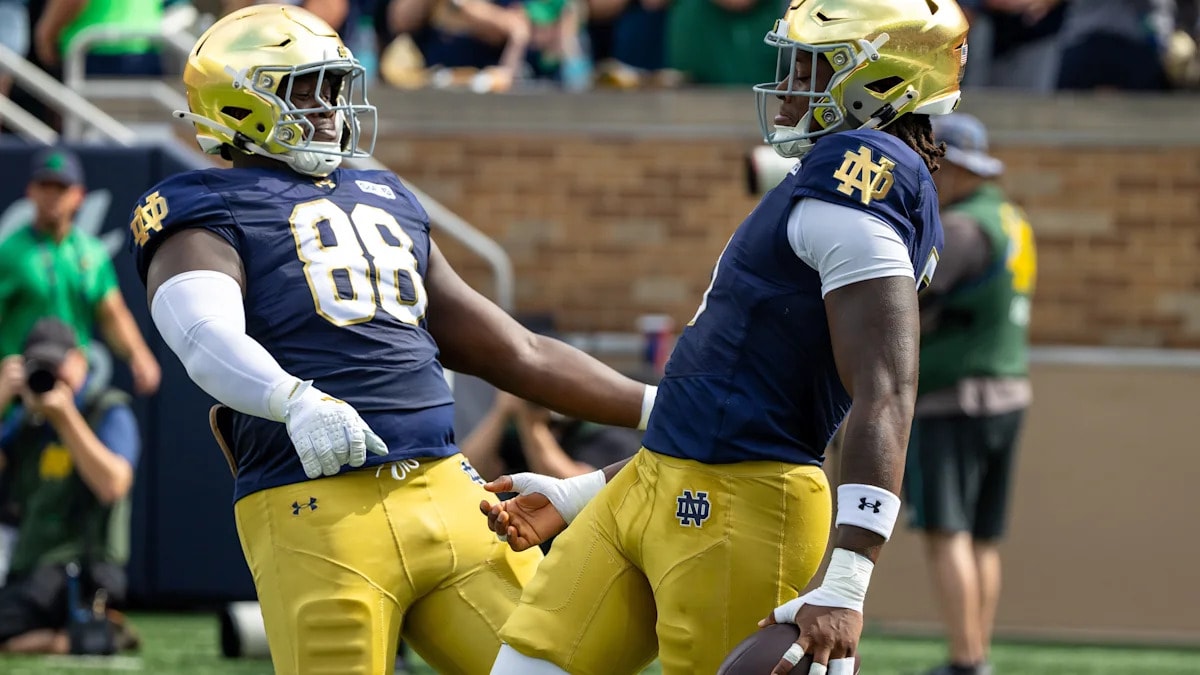
In the early moments of Notre Dame’s game against Stanford, the Fighting Irish defense made its presence felt by creating a turnover, giving the offense a short window to build momentum.
Notre Dame’s trip to Stanford featured a first-moment statement from the Fighting Irish defense. According to Yahoo Sports, Notre Dame started the game in a disruptive fashion by forcing a fumble as the Cardinal got their first real sequence of work, turning early pressure into a direct impact on possession.
Turnovers early in a college football game can change tempo in ways the box score will always understate. Even when a defense’s later series are more conventional, an early fumble forces the opponent to recalibrate, often shortening the “feel out” phase of an opening drive. For Notre Dame, the value is also structural, because it lets the offense operate with less delay and less cognitive load after special teams and scripted plays.
The broader context matters, too. Notre Dame’s defensive identity is built on forcing negative plays, and forcing fumbles is the kind of objective the coaching staff can emphasize across position groups. Creating a turnover does not automatically translate to points, but it changes the decision-making on both sides of the ball. Stanford has to recover emotionally and schematically, while Notre Dame can press forward knowing it already won a hidden statistical category.
The Yahoo report frames the early forced fumble as an early indicator of Notre Dame’s defensive impact against Stanford. That matters because Stanford’s attack is often most effective when it can establish continuity, protect the ball, and keep the opponent’s defenders from getting multiple swings at the quarterback or ball carrier. If Notre Dame’s early sequence disrupted rhythm, it can have downstream effects on how Stanford chooses routes, run fits, and pass protections for the remainder of the first half.
What is not confirmed in the available material is the specific form of the turnover sequence beyond the fact that a fumble was forced early. The opponent, the exact down and distance, and whether Notre Dame recovered the ball are not described in the accessible text of the report. Those details can matter for interpretation. A forced fumble recovered by the offense is a clean swing, while an unreadable recovery or a ball that went out of bounds can shift the value from “game-altering turnover” to “momentum pressure” without a possession change.
Still, the takeaway is clear: Notre Dame’s defense began the contest with aggression that immediately put the Cardinal on the back foot. That is the kind of opening that often helps a team settle in, particularly on defense, where confidence can snowball when the unit sees its physical traits produce tangible outcomes. For viewers, the next key question is whether Notre Dame can sustain that level of ball disruption beyond the opening sequence and whether Stanford can respond by tightening ball security on subsequent touches.
For the rest of this matchup, watch for two indicators. First, whether Notre Dame continues to generate additional forced issues, such as tackle-for-loss plays and additional ball-carrier disruption. Second, whether Stanford’s offensive play-calling becomes more conservative after the early fumble, which would suggest the early turnover carried psychological weight as well as technical value. If Notre Dame can keep the Cardinal from getting comfortable, this early sequence can become more than a highlight and instead a template for how the Fighting Irish plan to win.
Why It Matters
- A forced fumble early can shift the game’s tempo by shortening the opponent’s settling-in period.
- Turnovers force in-game adjustments, potentially affecting offensive play-calling and ball security priorities.
- Sustained ball disruption from a defense tends to reinforce offensive confidence by reducing “time to rhythm” for the offense.
- If the fumble changed Stanford’s risk tolerance, it can shape how both teams approach later red-zone and third-down situations.
Key Facts
- Yahoo Sports reported that Notre Dame’s defense forced a fumble to start the game versus Stanford.
- The early forced fumble was presented as the first clear example of Notre Dame’s defensive impact in the matchup.
- The report focuses on the opening sequence’s turnover impact rather than later defensive production.
- No additional verified details (such as who recovered the fumble or the exact down and distance) are included in the accessible material.