
THE APEX TIMES
Notre Dame’s Defensive Blueprint Under Marcus Freeman Bets on Returning Production
ESPN analyst Bill Connelly points to a defense that could be positioned to lead college football in production return, with the secondary and linebackers framed as the core pieces.
Notre Dame’s defense is entering the new season with a clear storyline and an equally clear pressure point: the program believes it can translate returning production into the kind of unit that wins championships. In a preview of the Irish defensive picture, ESPN analyst Bill Connelly’s production-based angle centers on the same theme head coach Marcus Freeman’s staff has emphasized since taking over the program’s defensive identity. If the unit performs as expected, Notre Dame has a real chance to be the nation’s standard-setter on that side of the ball.
The overarching claim is stark. According to Connelly’s assessment, Notre Dame and Freeman return the most production of any team in college football, and the benefit of that kind of continuity falls largely on defense. College defenses rarely get to count on every level returning experience, but the framing around Notre Dame is that the Irish aren’t rebuilding the system as much as they are reloading inside it, particularly with seasoned bodies spread across the depth chart.
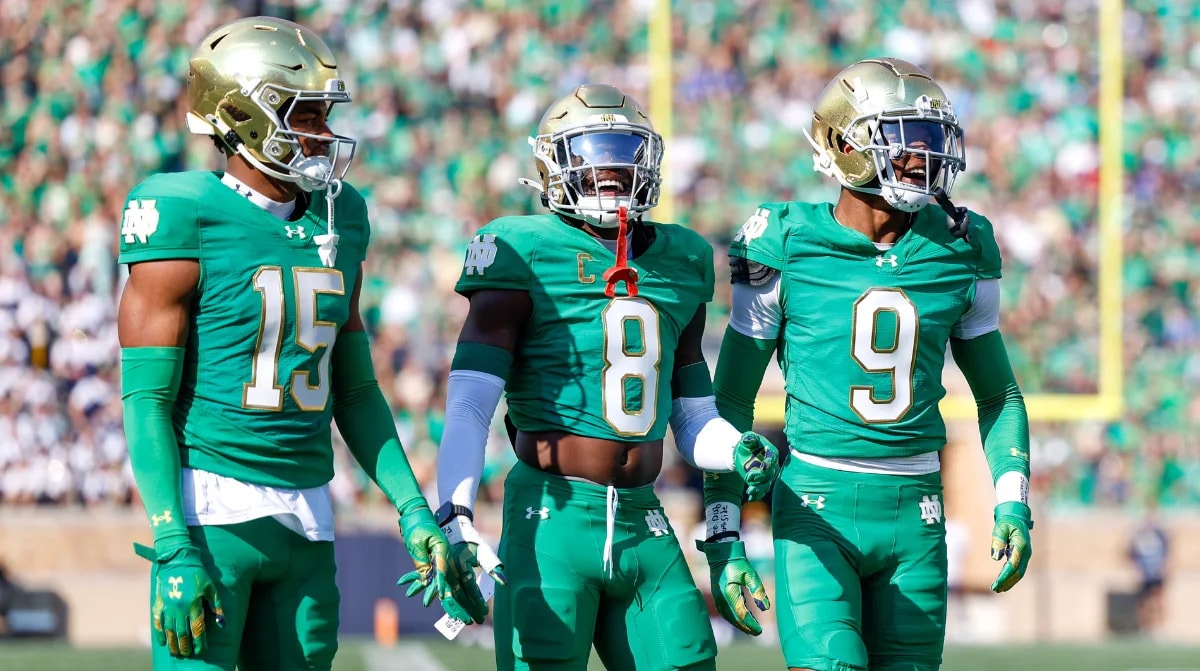
Within that production-return framework, the preview highlights two structural strengths. First is the secondary, described as capable of “lockdown” play. Second is the linebacker group, characterized as a veteran corps meant to stabilize the middle of the field and protect against both the run game and the short-to-intermediate passing lanes. Put simply, the argument for Notre Dame’s ceiling is not based on one flashy position. It is based on having enough continuity at the most decision-heavy parts of the defense to execute at a high level week after week.
Defensive coordinator Chris Ash returns with what the preview describes as a substantial collection of talent and experienced players across every level of the unit. That matters because Ash’s defense is designed to rely on pattern recognition and accountability, where defenders have to play fast without losing their assignment integrity. Returning production at multiple levels typically reduces the time needed for players to fully trust the system, particularly when opponents are tailoring their game plans to exploit the newest or most inexperienced matchups.
There is also an internal rhythm to the way Notre Dame is being set up. When a team returns the most production in the country, the “wait and see” window usually narrows, because the most meaningful outcomes are expected to happen immediately. For a program with Notre Dame’s national spotlight, that expectation lands hardest on defense. Offenses have variance, but defenses are measured by the ability to limit explosive plays, survive tempo shifts, and remain cohesive when the game tightens late.
Still, the preview is best read as a framework for what could be true rather than a guarantee. Production return and talent continuity do not eliminate the most common season variables, such as how quickly players handle adjustments from new offensive coordinators, how the unit manages situational football, and whether opponents can change the stress points through play design. In a sport where one third-down sequence can flip momentum, the difference between “best unit in the country” talk and that outcome is often execution at the margins.
For Notre Dame fans and conference watchers, the most important question will be whether the Irish can sustain the kind of pressure implied by the preseason description of a lockdown secondary and a veteran linebacker corps. If Freeman and Ash can pair that structural stability with consistent disruption, Notre Dame’s defense will not just be a strength, it will become a recruiting and reputation accelerant. The season’s early tests will indicate whether the unit is truly ready to carry the program’s championship expectations on a weekly basis.
Why It Matters
- If returning production converts into performance, it can reshape Notre Dame’s national defensive reputation quickly, affecting how opponents prepare week to week.
- A strong, cohesive defense typically shortens the margin for error in close games, a major factor in championship and bowl picture outcomes.
- The emphasis on the secondary and linebackers suggests Notre Dame could be particularly hard to exploit in both coverage and underneath run-pass gaps.
- Continuity under Chris Ash matters for in-season adjustments, especially as opposing offenses become more willing to attack tendencies once they identify them.
Key Facts
- The preview says ESPN analyst Bill Connelly believes Notre Dame and head coach Marcus Freeman return the most production of any team in college football.
- The story frames the defensive side as the main beneficiary of that returning production.
- It describes Notre Dame’s secondary as capable of lockdown play.
- It describes the linebacker group as a veteran corps intended to strengthen the middle of the defense.
- The preview credits defensive coordinator Chris Ash returning with a host of talent and experienced players across multiple levels of the unit.
- It argues that if the unit meets expectations, Notre Dame has a path to being the nation’s best defensive group.