
THE APEX TIMES
Oklahoma offensive line stays together after sluggish start, John Mateer says
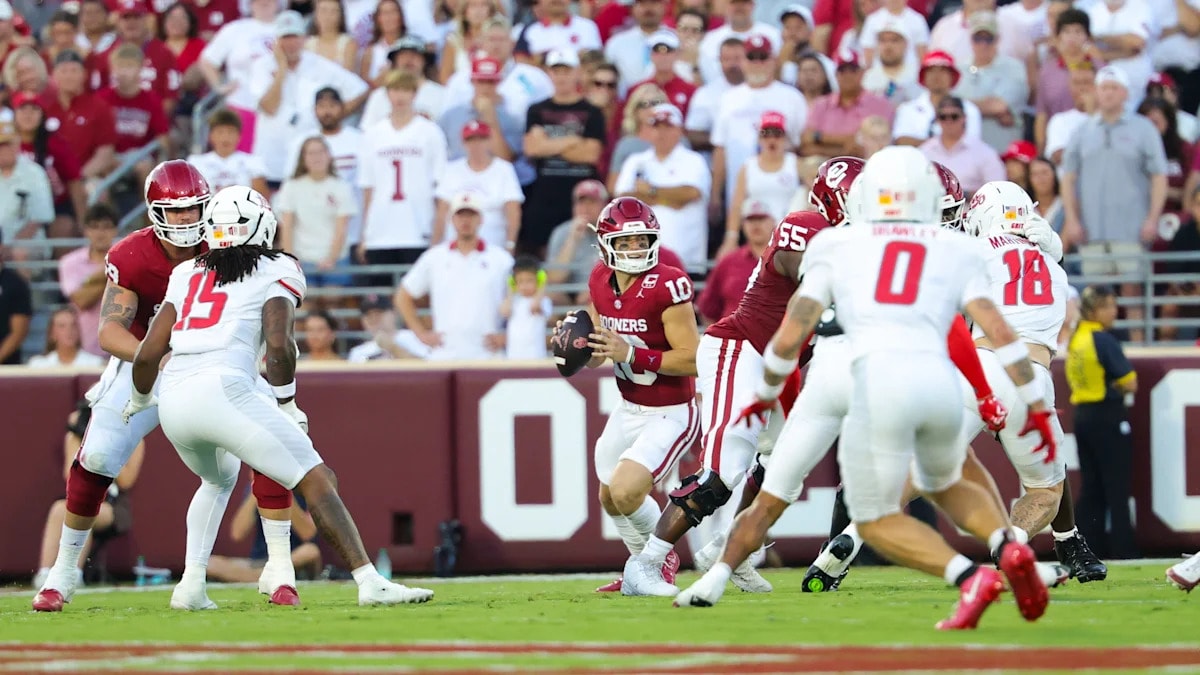
With the Sooners at 2-2, offensive line leader John Mateer is emphasizing cohesion and responsiveness as Oklahoma tries to keep its season from slipping away.
Oklahoma’s offensive line is trying to reset its approach after a sluggish start to the season, according to John Mateer, who pointed to unity along the unit as the Sooners look for a late-season correction. In a season that carries added weight for a program still chasing its next national championship moment, the Sooners’ early results have left the team’s path to meaningful postseason football narrower than many in Norman had hoped.
Mateer framed the immediate issue not as division inside the group, but as the need to respond more quickly once games get moving. He described the offensive line as remaining together, and said the group is “ready to get after it,” language that reads as a message aimed at tightening execution and addressing whatever was missing early in the season’s first stretch.
The stakes are magnified by the broader context around Oklahoma football. The Sooners’ preseason expectation included an attempt to end a long national championship drought, a wait that spans nearly three decades. While a program’s title picture is never decided this early, a 2-2 start is often the kind of record that forces teams to win consistently from this point forward rather than simply “improve” at a slow pace.
From a football standpoint, an offensive line is the stabilizing component that determines whether a quarterback can operate cleanly and whether the run game can generate sustained advantages. When an O-line starts slowly, it can ripple through third-down efficiency, red-zone play-calling, and overall play tempo. Mateer’s emphasis on togetherness suggests a unit that believes the fix is still within reach, even if the margin for error has shrunk.
Oklahoma’s immediate goal, then, becomes less about changing identity and more about consistency, especially in the early phases of games when first-half patterns are set. A slow start can test confidence across the offense, and offensive line leadership often becomes the mechanism for stopping that drift. Mateer’s message indicates the Sooners intend to treat the season’s uneven beginning as a temporary problem rather than a permanent ceiling.
The near-term question is what “ready to get after it” looks like on the field in measurable terms, particularly in how the line handles standard game stressors such as pass protection assignments and the ability to sustain blocks against live pressure. Oklahoma will also have to keep the offense from becoming reactive, since once play-calling turns strictly cautious, even good line play can struggle to create advantages.
For Oklahoma, the larger implication is that the program’s championship aspirations now depend more heavily on how quickly it corrects early-season performance. With the Sooners already at 2-2, the next few results will likely shape whether the team can build a second-half identity that supports postseason goals, or whether the season turns into a long climb from an early hole.
Why It Matters
- Offensive line cohesion can determine whether a team stabilizes the run game and protects the quarterback, especially during a season’s most consequential stretch.
- A 2-2 record increases the urgency for Oklahoma to win consistently, narrowing margin for late nonconference or early-league missteps.
- For a program with a decades-long championship drought, early execution often influences recruiting, confidence, and national perception.
- How quickly Oklahoma corrects early-season problems can define its playoff viability more than single-game storylines.
Key Facts
- John Mateer said Oklahoma’s offensive line remains united after a sluggish season beginning.
- Mateer characterized the unit as ready to respond and improve.
- The Oklahoma Sooners were reported to be at a 2-2 start.
- The report frames the season as an attempt to end Oklahoma’s nearly three-decade national championship drought.
- The piece centers on offensive line leadership and the team’s need to adjust after early results.