
THE APEX TIMES
Oklahoma State adds a goal-line handoff wrinkle for tight end Morgan McPhaul, producing a rushing TD
In a mid-week adjustment credited to coach Eric Morris, the Cowboys used a short-yardage handoff to tight end Morgan McPhaul to reach the end zone, a reminder of how OSU is trying to keep its goal-line attack layered.
Oklahoma State’s offensive staff made a late addition to its short-yardage plan, and tight end Morgan McPhaul cashed it in with a rushing touchdown. In a report published Oct. 13 by Yahoo Sports, the Cowboys’ goal-line handoff play to McPhaul was described as a mid-week addition to the playbook under coach Eric Morris, and the sequence is framed as a tangible example of OSU’s willingness to manufacture a new look inside the red zone.
The concept, as described in the report, centers on a tight end receiving a handoff in a short-yardage setting. That matters because goal-line sequences often come with tight windows and heavy defensive scrutiny, which tends to reduce the margin for “simple” play calls. By putting the handoff in the hands of a player whose typical role is closer to blocking and route running, OSU can force defenses to account for another layer of run-and-finish production rather than only quarterback or running back options.
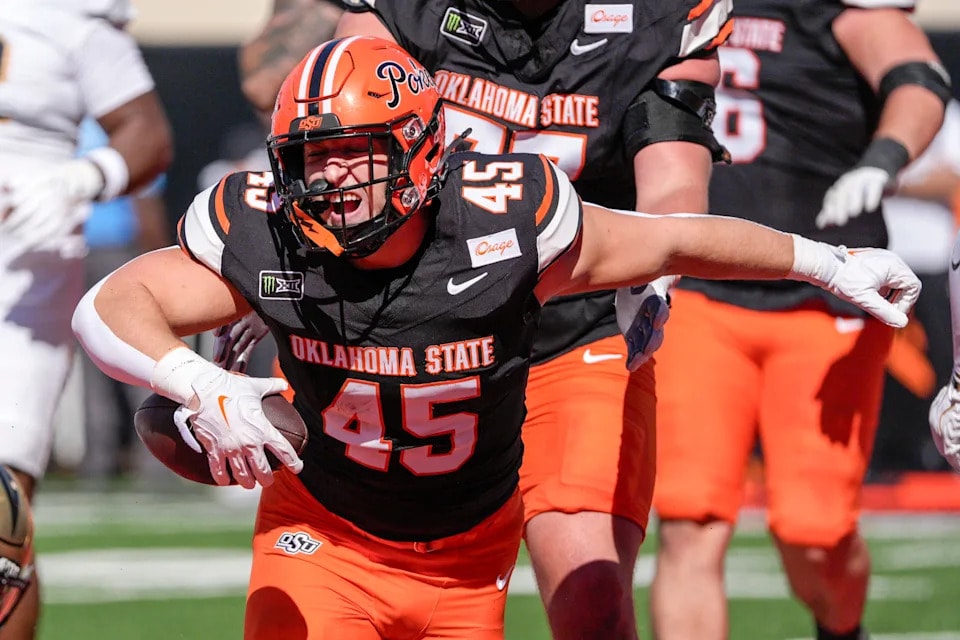
McPhaul’s touchdown came on a goal-line carry that the report categorizes as a rushing score. The game context associated with the story’s accompanying image indicates it occurred during OSU’s Oct. 10, 2026 contest against Central Florida at Boone Pickens Stadium in Stillwater, Okla. That timing places the play in a live, high-leverage moment rather than a practice-only setting, which is part of why it stands out as a “stock” item.
The underlying coaching point in a “stock report” format is not just that the tight end scored, but that the staff is actively tuning how it attacks from within a few yards of paydirt. Mid-week wrinkles typically come from isolating a defensive tendency from the previous week’s work and identifying a mismatch that can be exploited quickly. In this case, the reported addition puts McPhaul in a position to benefit from a designed exchange at the goal line, where leverage and numbers at the point of attack matter.
Tight ends can be especially useful in these packages because they combine size, in-line spacing, and physicality, which can help a team convert when defenders crowd the backfield. Even when the play reads as a “handoff to the tight end,” it still has to clear the first level of the defense and reach the second level with momentum. OSU’s staff crediting the call to Morris indicates an emphasis on developing execution beats, not only installing a new formation.
For Oklahoma State, the immediate takeaway is that the red-zone playbook is not static, and players beyond the traditional run-touch roles can be integrated into scoring looks. The longer view is that repeated use of similar action, even if opponents adjust coverage and alignment, can create cumulative pressure. If OSU continues to give McPhaul a role in short-yardage, defenses may have to widen their run fit responsibilities or risk falling behind on conversion attempts.
What to watch next is whether this goal-line handoff becomes a recurring part of OSU’s package or remains a targeted answer tied to the opponent. If it shows up again in subsequent red-zone situations, it would suggest the play has earned a spot as a reliable alternative when the first read is shut down. If it appears less often, it may still have served its purpose as a mid-week matchup tool that delivered one key score.
Why It Matters
- Goal-line touchdown plays often reveal how teams plan to convert when space disappears, and OSU’s use of a tight end handoff adds another conversion channel.
- Installing mid-week can be a sign the staff is actively countering opponent defensive habits, which can affect red-zone efficiency.
- If McPhaul’s rushing involvement expands, defenses may have to allocate more attention to OSU’s tight end room in short-yardage fits.
- A successful wrinkle can influence how opponents practice, potentially changing how they set their front and second-level defenders at the goal line.
Sources
Key Facts
- Yahoo Sports reported that Oklahoma State’s goal-line handoff play to tight end Morgan McPhaul was added to the playbook mid-week by coach Eric Morris.
- The play resulted in a rushing touchdown by McPhaul, described as a goal-line handoff concept.
- The story’s image caption associates the touchdown with OSU’s Oct. 10, 2026 game at Boone Pickens Stadium.
- The report frames the touchdown as an example of OSU’s short-yardage creativity and package adjustment.
- The article appears as an Oklahoma State “stock report,” emphasizing notable plays and coaching decisions.