
THE APEX TIMES
Oliver Marmol ejected after dispute over delayed ABS challenge in Cardinals-Twins game
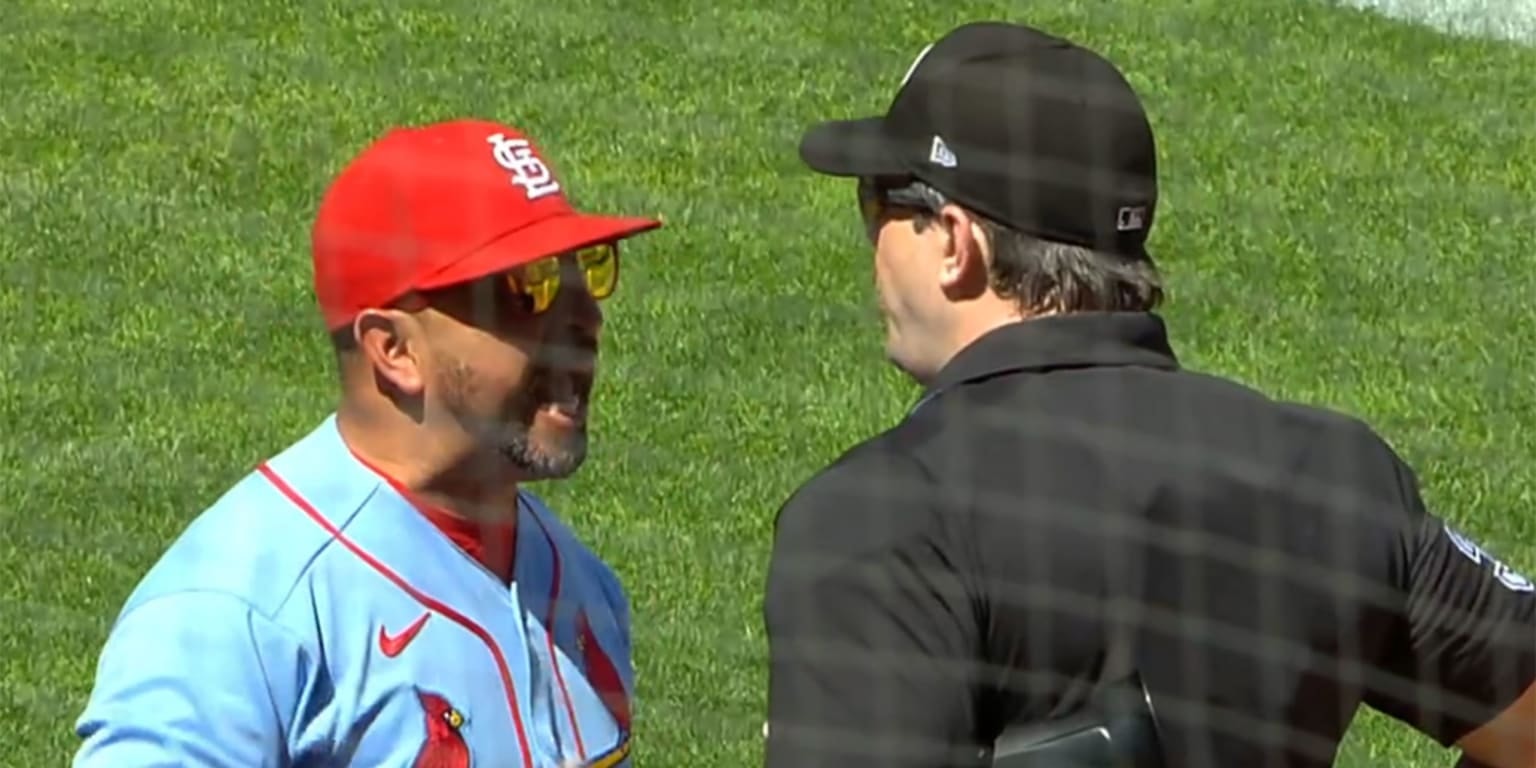
In the bottom of the eighth inning, Cardinals manager Oliver Marmol was removed after arguing a Minnesota challenge involving Austin Martin’s attempt to challenge a strike-three call under Major League Baseball’s automated ball-strike review system.
Major League Baseball ejection-and-review drama surfaced in Saturday’s Cardinals-Twins game in St. Louis when Cardinals manager Oliver Marmol was tossed after contesting how Minnesota’s Austin Martin’s automated ball-strike system challenge was handled. The incident came in the bottom of the eighth inning, a tense moment late in a game the Cardinals would eventually win 9-6.
According to the league’s automated ball-strike rules, if a batter, pitcher, or catcher wants to initiate an ABS challenge, the challenge must be started by tapping the player’s cap. That procedural step matters because ABS is not simply a replay review triggered at any time. It is a time-sensitive mechanism tied to when the challenge is initiated and confirmed within the framework MLB uses for automated calls.
In this case, the dispute centered on what was described as a delayed ABS challenge from Martin. The Cardinals argued that the challenge should not be allowed in that late window, and the back-and-forth between Marmol and the crew escalated quickly. The situation ended with Marmol being ejected during the at-bat sequence as the challenge outcome played out in real time.
ABS has become a regular part of the late-inning calculus, particularly when a close called strike can swing pitch counts, leverage, and the shape of an inning. While managers have always managed their attention around challenge windows, ABS procedures add an additional layer: it is not only about whether a team wants a review, but about whether the review is initiated exactly as the league’s rules require.
The Cardinals still managed to secure the victory despite the managerial ejection, which is often its own form of disruption for a team, pulling a manager from the dugout at a critical stage. For Minnesota, getting a challenge permitted, even after a timing dispute, reflects how the ABS review framework can create moments that teams either seize or lose based on the timing of a tap-and-confirm sequence.
What happens next for both clubs will likely hinge less on the ejection itself and more on how it affects game-management decisions in future plate appearances. With automated ball-strike reviews, teams often fine-tune when hitters and catching staffs are instructed to initiate reviews, especially during later innings where the margin for error in timing can be narrower.
For fans and observers, the incident is a reminder that ABS is not only a technology story, it is a procedures story. When disputes turn on timing and whether a challenge was properly initiated, the rulebook details can become as consequential as the pitch that triggered the review.
Why It Matters
- Late-inning disputes around ABS procedures can swing plate outcomes, inning momentum, and bullpen leverage.
- The ejection removes a key on-field decision-maker from the dugout at a time when game management matters most.
- For both teams, the incident underscores how timing and staff communication can determine whether a challenge is allowed.
- As ABS becomes more routine, procedural disputes may become a bigger storyline than individual pitch results.
Key Facts
- Cardinals manager Oliver Marmol was ejected in the bottom of the eighth inning during Saturday’s game versus the Twins.
- The ejection followed Marmol’s argument over a delayed automated ball-strike system (ABS) challenge.
- Minnesota’s Austin Martin was involved in the ABS challenge tied to a called strike-three.
- The Cardinals won the game 9-6.
- MLB’s ABS rules require a batter, pitcher, or catcher to tap their cap to initiate an ABS challenge.