
THE APEX TIMES
Patriots’ camp focus turns to Drake Maye-A.J. Brown chemistry as early practices wind down
New England is in the thick of training camp work, and the central storyline inside the building is the connection between quarterback Drake Maye and receiver A.J. Brown. On a day described as the 13th of 14 practice periods, Brown spent time on the field with the quarterbacks in no-contact gear as the team moved toward the end of its early-session sequence.
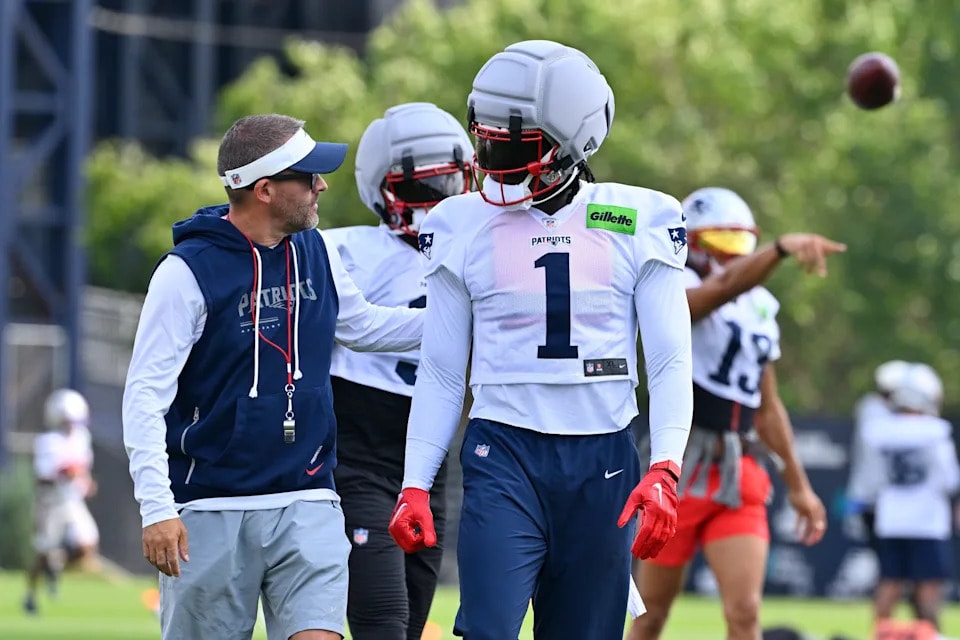
By the time the Patriots reached the 13th practice period of 14 in their early-training-camp stretch, the work taking place in front of the quarterbacks had a familiar theme: building chemistry with A.J. Brown. In a practice scene described from Gillette Stadium in Foxborough, Brown knelt with the quarterbacks while wearing red no-contact jerseys, a visual shorthand for how New England is treating the connection as an ongoing priority rather than a one-day event.
The backdrop matters for context. Brown’s addition to the Patriots has been framed by the team’s offseason objectives around pairing a high-impact receiver with a developing passer, and Maye’s growth has been closely tied to how quickly he can trust timing and route-based detail with a new No. 1-type target. Early camp is where those details tend to show up first, particularly in synchronization between quarterback cadence, throwing windows, and receiver leverage.
What Patriots fans will look for next is not only the completion count, but the repeatability of the process. Camp work is often structured to reduce variables, and no-contact sessions can emphasize rhythm, footwork, and communication without the unpredictability of full-speed collision. According to the practice description, Brown’s close time with the quarterbacks fits that pattern, suggesting the staff is continuing to invest in the quarterback-to-receiver relationship during the final stretch of the early-period block.
The Patriots’ offensive coaching staff also has a practical reason to keep chemistry at the forefront: a new pairing has to compress learning time. Routes and protections are built from assumptions, and those assumptions become reliable only after many reps. When a team brings in a receiver who is expected to play a leading role, the quarterback’s comfort can become a key driver of offensive identity, even before pads and game-speed tempo fully arrive.
There are, of course, limits to reading too much into any single day of early-camp observations. Training periods are numbered and sequenced, and reps can be influenced by the practice plan for that specific week. Still, the decision to feature Maye and Brown interactions during a no-contact window is consistent with teams prioritizing the foundation work before the schedule shifts toward higher intensity.
For what to watch moving forward, the simplest indicators will be how the timing looks across multiple sessions and how Maye responds in quick decisions when the route picture changes. If the chemistry is truly taking shape, it typically shows up as cleaner quarterback-receiver mechanics, quicker recognition on the fly, and more consistent execution of designed concepts rather than isolated highlight plays.
In the short term, New England’s camp narrative is anchored to whether Maye can translate early learning into confident throw-and-catch habits with Brown. In the long term, that same connection could influence how the Patriots structure targets, spread the field, and establish sustained offensive tempo as the rest of camp progresses.
As the team moves beyond its early-practice sequence, the next question is how quickly the same partnership can carry into later, higher-contact work. Chemistry is not a switch. It is a pattern that has to survive different coverages, tempo changes, and defensive wrinkles, and the Patriots are treating Maye and Brown as the foundation of that pattern.
Why It Matters
- Chemistry between a developing quarterback and a lead receiver can shape how quickly a team’s passing game becomes reliable.
- Early camp focus can determine how much the Patriots emphasize route timing, trust, and communication before higher-intensity work begins.
- A consistent Maye-to-Brown connection can affect the offense’s ability to stretch the field and sustain drives.
- As camp ramps up, the next step will be whether early no-contact timing transfers into game-speed execution.
- The Patriots’ offensive identity this season can hinge on how the team pairs quarterback growth with top-end receiving talent.
Key Facts
- The Patriots’ early training camp sequence described a 13th practice period of 14 before an early-session conclusion.
- The practice description includes A.J. Brown working closely with the quarterbacks during a no-contact segment, wearing red no-contact jerseys.
- The central reported focus of the piece is building chemistry between Patriots quarterback Drake Maye and receiver A.J. Brown.
- The setting given is Gillette Stadium in Foxborough, Massachusetts.
- The story frames the Maye-Brown connection as a top priority for New England as camp work continues.