
THE APEX TIMES
Rams restructure Myles Garrett agreement, reshaping Los Angeles’ future salary-cap picture
A reported contract rework alters how the Rams’ cap space is distributed across several seasons, including a sizable dead-money hit after the deal voids.
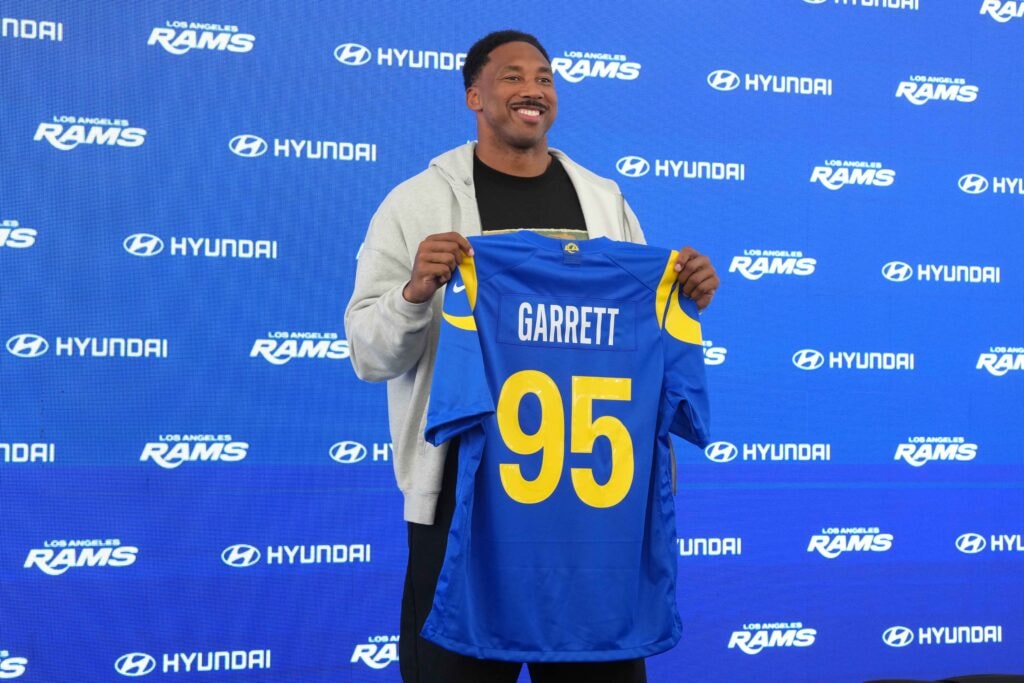
The Los Angeles Rams have reportedly reworked the contract structure tied to Myles Garrett, a move that changes how much cap space the team will carry and when the financial impact will arrive. While the reported adjustment is not being described as a new raise for Garrett, it shifts the timing of his cap charges, lowering the near-term number and pushing larger charges into later years.
According to Pro Football Rumors, the restructure sets Garrett’s 2026 cap charge at $8.84 million. That figure is expected to climb notably each season afterward, reaching more than $48 million in 2030, a year when the Rams’ books could become significantly more constrained if other roster decisions also demand space.
The reporting also points to a large dead-money obligation tied to the contract’s end. After the agreement voids in 2031, the Rams would face a reported dead-money charge of $39.91 million. In practical terms, dead money is a cap cost that remains even if a player is no longer on the roster, so the timing of void terms can matter as much as the annual cap charge.
The concept behind these restructures typically centers on the mechanics of cap accounting. Teams can redistribute value across the life of a contract to create room in one season, often with the tradeoff that future years are more expensive. In this case, the near-term 2026 figure appears to be positioned as an immediate benefit relative to what the later charges could look like.
It is also worth noting what is not established by the available reporting. The move is described as a rework of the trade pickup’s contract, but the details provided do not confirm whether the Rams and Garrett agreed to additional guarantees, a different contract length, or new money terms beyond the cap-structure changes. Without a team or league transaction filing referenced in the available material, the exact contractual mechanics remain best understood as a cap-accounting change rather than a broad new compensation headline.
For the Rams, this kind of long-view financial planning typically connects to roster-building priorities. Paying attention to 2026 through 2031 cap impacts can influence how aggressively Los Angeles pursues extensions, free-agent targets, and contract reworks for other key players, especially as the team manages multiple players whose deals may also have cap-accelerating features.
What to watch next is whether additional reporting or an official cap disclosure refines the picture for 2026 and beyond. If the Rams make further moves in the 2026 offseason, the annual charges and void-year cost will shape how much flexibility the team has for depth, pass-rush rotation, and secondary needs. The 2030 and 2031 figures, in particular, can become defining constraints for any larger roster reset that the franchise may be considering.
Why It Matters
- The restructure affects how much salary-cap flexibility the Rams have in the near term and later years.
- Rising cap charges in 2030 can limit how Los Angeles allocates resources to new deals or extensions.
- The reported 2031 dead-money cost can create a long-term cap anchor even if roster turnover occurs.
- Teams often use cap restructures to manage timing, which can influence broader roster strategy across multiple seasons.
Key Facts
- Pro Football Rumors reported that the Rams reworked Myles Garrett’s contract structure.
- Garrett’s reported cap charge for 2026 would be $8.84 million.
- The cap charge is reported to rise each year after 2026, topping $48 million in 2030.
- After the contract voids in 2031, Los Angeles is reported to face $39.91 million in dead money.
- The reporting characterizes the change as a contract rework, not a stated raise for Garrett.