
THE APEX TIMES
Rays’ efficiency question answered: defense, baserunning and contact all doing the heavy lifting in Game 5
Tampa Bay turned another middle-infield defensive moment in the ALCS, while its offense kept producing without relying on homers. The result is a club one win from the World Series.
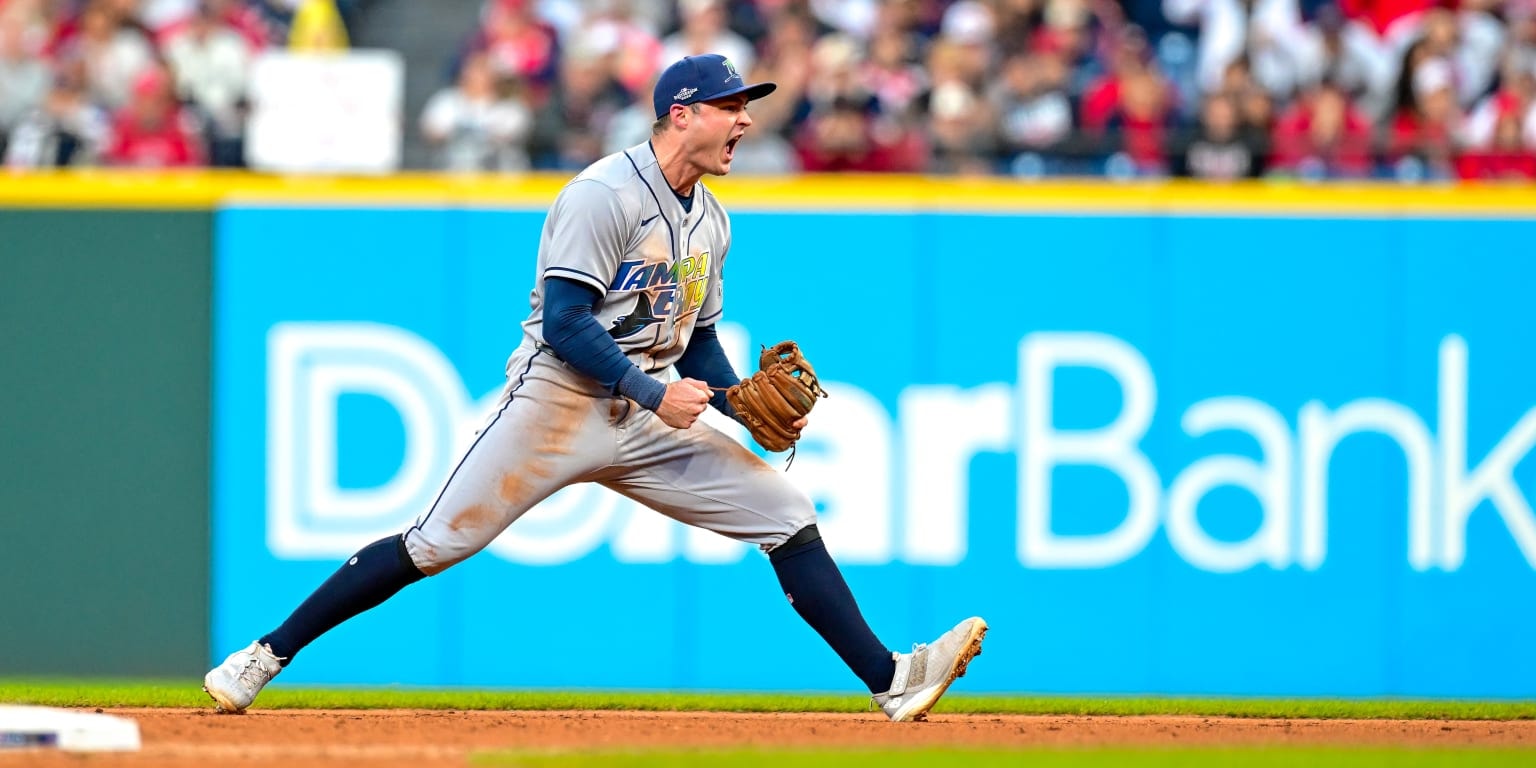
The Rays’ postseason push in the ALCS is being powered less by power and more by how consistently they erase opponents’ chances, starting with the field and extending to the way they manufacture innings. In Game 5 at Cleveland, Tampa Bay’s middle infield executed a key sequence that helped turn Jose Ramirez’s hard-hit grounder into an out.
A ground-ball effort from Rays second baseman Ben Williamson began the damage, as he dove to his right, made the catch, and threw to first for the first out of the bottom of the fourth. The next batter, Chase DeLauter, also hit a ball Williamson ranged back for, and Williamson made the second-out throw as the Rays kept the inning small.
That defensive momentum aligned with a broader theme Tampa Bay has emphasized throughout the series: methodical, repeatable offense and disciplined baserunning. Across Games 4 and 5, the Rays went 23-for-71 (.324) and hit 8-for-21 (.381) with runners in scoring position, while also going 6-for-6 on steal attempts in the ALCS entering Game 5.
The Rays’ style stands out even in a postseason landscape that often rewards slugging. Through this point in the ALCS, the Rays had hit two home runs, and neither one was described as decisive: Cedric Mullins’ Game 1 solo shot came in a loss, and Yandy Diaz’s two-run homer in Game 4 functioned as added insurance in a larger win.
On the pitching side, Tampa Bay’s control was part of the overall equation, with the Game 5 spotlight on Drew Rasmussen quieting Cleveland’s bats in a series that had already shifted in Tampa Bay’s favor. Still, Tampa Bay’s profile here is not a one-factor formula. The club also points to the way it limits opponents once they’re in and tries to force the game into manageable innings through positioning and out-making.
The Rays’ approach is reflected in how they produce outs on the kind of contact baseball is built on. Taylor Walls, Williamson and Richie Palacios each ranked below the 20th percentile in range during the regular season, yet Tampa Bay was described as turning 80% of straightaway ground balls into outs in the postseason entering Game 5, a conversion rate that supports the idea that their positioning and fundamentals are finding outs reliably.
With Tampa Bay one win away from the World Series, the central question is effectively answered by what the Rays are doing every day: playing defense that turns hard contact into routine outs, taking bases aggressively, and continuing to win with contact-driven offense that does not require frequent home runs to make the difference.
The ultimate test for the Rays, as the picture develops, is whether their “magicians” efficiency can keep neutralizing Cleveland’s chances without relying on the long ball as a crutch. For now, the ALCS has tilted toward Tampa Bay’s repeatable process, not a single breakout moment.
Why It Matters
- The Rays’ path to the World Series is being defined by repeatable in-game execution, not just power, which can change how opponents plan baserunners, swing decisions, and late-inning approaches.
- Middle-infield defense is functioning as a series-long leverage point, turning hard-hit balls into routine outs and shrinking Cleveland rallies.
- Tampa Bay’s offense has shown it can produce with contact and situational hitting, which helps in a postseason format where managers can quickly reduce the margin for error.
- If Tampa Bay can sustain this model while controlling baserunning and limiting damage in the field, the AL pennant picture becomes about consistency over spectacle.
Sources
Key Facts
- In Game 5 of the ALCS, Rays second baseman Ben Williamson made a diving stop and throw to first on a Jose Ramirez grounder for the first out of the bottom of the fourth.
- Williamson also made the second-out play after Chase DeLauter hit a ball his way as he ranged back to fire to first.
- Across Games 4 and 5, the Rays went 23-for-71 (.324) and 8-for-21 (.381) with runners in scoring position.
- Through Game 5, the Rays were 6-for-6 on steal attempts in the ALCS.
- Through the ALCS entering Game 5, the Rays had two home runs, with neither described as decisive to the outcomes of the games in which they appeared.