
THE APEX TIMES
Red Auerbach’s coaching tree still shapes the NBA, 60 years after his last game
History Month spotlights how Arnold “Red” Auerbach’s approach to coaching and roster building has echoed through generations of professional basketball leaders, long after his own sideline career ended.
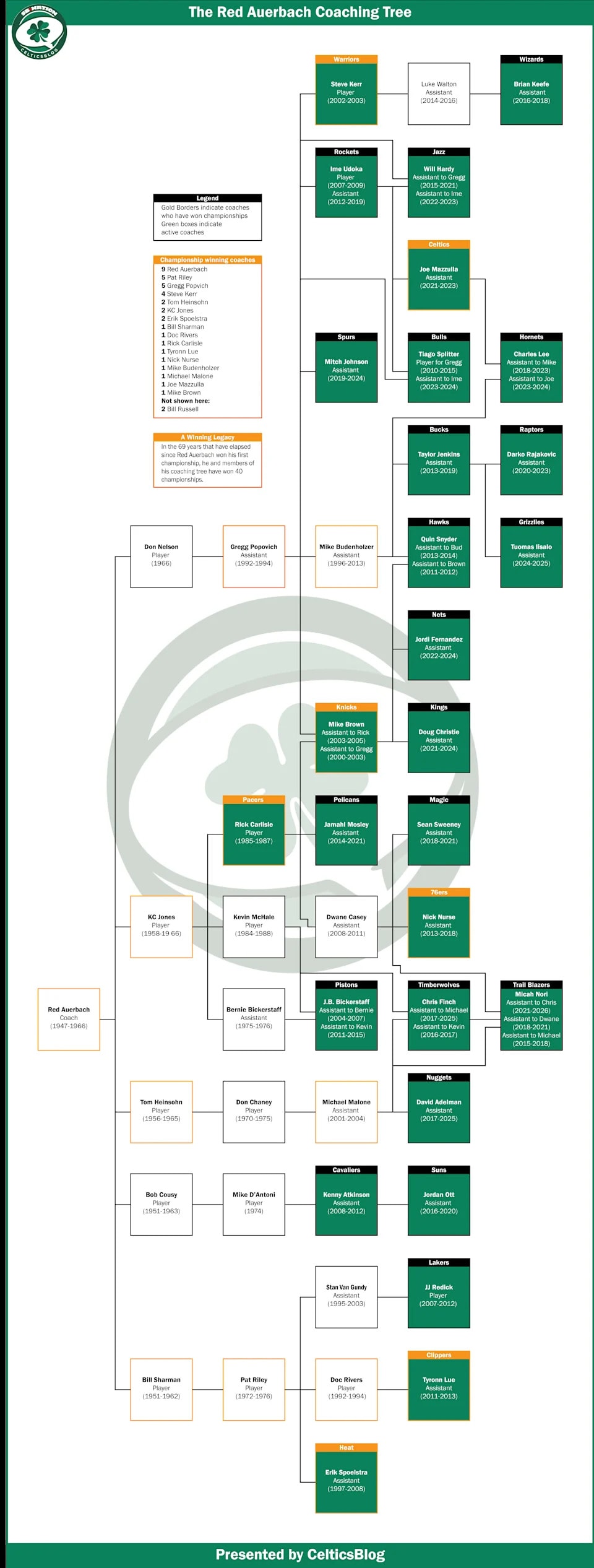
Arnold “Red” Auerbach’s coaching tree remains one of the most studied lines of influence in NBA history, according to a History Month feature from Yahoo Sports. The piece frames Auerbach as an outlier in impact, arguing that among the NBA’s more than 350 head coaches, no single figure has exerted greater influence on the shape of professional basketball.
The basic idea behind a coaching tree is straightforward, if not always measurable. Coaches teach not only systems but also organizational habits, talent-evaluation instincts, and decision-making styles. Over time, assistants and mentees carry those traits to their own head-coaching jobs, creating a network of basketball DNA that can show up in the way teams defend, develop players, and handle roster construction.
In Auerbach’s case, the feature emphasizes durability. It notes that it has been roughly 60 years since he coached his last game, yet his “tree” is still described as strong. That kind of longevity matters in the NBA because professional basketball changes quickly, from offensive priorities to defensive schemes to the way front offices build through the draft, trades, and free agency.
What makes Auerbach’s influence stand out, as described by the article, is breadth. The NBA has had a long turnover of head coaches, with the league surpassing the 350 mark in the number of individuals who have held the role. The feature’s central claim is that Auerbach’s reach among those coaching generations is unmatched, meaning the mentorship line has kept resurfacing in new head-coaching staffs rather than fading with time.
Auerbach is also closely associated with a particular standard of basketball organization, where strategy is only part of the job. The feature’s argument implicitly ties coaching to broader team-building principles, suggesting that his methods were not just about X’s and O’s but about how to think like an operator in a league where star talent and role player fit can decide seasons. When an organizational philosophy is adaptable, it tends to survive staff turnover, which can help explain why his coaching tree is presented as still “as strong as ever.”
Still, it is worth noting what this particular feature provides and what it does not. The visible description emphasizes the historical thesis, but the excerpt available here does not list specific coaching descendants, assistants, or a ranked accounting of Auerbach’s most notable protégés. Readers looking for a deeper map of the coaching tree may want to treat the Yahoo framing as a guided interpretation rather than a complete ledger of every branch.
For fans and teams, the practical takeaway is not that one coach’s philosophy can remain unchanged forever, but that Auerbach’s approach appears to have scaled across eras. As NBA rosters and styles continue to evolve, the ongoing presence of his influence, as argued in the feature, suggests that organizations will keep returning to the same core questions: how to identify talent, how to turn players into consistent contributors, and how to build a staff culture that can outlast the head coach.
Why It Matters
- A coaching tree is one way to understand how team-building philosophies migrate across the league, even as rosters and playing styles change.
- If Auerbach’s influence is as broad as described, it helps explain why certain organizational patterns keep reappearing in NBA coaching staffs over multiple generations.
- The argument also reinforces that the head coach role is not only tactical, but a managerial position that shapes development pipelines and decision-making habits.
- For teams scouting coaching candidates, the continued discussion of Auerbach’s reach adds context to what leadership traits are likely to persist.
Key Facts
- A History Month feature highlights Arnold “Red” Auerbach’s coaching tree and describes it as still strong roughly 60 years after his last game as a coach.
- The feature states the NBA has had over 350 head coaches in league history.
- It argues that no individual has exerted greater influence on the shape of professional basketball than Auerbach among that population.
- The story is framed around the long-term idea that coaching influence can spread through assistants and mentees into later head-coaching roles.