
THE APEX TIMES
SB Nation survey points to Julian Champagnie as a key on-court lift for the Spurs
A new look at lineup impact suggests San Antonio’s second unit could lose its edge if Julian Champagnie does not remain in the starting mix.
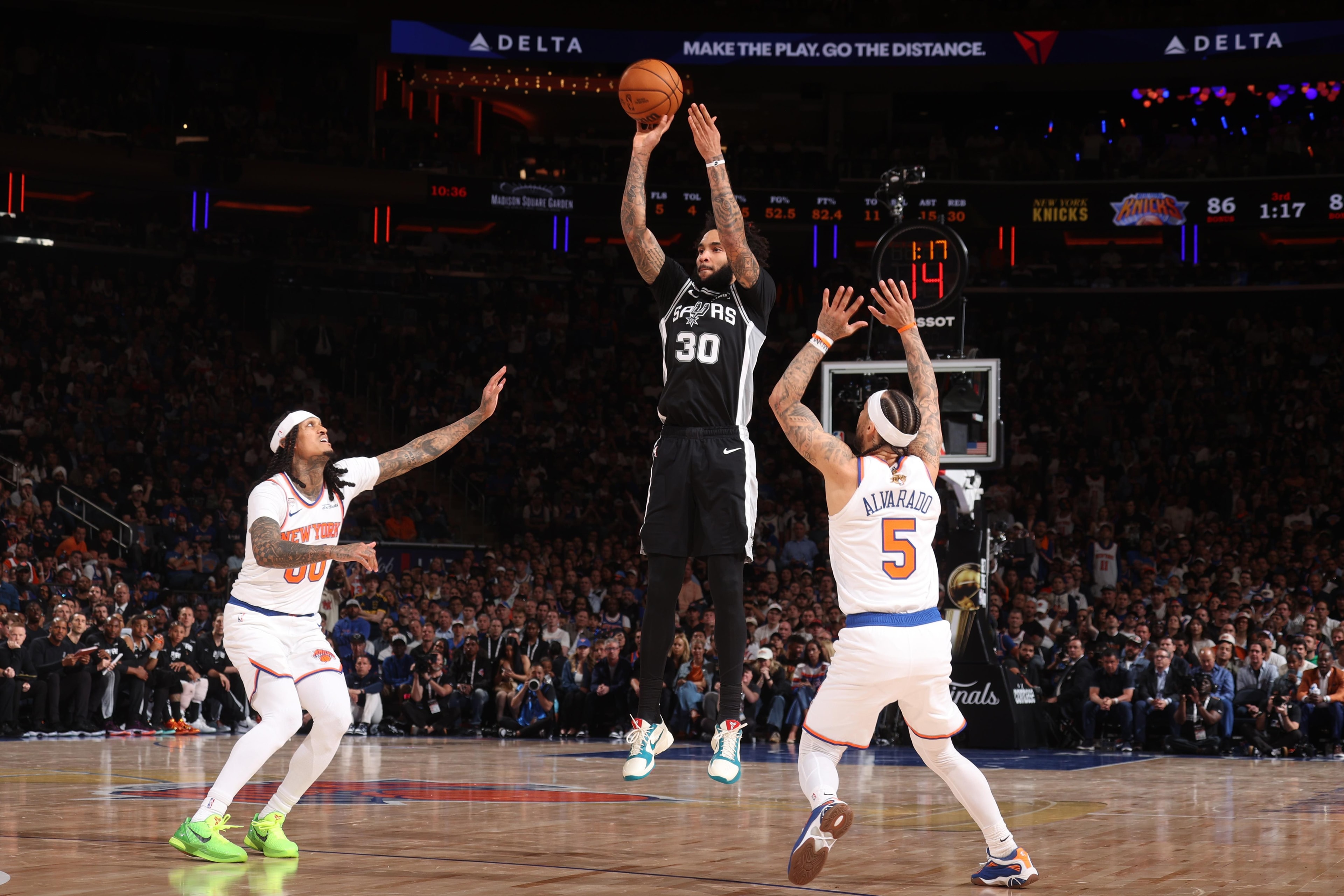
The latest SB Nation survey highlights an on-court difference that has become hard to ignore for the San Antonio Spurs: when Julian Champagnie is on the floor, the team plays differently than when he sits. In the findings, the Spurs’ net rating rises noticeably with Victor Wembanyama on the court, and it also improves in a meaningful way with Champagnie. The conclusion is simple, if not always comfortable for roster planning, Champagnie should keep his starting spot.
The survey’s framework is built around comparing team performance when specific players are on the court versus off it. That is not the same as proving a player “caused” a turnaround, because basketball is always shaped by matchups, game scripts, and who else is available in a rotation. Still, the results stand out because they point to two distinct Spurs indicates last season. Wembanyama’s on-court impact shows up clearly, and the same type of “who changes the numbers” effect appears with Champagnie as well.
Wembanyama’s on-court effect in the survey is described as a net rating increase of 15.7 points when he is on the court compared to when he is off it. The writer notes that this kind of result feels intuitive, because Wembanyama’s influence can affect multiple possession types at once, from rim protection and defensive switching to the spacing effects that alter how opponents defend the half court. The survey’s broader value is not that it discovers Wembanyama, but that it uses the same method to identify a second player who consistently changes the Spurs’ profile.
That second player is Champagnie, the wing who has often been viewed as a role rotation piece rather than a centerpiece. The survey’s takeaway challenges that framing by arguing that Champagnie’s presence is connected to an improvement in San Antonio’s performance when he is actively playing. The fact that the survey calls out his role alongside Wembanyama suggests San Antonio might have something more stable than “minute-by-minute replacement value” in its starting lineup.
Champagnie’s case matters for a Spurs team that has been trying to define its identity around Wembanyama’s generational impact while still building a supporting cast that can withstand defensive adjustments. A team can survive stretches without its top talent, but it becomes more difficult when opponents can press the supporting group’s weaknesses and force the offense into inefficient, low-quality looks. If Champagnie is truly one of the more reliable contributors to a net rating lift, that strengthens the argument for keeping him in the games’ highest-leverage lineup windows.
At the same time, the survey format does not settle the deeper coaching question of what that starting role should look like. A player can be impactful because of what he does in isolation, because of the teammates he plays with, or because of the specific defensive assignments he draws. The Spurs could still explore different starting configurations, but the survey implies that removing Champagnie from the starting group would be a bigger gamble than simply shuffling minutes. If the numbers move in the wrong direction, the problem would not just be a lack of effort or execution, it would be the loss of a pattern that shows up across on-court versus off-court comparisons.
What to watch next is whether training-camp and early-season usage reflect the survey’s logic. If Champagnie continues to receive starting reps, it would be a vote for continuity in how San Antonio wants to attack and defend with its top units. If the Spurs experiment with shifting him deeper into the bench rotation, the immediate question becomes whether the lineup’s net impact is preserved through different combinations, or whether the drop-off suggested by the on-court/off-court comparison becomes visible in live games.
Overall, the survey offers a reminder that modern roster evaluation is not only about who has the biggest highlight package. For the Spurs, the more practical question is which players reliably change the team’s statistical footing. According to the findings, Champagnie belongs in that conversation, and the argument for him as a starter rests on more than perception. It rests on the Spurs’ performance profile when he is on the floor.
Why It Matters
- If Champagnie’s on-court impact is tied to his starting role, it affects how the Spurs build lineup stability around Wembanyama.
- Starting-lineup decisions influence matchup planning, especially for wings who can stretch defenses and defend multiple roles.
- A reliable net-rating contributor in the first unit can help the Spurs avoid offensive droughts when opponents adjust to Wembanyama.
- The Spurs’ rotation identity could be shaped as much by supporting-wing usage as by the franchise centerpiece.
- The early-season question is whether the team’s actual rotation matches the survey’s argument for continuity.
Key Facts
- A new SB Nation survey evaluates lineup impact by comparing team performance when specific players are on the court versus off it.
- The survey reports Victor Wembanyama’s on-court impact as a 15.7-point net rating increase compared to when he is off the court.
- The survey also identifies Julian Champagnie as a second player whose presence correlates with a meaningful improvement for the Spurs.
- The article’s main conclusion is that Julian Champagnie should keep his starting spot.
- The analysis frames the result as an on-court performance difference rather than a definitive cause-and-effect proof.