
THE APEX TIMES
Spurs’ wings and spacing plan have made Victor Wembanyama harder to contain in the NBA Finals
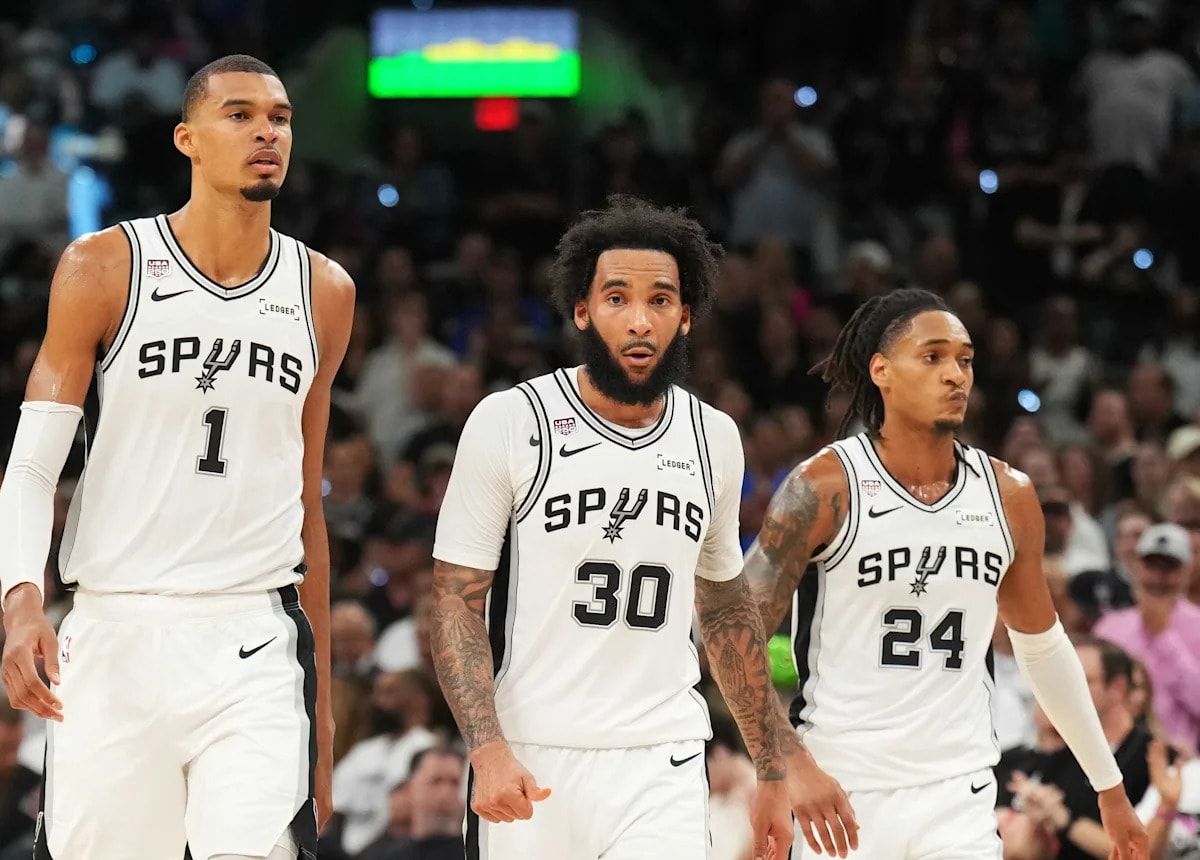
San Antonio’s Finals surge has relied less on headline scorers and more on how its wing rotation generates spacing that changes what defenders can do around Victor Wembanyama.
In the NBA Finals, the most noticeable part of Victor Wembanyama’s game is the way he erases space near the rim. The less visible part is how San Antonio’s wings and spacing help make that rim pressure pay off without forcing the Spurs to live exclusively at the line or at the paint. In Game 3, San Antonio found a way to keep its stars from getting trapped by choosing the right angles, and then by turning outside looks into a threat that pulled defenders away from their most comfortable positions.
The statistical picture is modest, but the strategic point is sharp. During the Finals, the Spurs have been converting just over 11 three-pointers per game at a 32.1% clip, numbers that would have landed near the bottom of the regular season. That matters because it reframes what “good shooting” looks like for this roster. The goal is not to suddenly become an elite jump-shooting team. It is to produce enough perimeter respect that Wembanyama can be more consistent as a target, a screener, and a finisher rather than a decoy for collapsing help.
A focal point of that approach has been how San Antonio functions when Devin Vassell and Julian Champagnie share the floor. According to a Yahoo Sports breakdown, there was an early oddity in the Finals: through the first seven games, there was never a contest in which both shooters finished better than 40% from deep together. In other words, the defense had a simple way to respond. When the wings were cold at the same time, Oklahoma City’s aggressive, funneling defensive style (as described in that analysis) had less reason to hesitate, because the middle of the floor could be protected without conceding too much.
Game 3 offered a different look at what the Spurs can do when their spacing lines up. Yahoo reported that San Antonio’s wing play and decision-making, especially with Vassell and Champagnie on the floor together, were “quietly changing” how the matchup is viewed, because defenders cannot ignore the sidelines while still trying to take away Wembanyama’s preferred options. New York Post coverage of the same game emphasized Wembanyama’s baseline control, noting he started with two dunks and ultimately torched New York for 32 points on 11-of-18 shooting, along with eight rebounds, six assists, and three blocks.
New York’s defensive answers in Game 3 also showed what the Spurs’ plan is trying to prevent. When Wembanyama’s touch inside leads to help, the wing rotation has to convert that attention into open looks or organized secondary pressure. In the fourth quarter, the Knicks missed nine straight three-point attempts at one stretch, per the Post, and the Spurs’ closing line included key free throws. The broader implication is that the Spurs do not have to hit every outside shot to win a version of the game where Wembanyama’s gravity keeps help defenders moving, and the wings keep the rotation honest.
San Antonio’s lineup is also built for this kind of “two-player spacing” moment. In this series, the wings have effectively become part of the infrastructure around Wembanyama: they handle perimeter assignments, they prepare to punish over-commitment, and they help determine whether New York can double without giving up clean counters. Yahoo’s analysis specifically tied the improvement in Game 3 to personnel choices and spacing decisions intended to maximize Wembanyama’s presence.
There is still no guarantee that the Spurs’ perimeter production will become consistently efficient. If Vassell and Champagnie are both below their normal output in the same game, the Knicks’ defense can again take more risks and protect the paint. But the first thing to watch next is not just whether the wings make shots, it is whether their presence changes who New York can send at the ball and where it can live with giving up room to operate. If San Antonio keeps extracting even average efficiency from its wing spacing, Wembanyama’s finals run becomes less of a matchup problem for one player and more of a series problem for the Knicks’ entire defensive rotation.
Why It Matters
- This is a Finals matchup where attention to spacing can matter more than pure shooting efficiency, because Wembanyama’s rim pressure forces help decisions.
- The performance of Vassell and Champagnie together affects how much the Knicks can collapse in the middle, which in turn changes the difficulty of Wembanyama’s touches.
- If San Antonio can make New York defend the wings consistently, it stretches the Knicks’ rotation and increases the quality of Wembanyama’s second actions.
- Conversely, if both wings are cold in the same game, the Knicks can revert to riskier paint defense and take away Wembanyama’s most efficient looks.
Sources
Key Facts
- San Antonio’s Finals three-point volume has been just over 11 attempts per game at a 32.1% clip, which would be near the bottom of the regular season.
- A Yahoo Sports analysis attributes the Spurs’ matchup shift to wing spacing and decision-making designed to maximize Victor Wembanyama’s effectiveness.
- Yahoo reported that through the first seven Finals games, Vassell and Champagnie had no game where both finished better than 40% from three together.
- In Game 3, New York Post coverage said Wembanyama scored 32 points on 11-of-18 shooting with eight rebounds, six assists, and three blocks.
- The same Game 3 report described San Antonio’s wing-and-rotation closing sequence, including a stretch where the Knicks missed nine straight threes in the fourth quarter.
- The New York Post also reported that Stephon Castle played a key late role, including two free throws with 6.8 seconds remaining.