
THE APEX TIMES
St. Louis Cardinals’ prospect lens gets a new test as minor-league run scoring surges in 2026
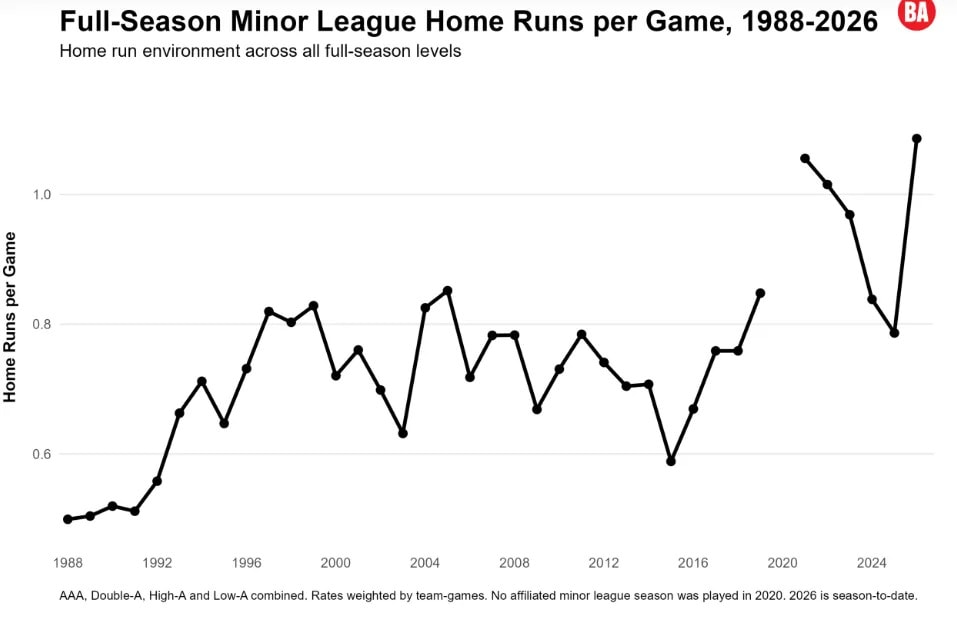
A rise in homer production and batted-ball value across Triple-A and Double-A has pushed baseball analysts to revisit how much “power indicators” should count when looking at St. Louis Cardinals prospects.
Major League Baseball’s farm system has always been a place where prospects are separated into two buckets: those who can carry skills against professional pitching, and those whose numbers mostly reflect league-wide conditions. In 2026, a run-scoring surge in the minors, marked by higher homer rates and improved batted-ball expected value, is forcing evaluators to ask a harder question for organizations like the St. Louis Cardinals: are elevated prospect power marks a true report, or simply the product of a livelier environment?
In a recent analysis for Yahoo Sports, the argument is not that scouts should ignore the minors. It is that the “translation” work becomes more complicated when the baseline changes. When home-run rates and batted-ball EV jump at the same time, traditional process markers that used to be relatively stable, such as isolated power, can start to overstate how close a hitter is to becoming a consistent MLB slugger.
The Cardinals, like every club, rely on multiple layers of evaluation. Watching swing quality and approach is still the first filter. But front offices and player-development departments have increasingly layered in data tools that attempt to quantify contribution, including batted-ball quality and other run-estimation approaches. The Yahoo piece frames the current problem as a scoring inflation issue, where elevated “contributors” in prospect scoring models could be rewarded more for identifying a player who looks productive right now, rather than one whose skills are most resilient to changing run environments.
A key detail in the analysis is the emphasis on the minors’ homer and batted-ball EV jump and what it means for prospect scoring frameworks that hand out added points to players who demonstrate repeatable impact. If the environment boosts most hitters, then a prospect’s rank can rise simply because the league context shifted. That does not make any individual prospect less legitimate, but it does mean evaluators must adjust how they interpret the magnitude of the output.
The article points to one of the season’s “surprising breakouts,” specifically calling out performance tied to power. Even with that focus, the thrust is broader than one name. Evaluators have to differentiate between a hitter who has made a mechanical or approach-driven leap and a hitter whose results are riding the same wave as everyone else. The practical takeaway is a recalibration of skepticism: strong power contact matters, but its meaning is best measured against both opponent quality and year-to-year run environment shifts.
For Cardinals fans, the timing is consequential. St. Louis does not build its MLB roster solely on raw minor-league lines. It targets tools that are more stable across levels, then maps them to a path into the big leagues. If minor-league scoring is unusually elevated in 2026, the Cardinals’ internal and external debate around which prospects are “next” could become more data-intensive, with additional emphasis placed on contact quality, plate discipline, and how a player’s batted-ball profile holds up relative to league peers.
Looking ahead, the most important test is whether the power indicators persist as the season progresses and as prospects reach higher competition. If the homer and batted-ball EV surge is mostly context-driven, many players’ standout outputs will fade when they face tighter MLB-adjacent pitching. If instead the standout power is skill-driven, the same players should show both elite contact and the ability to generate high-value balls even when league scoring normalizes.
Why It Matters
- Prospect rankings can become less comparable across years when the minor-league run environment shifts dramatically.
- Higher homer and batted-ball EV rates increase the risk of overvaluing output without enough adjustment for league context.
- Teams like the Cardinals may need stronger evidence that a power breakout is skill-based before projecting near-term MLB impact.
- Watch to see whether power indicators persist when prospects face tougher pitching and when environmental factors normalize.
Sources
Key Facts
- The analysis argues that a run-scoring increase in the minors during 2026 is changing how prospect power should be evaluated.
- It cites big jumps in minor-league homer rates and batted-ball expected value as central to the problem.
- It frames prospect scoring models as being influenced by “elevated” credit for identifying contributor-level production on a platform.
- The piece highlights that one breakout performance in 2026 has been particularly notable for power among Cardinals prospects.