
THE APEX TIMES
Suns face a familiar question: can last season’s breakthrough hold up?
A new breakdown from Yahoo Sports argues Phoenix’s path to another strong year will not be automatic, despite real talent and a tougher league-wide adjustment period.
The Phoenix Suns are entering a new season with one thing most contenders do not get to ignore, they already surprised people. Last year, they did not merely win games, they made plenty of opponents feel like the contest would not stay comfortable for even one night. That kind of momentum can be intoxicating, but it can also create a harder-to-sustain standard. In a recent Yahoo Sports piece, the argument is that the Suns may be better on paper, yet still vulnerable to disappointment if a few key elements do not click the way they did in the first run.
The first concern is what happens when opponents stop treating you like a mystery. When a team “catches the league off guard,” scouting gets sharper fast, matchups get more specific, and in-game adjustments become more immediate. For Phoenix, the challenge is converting talent into repeatable advantages rather than relying on the element of surprise that can fade once everybody has seen the playbook once. In practical terms, it means turning moments into structure, and structure into consistency, especially late in games when teams stop experimenting and start hunting tendencies.
The second issue, as framed in the analysis, is whether the Suns’ identity is stable enough to survive even minor dips in execution. Good teams can have stretches where shots do not fall, possessions get messy, or the offense becomes a half-step slower. When that happens to a roster that built momentum with rhythm, the risk is that the offense begins to feel like a collection of good ideas instead of one cohesive system. The Suns have the kind of star power that can still create advantages on its own, but the question is whether the rest of the roster consistently supports that creation across different styles of defense.
The third concern revolves around the “easy win” perception reversing itself. In the piece, Phoenix is described as becoming a 48-minute battle for opponents, win or lose. That is a strong reputation, but reputation can become a cage match for any team that does not keep finding ways to separate. If Phoenix’s margin for error shrinks, games can become more fragile, and even a good team can be pulled into too many swingy outcomes. The Suns would be looking to avoid the pattern where their best nights are brilliant, but their baseline nights are not quite enough to keep the results steady.
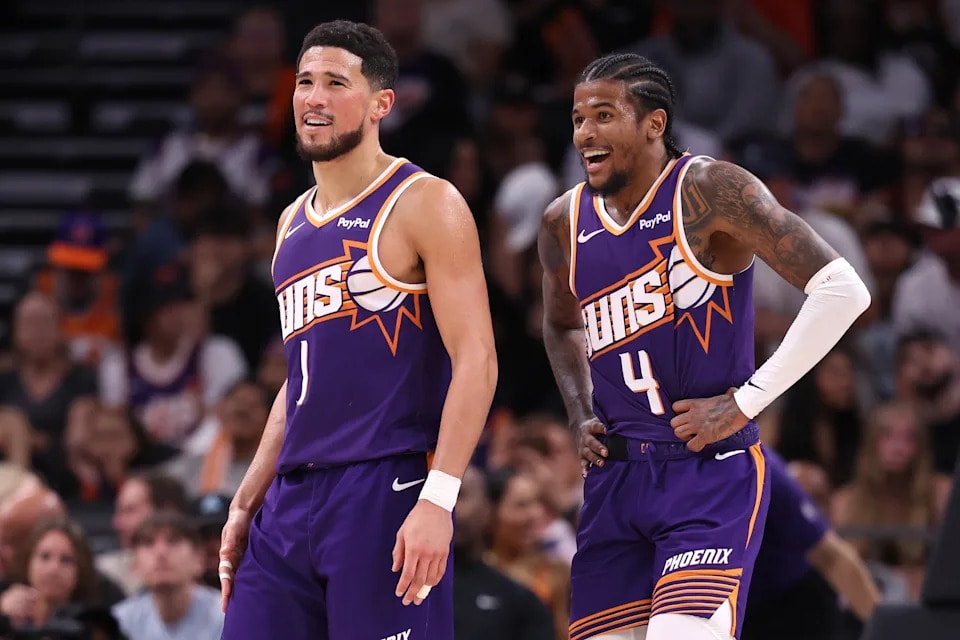
Devin Booker and Jalen Green are referenced in the coverage photo context, a reminder of the mix of scoring gravity the Suns lean on. Still, the essence of the Yahoo Sports argument is less about any single player and more about how the whole team functions when the league’s attention is fully on Phoenix. The NBA is unforgiving to teams that cannot quickly counter the counters. Even high-end rosters face the reality that the hardest part of a surprise season is the second one.
There is also a built-in caveat with any “could disappoint” framing. Early-season narrative can be shaped by expectations, and expectations can be shaped by last season’s highlight reel. A team does not need to dismantle everyone to be successful, but it does need to manage the difference between playing like a contender and simply having contender-sized talent. For Phoenix, that distinction will show up in how quickly they answer when games do not start smoothly and when opponents tighten the first half possessions.
What to watch next is whether Phoenix can keep its brand of pressure and pace without sacrificing shot quality and defensive order. Pay attention to whether their offense looks organized on nights when opponents make it difficult early, and whether the team’s rotations and matchup decisions remain decisive rather than reactive. If the Suns can turn last year’s breakthrough into dependable habits, the disappointment question loses power. If not, the league will be ready for them the way it was not ready the first time.
Why It Matters
- If Phoenix’s repeatability slips, the team’s path through the regular-season standings can tighten quickly in a league where midrange results become playoff-deciding.
- Opponent scouting and in-game adjustments typically intensify against teams that previously “caught the league off guard,” raising the bar for Phoenix’s game-to-game consistency.
- A drop from “battle-ready” to “baseline-inconsistent” can turn close games into a pattern, which matters for seeding and playoff matchups.
Key Facts
- Yahoo Sports published an analysis titled around three reasons the Suns could disappoint this season.
- The piece describes the Suns’ prior season as one in which they surprised opponents and made games into long, hard contests.
- The central theme is whether Phoenix can translate more talent into being “actually better now,” not just better in flashes.
- The coverage references Devin Booker and Jalen Green in the accompanying Phoenix team imagery context.
- The argument is framed around adjustment by opponents and repeatability of performance, not a single roster transaction.