
THE APEX TIMES
The Utah Jazz’s 2026-27 Season Gets a Forecast-By-Comparison Treatment
A new piece looks for lessons by pairing this Jazz iteration with past teams that turned momentum into surprise, using history as a lens for what comes next.
A common preseason question in the NBA is how to separate projection from pattern. On Oct. 13, 2026, Yahoo Sports published an attempt to do exactly that for the 2026-27 Utah Jazz, framing the team’s outlook through historical parallels rather than purely forward-looking analytics or roster-only debate.
The article’s premise leans on a literary idea attributed to the French writer Alphonse de Lamartine, who in 1854 described history as something that teaches even the future. The intent is not to claim the Jazz will repeat a specific past run, but to ask what kinds of teams, with what kinds of trajectories, were able to overperform relative to expectations. In other words, the comparison exercise is meant to spotlight repeatable organizational and on-court patterns, not prophecy.
Within that framework, the piece examines three historical teams that it argues can “teach” something about this year’s Jazz. The comparison approach is essentially scenario-based: if a team at some point in its season had certain features or overcame common obstacles in a particular way, then the Jazz’s present build can be evaluated for similar traits.
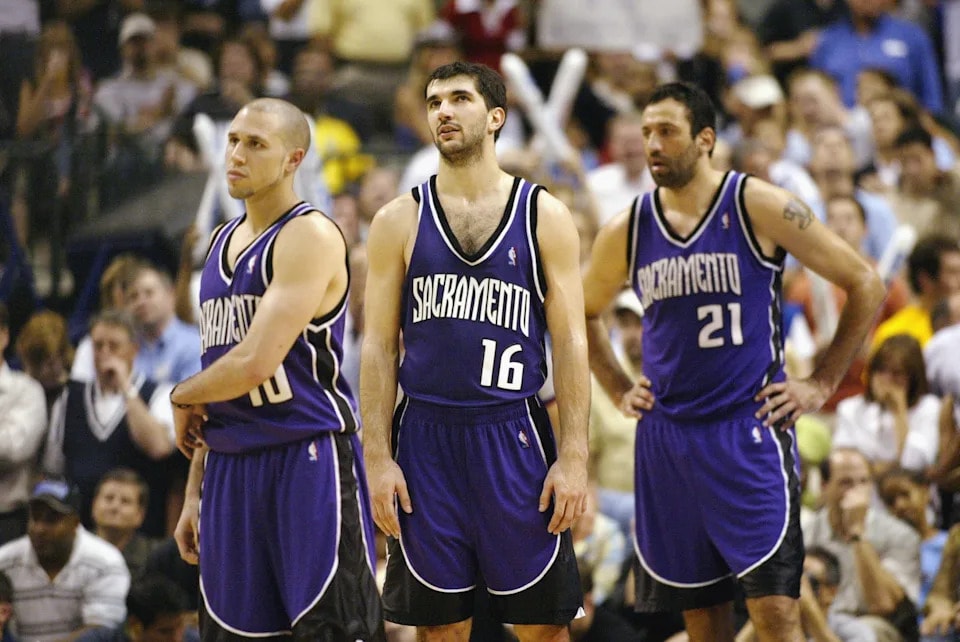
One of the historical examples is clearly tied to the late-season intensity and playoff volatility of the early 2000s Sacramento Kings. The accompanying image highlights the Kings in the Western Conference semifinals against the Dallas Mavericks in 2003, with Sacramento portrayed in the moment after being upset in a game-five loss. Even without treating that specific series as a direct blueprint, the selection fits the article’s broader emphasis on teams that lived in the pressure zone, where rotations tighten and roles become sharper.
The logic behind using playoff context is straightforward. When games shorten and error margins shrink, teams reveal whether their strengths are stable enough to withstand adjustments. A comparison model like this tries to answer whether the Jazz’s strengths for 2026-27 are built on sustainable foundations, such as shot quality in half-court offense, reliable defensive structure, or bench contributions that keep the floor balanced, or whether those strengths are more fragile when the opponent dictates pace and matchup terms.
At the same time, the exercise has clear limits. History can show what once worked, but it cannot control for era differences in pace, spacing, officiating emphasis, roster construction norms, or even the style of coaching that governs game management. A team’s “equivalent” is usually more cultural than mechanical, more about the type of season than the exact statistical profile.
What to watch next, then, is not whether Utah matches a specific former record or replicates a playoff bracket storyline, but whether the Jazz show the qualities the article is trying to isolate. If the Jazz’s season reveals consistent performance under late-game pressure, improved cohesion across rotation tiers, and the ability to hold leads or close gaps against opponents that game-plan in real time, those would be indicates that the historical comparison is identifying meaningful parallels. If instead the Jazz repeatedly struggle once scouting matures and matchups tighten, the analogy may still be interesting, but its predictive value would fade quickly.
Why It Matters
- Preseason projections often struggle to capture how teams perform once scouting adjusts, so comparisons to past playoff-context teams can sharpen expectations.
- The approach encourages evaluation of team traits that are more stable than raw roster talent, such as resilience, role clarity, and late-game execution.
- It sets a narrative test for Utah’s season: whether the Jazz’s strengths hold up under pressure as the year progresses.
Key Facts
- Yahoo Sports published an Oct. 13, 2026 story focused on identifying historical equivalents for the Utah Jazz’s 2026-27 outlook.
- The piece uses the idea attributed to Alphonse de Lamartine that history can teach the future as the guiding theme.
- The article says it examines three historical teams to draw lessons relevant to the Jazz’s projected season.
- A featured visual references the 2003 Sacramento Kings during the Western Conference semifinals against the Dallas Mavericks.