
THE APEX TIMES
UCLA vs. USC becomes women’s basketball’s signature Los Angeles showdown as the title window shifts
With UCLA carrying the weight of a national championship and USC determined to keep pace, the UCLA-USC series is being framed as the sport’s “in-town” standard-bearer. The rivalry, already intense, now carries a bigger share of momentum for the Pac-12 successor era.
UCLA and USC women’s basketball are increasingly being positioned as the sport’s most consequential matchup within one metropolitan area, an evolution that matters because it compresses championship-level pressure into a rivalry game rather than a postseason abstraction. The framing coming out of the latest conversation around the two programs begins with UCLA’s status as a defending national champion, and it treats the next chapter as one defined by who can keep reloading without losing identity or defensive structure.
The backdrop for UCLA’s standing is straightforward: the program has already proven it can win at the highest level, and it is now trying to maintain that standard through roster renewal. In the rhetoric surrounding the matchup, the idea is less about a single star carrying the moment and more about depth, coaching continuity, and the ability to replace production without turning the team into something else entirely.
USC, for its part, is cast as the natural counterweight in the same geography and recruiting footprint. When a rival is recruiting and developing with championship aspirations, it changes the meaning of every possession, because the game becomes a referendum on how quickly each program is moving on from what came before. USC’s pursuit is particularly relevant in a sport where the distance between “competitive” and “championship” can be measured in a few specific roles, guard play, rim protection, and late-game shot-making.
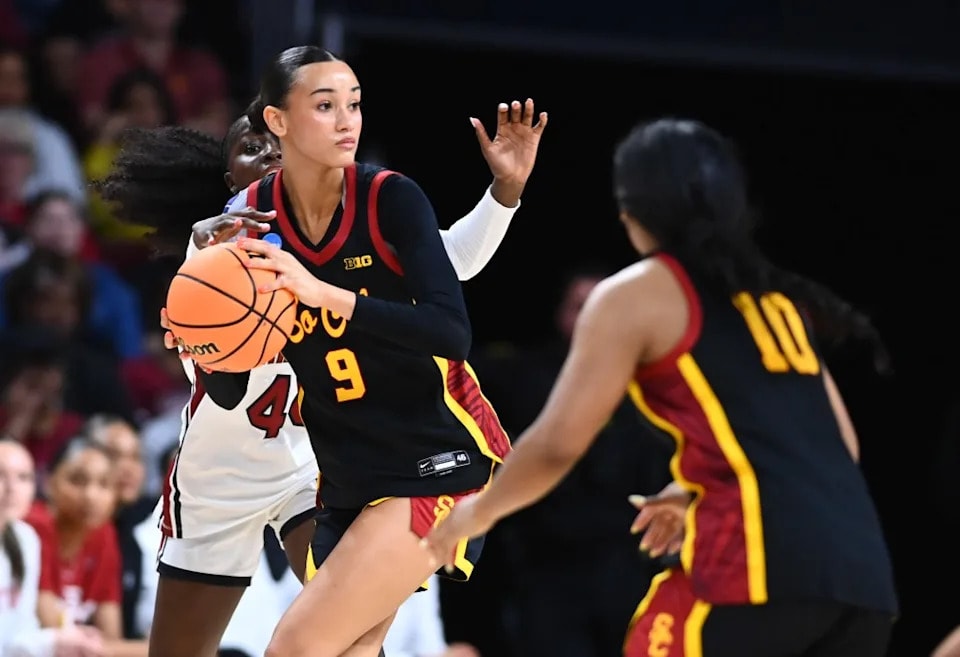
Part of what gives the UCLA-USC story extra texture is how teams from this part of the country often represent a blend of talent sourcing and style. USC has been linked in coverage to Jazzy Davidson, a Trojan guard who appeared in NCAA tournament action earlier in the year, illustrating that the program’s identity can be built around backcourt play as well as frontcourt toughness. The implication of using a player like Davidson as a reference point is that USC’s best ceiling is tied to what it can generate in high-leverage sequences, especially when games tighten.
Still, it is important not to overread framing into guaranteed outcomes. Rivalry-game coverage tends to simplify the picture into a clean contrast, and the realities of the season will depend on execution, health, and how quickly new pieces fit. Without a confirmed set of specific on-court matchups, projected rotations, or game-by-game scheduling context tied directly to this item, the most responsible takeaway is that the rivalry is being treated as a “title-shaping” matchup rather than a traditional regional marker.
What to watch next is how each team handles the first real tests that force them to translate offseason ambition into in-game details. For UCLA, that means whether it can sustain championship habits while integrating fresh contributions. For USC, the question is whether its roster construction and on-court decision-making can consistently match a team that has already proven it belongs at the top of the sport.
For fans, the immediate appeal is obvious, two elite programs in the same city with a shared sense of stakes. For the league, the broader appeal is that the rivalry can function as a reliable stage for showcasing the sport’s top qualities, high-pressure defense, shot creation under fatigue, and the ability to win when the pace slows and mistakes become expensive.
Why It Matters
- A rivalry with title-level stakes can shape how both programs are perceived nationally, beyond conference play.
- If UCLA sustains championship performance, the UCLA-USC game becomes a measuring stick for the entire contenders tier.
- USC’s ability to respond to UCLA’s reloading narrative will influence recruiting posture and development narratives.
- When two programs share the same metropolitan spotlight, their matchups can become a consistent barometer for the sport’s style and competitive balance.
Key Facts
- The rivalry between UCLA and USC women’s basketball is being highlighted as the most significant “in-town” showdown.
- UCLA is described as the defending national champion in coverage tied to the rivalry.
- The framing emphasizes UCLA’s roster renewal and continued competitiveness after winning a title.
- USC is presented as the program positioned to challenge UCLA’s championship momentum in the same geographic market.
- A USC player, Jazzy Davidson, is referenced via imagery connected to the program’s NCAA tournament participation earlier in 2026.