
THE APEX TIMES
UFC 330 in Philadelphia tees up two very different title-fight tests for Makhachev, Garry and Dern, Robertson
Islam Makhachev vs. Ian Machado Garry and Mackenzie Dern vs. Gillian Robertson are both penciled as championship set pieces, but the matchups set contrasting problems in striking, grappling, and pace.
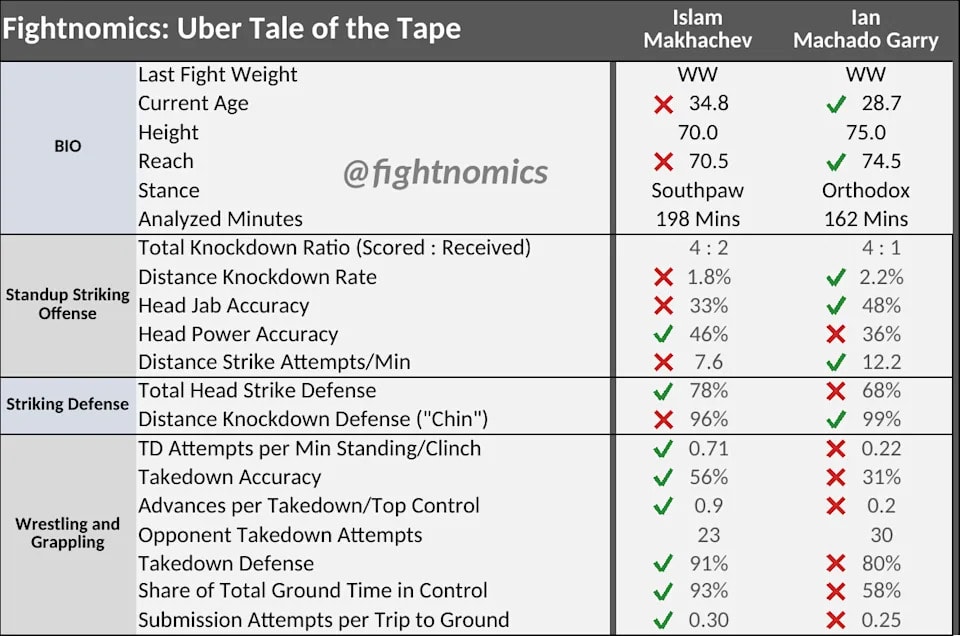
UFC 330 arrives in Philadelphia with a rare dual-title format, and the main-event landscape splits neatly into two stylistic equations. On Saturday, Islam Makhachev takes on Ian Machado Garry in a welterweight title fight dynamic that blends high-end takedown wrestling with top-tier positional grappling, while the co-main title pairing features Mackenzie Dern against Gillian Robertson, a matchup where submission threat and mat control could dictate every exchange.
From a pure tactical standpoint, the night is structured to reward different skills. The Makhachev-Garry matchup is framed as an all-around fight in which each fighter’s best attributes lean on mat success, but the threat vector begins on their feet. Makhachev’s record has long been tied to converting momentum into control, while Garry’s reputation has been built around longer-range striking and the ability to pressure opponents into uncomfortable entries. How often either man can dictate where the fight takes place may matter as much as which fighter scores more clean moments.
The co-main title fight sets a contrasting tempo. Dern, known for a submission-first approach and an ability to threaten even while positions are still developing, faces Robertson, whose own game has been built to neutralize danger by contesting space and working for her own routes to control. When Dern is in legitimate danger zones on the back half of exchanges, her ability to create submissions can force constant defensive adjustments. For Robertson, the strategic task is to limit the time Dern spends in the kinds of positions that turn scrambles into finishing opportunities.
A major thread running through pre-fight analysis around UFC 330 is the idea that the matchup paths are similar in some respects, even when the stylistic outcomes differ. The coverage highlights a “strikers and grapplers” lens used to map how fighters tend to do damage across phases, pointing to the notion that each of the title challengers brings a specific combination of attack types. In other words, the fights may not be identical in look, but they are anchored in comparable skill categories: striking exchanges that carry wrestle-and-control implications, and grappling sequences that can shift the fight’s momentum quickly.
What makes the Philadelphia card especially watchable is that both title fights appear to be built for meaningful swing factors rather than one-dimensional plans. With two championships on the line, the margin for error shrinks. Even small sequence wins, such as one successful takedown or one defensive stand that prevents a positional advantage, can have outsized impact because a title environment typically increases urgency and reduces the willingness to “feel things out” for long stretches.
There are, however, limits to what can be concluded from pre-fight breakdowns and analytical frameworks alone. The same statistical or matchup models that suggest a path to value cannot account for late-game execution, corner adjustments between rounds, or the unpredictable way momentum changes over five-minute intervals. For viewers, the clearest way to judge the night’s two title arcs will be to watch which fighter consistently forces the fight into their preferred problem set, and then to track whether that pattern survives the inevitable counterpunch.
If the Makhachev-Garry fight tilts toward extended wrestling and grappling dominance, it would further reinforce how elite wrestling entries and follow-up control can erase the benefits of long-range striking. If the contest instead becomes a striking-heavy exchange that repeatedly resets after defended entries, it could shift the title narrative toward who can land impact without surrendering positions. In the co-main, the primary question is whether Dern can land in submission-ready configurations frequently enough to overwhelm Robertson’s defensive posture, or whether Robertson can blunt threats long enough to turn control into her own finishing chances.
Why It Matters
- Two championships on one card raise the stakes on how quickly fighters can impose their preferred style.
- The Makhachev-Garry matchup could clarify whether distance striking can coexist with wrestling-heavy control attempts at the highest level.
- The Dern-Robertson fight spotlights how submission threat and defensive grappling can trade advantages over the full title-round structure.
- Both title fights can reshape how fans and matchmakers view the next set of contenders based on who controls the fight in the most repeatable ways.
Sources
Key Facts
- UFC 330 takes place in Philadelphia on Saturday.
- The event features two title fights: Islam Makhachev vs. Ian Machado Garry and Mackenzie Dern vs. Gillian Robertson.
- The pre-fight framing centers on contrasting matchup dynamics, including different striking and grappling tendencies.
- Analysts have used a strikers-and-grapplers style breakdown to explain how the title fights may play out.
- The card’s championship structure increases the importance of sequence-to-sequence momentum rather than single-round dominance.