
THE APEX TIMES
USC and Lincoln Riley face the credibility test after a lifeless start, and the excuses ran out fast
A pointed critique of USC football’s early performance and the public response to it has reignited the question that never really goes away for the Trojans: are results matching the standard, or is the program settling for comfort?
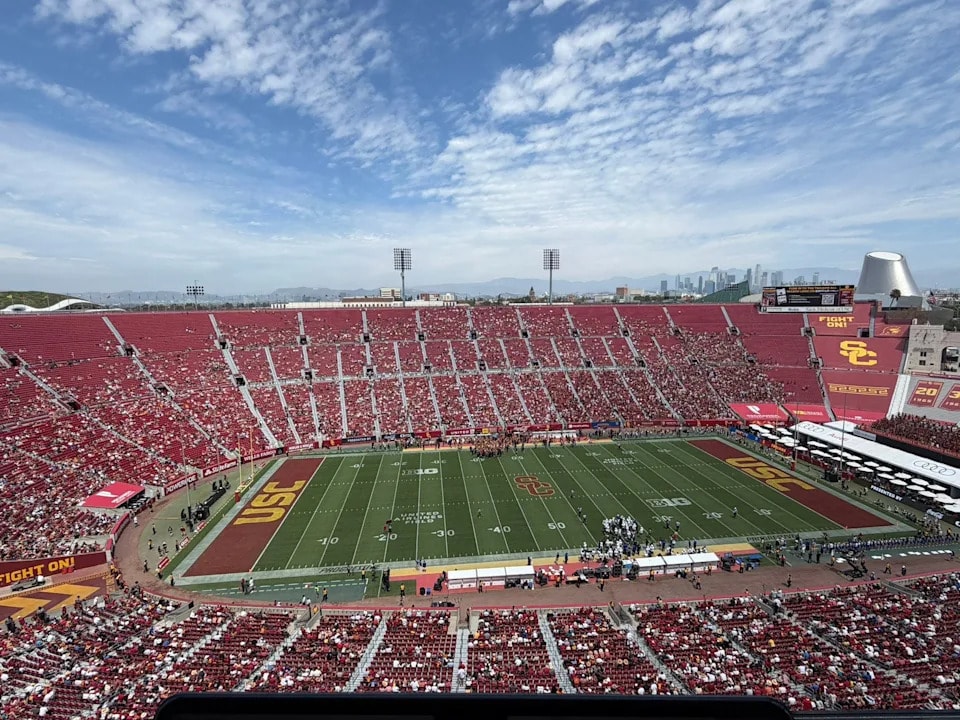
The Los Angeles Memorial Coliseum has always been more than a stadium for USC, it is part of the program’s identity. On Aug. 29, 2026, the Trojans opened their season against San Jose State, and a Yahoo Sports photo caption described the venue as mostly empty, a visual that fueled a broader argument about the state of USC football. In the accompanying analysis, Yahoo Sports framed USC’s on-field level as “average,” arguing that the program and its head coach, Lincoln Riley, have not earned the kind of patience that turns seasons into repeat performances rather than turning points.
Riley’s tenure is now judged by the outcomes USC expects, not by the explanations the sport provides. The Yahoo Sports piece largely reads as a verdict on the tone around the program, suggesting that a culture of excuses, whether about preparation, circumstances, or narratives that soften criticism, has no place when a team with USC’s resources is failing to separate itself. This is not simply a comment on entertainment value. It is about authority, and whether the Trojans’ football operation can make the simple promise their fan base expects: win on a consistent basis and look like the more prepared team.
What makes the criticism sharper is the juxtaposition between reputation and reality. USC’s brand is built on the idea that Saturdays in Los Angeles are supposed to look different, and that the Trojans should force opponents into uncomfortable football. When the analysis says USC football looks like it is lacking “juice,” it is pointing at more than effort. It is describing a sense that the team’s process does not create enough separation, whether in execution, tempo, discipline, or game-day intensity.
The public-facing issue is the same one that follows every high-profile program: expectation management. USC has long carried the weight of being a national conversation every fall, which magnifies each visible sign of underperformance. The Yahoo Sports critique implies that the sport has begun accepting mediocrity as a normal chapter, and it challenges that tendency by insisting that explanations do not substitute for improvement. The piece’s focus on “average” is a reminder that for USC, “competitive” is not the ceiling, it is the starting point.
There is also a recruiting and brand implication, even when the specifics are not the subject of the article. When a program’s performances do not match its messaging, momentum on the recruiting trail can be harder to sustain, and the internal pressure on coaching decisions rises. Riley’s staff will be evaluated not only on results, but on whether USC’s football identity becomes more tangible week to week: sharper starts, more reliable execution, and the kind of coaching clarity that reduces mental mistakes.
For USC and Riley, the next test will be translating criticism into measurable improvements as the season develops. Watch for whether the Trojans can sustain intensity beyond opening stretches, and whether they can turn early-season ambiguity into consistent game control. In college football, the margin for philosophical debates is small. The standard is not a speech, it is the scoreboard and the product on the field, and this latest critique is built around that difference.
Why It Matters
- For USC, public perception is inseparable from performance, and a “lifeless” look creates pressure for immediate corrections.
- A head coach’s credibility is tested not by intent, but by results that match the program’s national expectations.
- When a program appears “average,” it can affect player confidence and staff decision-making, especially early in the season.
- Criticism like this can also shape how recruits and transfers interpret the team’s trajectory, even before any formal recruiting-cycle updates are known.
Sources
Key Facts
- Yahoo Sports published an analysis criticizing USC’s early-season football quality as “average.”
- The article focuses on Lincoln Riley and the idea that there is too much reliance on excuses in the sport.
- A Yahoo Sports photo caption described the USC season-opening game at the Los Angeles Memorial Coliseum against San Jose State on Aug. 29, 2026, as having mostly empty stands.
- The piece uses the Coliseum image to frame dissatisfaction with the atmosphere around USC’s current football direction.