
THE APEX TIMES
Wembanyama’s physicality question hangs over the Finals after an elbow incident in Game 4
Victor Wembanyama’s right elbow to Karl-Anthony Towns’ chin in Game 4 has become the defining talking point heading into the next stretch of the NBA Finals, raising questions about how hard he can play without crossing the line.
The NBA Finals focus can shift in an instant, and this series’ latest pivot came from a single contact point. In Game 4, Wembanyama’s right elbow caught Karl-Anthony Towns in the chin, a moment that immediately changed the emotional temperature and the tactical conversation around physicality. According to Yahoo Sports, the central issue now is whether Wembanyama can return in Game 5 and play with the same intensity and physical presence that have powered his impact, without creating further foul or discipline concerns.
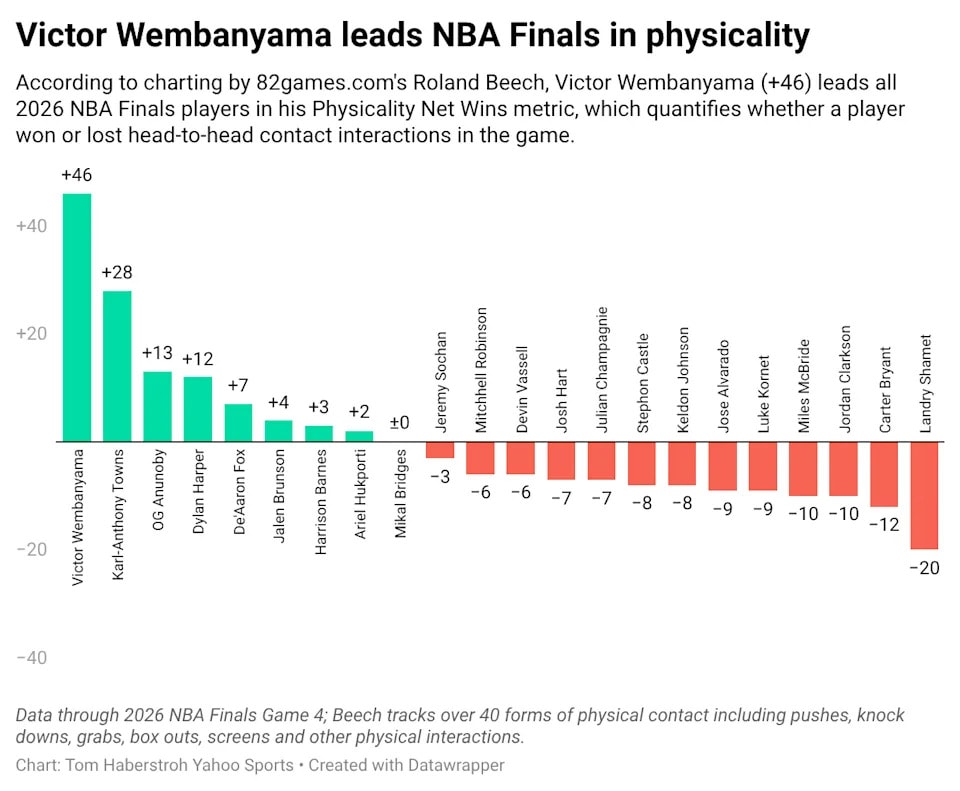
Wembanyama has been a matchup problem throughout the playoffs, largely because his physicality is not only about strength, it is about positioning, timing, and reach. That kind of presence matters more in the Finals, where offenses and defenses tighten and refereeing becomes even more sensitive to contact. After the elbow incident, the series becomes partly about what he does on-court and partly about how he manages contact and spacing when guards and bigs fight through screens and entry passes.
Yahoo Sports frames the looming question as a combination of flagrant risk and fatigue. That is a notable distinction, because even if a player avoids the specific kind of foul that escalates, the broader cost of playing at peak force can linger. Physicality in this context means more than taking hits, it means repeated high-effort contests at the rim and in the half court, where long stretches of sprinting closeouts and recovering rotations can wear down even elite athletes.
For the team defending Wembanyama, the adjustment is straightforward: attack angles and timing where a big’s body mechanics can be the difference between clean contest and illegal contact. For the team relying on his offense and defense, the challenge is more delicate. Wembanyama cannot be effective only when he is perfectly spaced, because the sport’s most common situations in high-level playoff basketball force contact at the margin. The coaching staff’s practical task is to help him affect play while reducing the number of late-arriving, high-leverage swings that can turn into an uncontrolled elbow or shoulder.
This is why Game 5’s storyline is bigger than a single sequence. If Wembanyama’s physical game has to soften, it can reverberate through everything around him, including defensive rim protection, how aggressively he can step into driving lanes, and how much cover he can provide on switches. In a Finals, where each possession compresses into fewer margin-for-error moments, even a small reduction in one player’s assertiveness can change the shape of the matchup.
There is also the optics component. When a play draws immediate scrutiny, officials tend to notice similar mechanics more quickly, and opponents tend to test those boundaries. Yahoo Sports’ emphasis on “everything changed” after Game 4 reflects a common Finals dynamic: the league’s judgment about acceptable contact becomes a part of the chessboard, not just a background factor.
What to watch next is whether Wembanyama can maintain his normal contest style without drifting into the kind of contact that creates escalation. Pay attention to his body control in post contests, how he approaches rebounds and drives, and whether he relies on cleaner reach and positioning rather than late, high-speed proximity. If his physicality stays intact, the series likely continues along its established lines. If it has to adjust, the Finals will tilt toward a more cautious version of his game for the remainder of the stretch.
Because the broader discipline details are not included in the available preview text, this account stays anchored to what is confirmed in the reporting: the Game 4 elbow to Towns’ chin and the question it has raised for the next game. Any follow-up decisions, including whether additional penalties were assessed, should be treated as separate facts to confirm from official NBA communications and postseason officiating records.
Why It Matters
- The Finals are more sensitive to contact, so a key physical incident can influence both officiating posture and player behavior.
- If Wembanyama reduces aggressiveness to avoid foul escalation, it can affect rim protection, help coverage, and defensive intimidation.
- A fatigue-related physical adjustment can change his efficiency and decision-making late in possessions.
- How Wembanyama plays in Game 5 can alter the matchup identity for the remainder of the series, not just one game.
Sources
Key Facts
- In Game 4 of the NBA Finals, Victor Wembanyama’s right elbow caught Karl-Anthony Towns in the chin.
- The Game 4 contact has become the main storyline heading into Game 5.
- Yahoo Sports reports that the central question is whether Wembanyama can maintain his typical physicality without creating further flagrant or foul risk.
- Yahoo Sports also connects the issue to the possibility of fatigue affecting how hard Wembanyama can play.
- The series’ physicality approach may shift depending on how Wembanyama manages contact and body mechanics in the next game.