
THE APEX TIMES
Yoshinobu Yamamoto’s splitter is the difference-maker in a Dodgers rotation built on fastball command
Even with a rotation that features elite secondary pitches across the staff, Yamamoto’s approach highlights why the Dodgers’ ace profile often starts with what they throw most, then what they can make hitters misread.
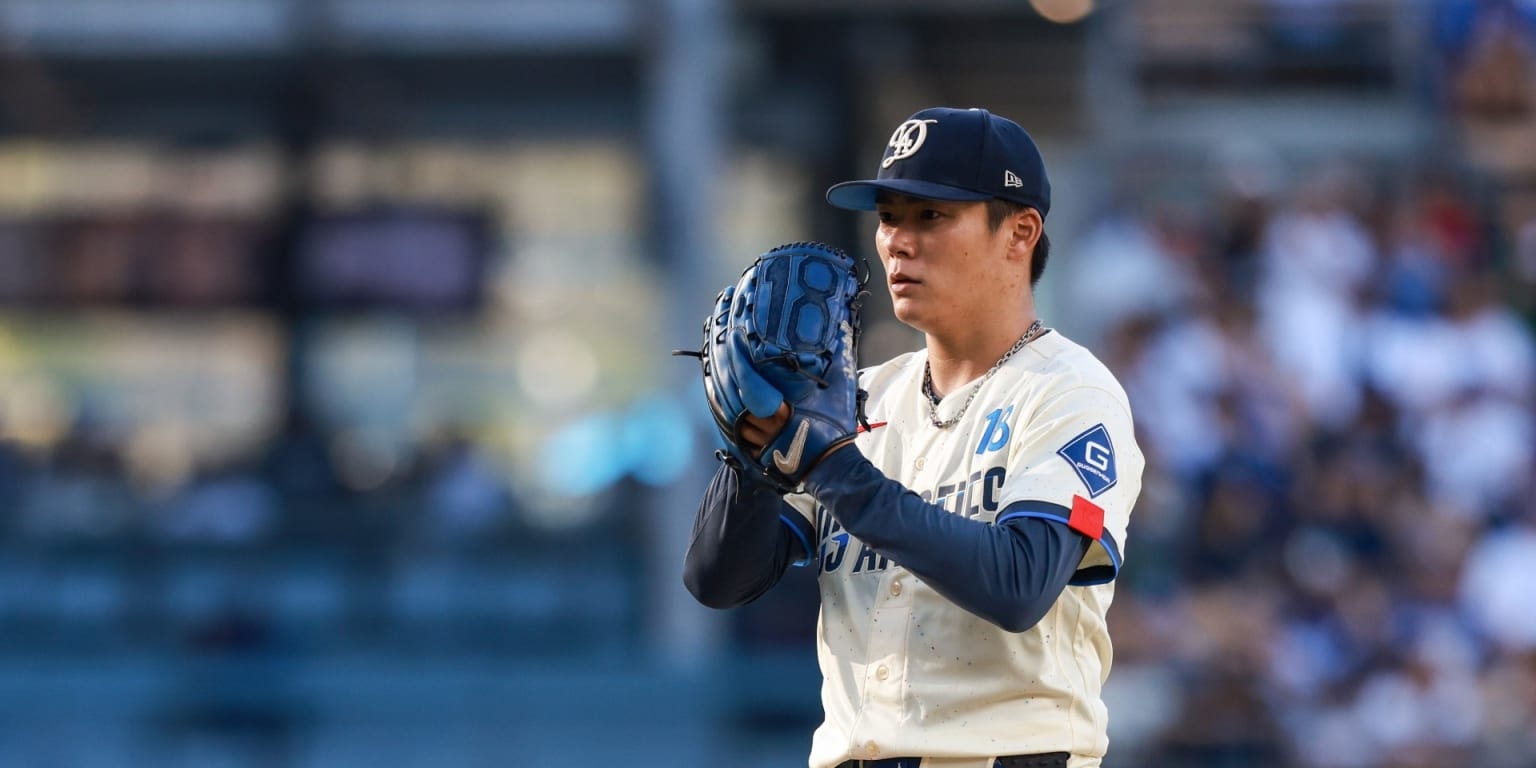
Yoshinobu Yamamoto has become a central figure in how the Los Angeles Dodgers think about pitching craft: when a pitcher’s best pitch is built for deception, the foundation still comes from the pitch hitters see most. In the Dodgers’ rotation at full strength, multiple starters have secondary offerings that can look untouchable on a given night. Yet an MLB breakdown focusing on Yamamoto frames the key contrast as something deeper than “nastiness,” emphasizing that for him, the splitter is a weapon whose evolution is designed to amplify what comes before it.
The Dodgers have constructed an ecosystem of off-speed fear, but the article’s central point is that secondary pitches, however lethal, are rarely the whole story. The fastball is the baseline, the most used pitch, and it sets up everything else. When a starter can command a four-seam fastball with enough authority to establish timing, the pitcher gains permission to deviate. That deviation is where Yamamoto’s splitter comes in, turning a pitch that could otherwise be merely different into a pitch that plays like a read-and-react problem for hitters.
The rotation comparison matters because it clarifies what Dodgers fans are used to seeing when they watch their staff. The MLB piece places Yamamoto in the same conversation as other prominent Dodgers starters known for pitch variety. Tarik Skubal’s changeup, Shohei Ohtani’s sweeper, and the curveballs associated with Blake Snell and Tyler Glasnow are all cited as examples of how a rotation can live on secondary movement and feel. The analysis then draws a line between those secondaries and the practical reality that, for each ace, the most-used pitch is still typically the fastball.
In that framing, Yamamoto’s splitter is not presented as a random third or fourth offering. Instead, it is described as an evolving part of his repertoire that helps separate him from the rest of a rotation full of high-end talent. Splitter “evolution” is the lens used, suggesting that the pitch has been shaped for more than one scenario. The goal is to create a durable pattern: hitters are forced to treat the fastball and off-speed in the same visual language long enough that the ball’s late behavior becomes the deciding factor.
That matchup logic is why the splitter stands out even in a lineup where other starters can show off prominent breaking balls and changeups. If a pitcher’s fastball command is strong enough to anchor the count, then the splitter becomes a swing decision pitch. The ball can be made to look like it might be one thing, then finish in another, particularly when the hitter’s timing is already committed. The MLB discussion underscores that the pitch is a centerpiece of Yamamoto’s identity, not just an occasional strike.
For the Dodgers, the tactical payoff is as much about structure as it is about any single result. A team that can put together starters who all have deception, but deception of different kinds, tends to benefit from continuity. It also changes how opposing hitters approach the middle innings. Even if a batter adjusts to one pitch shape, the Dodgers can pivot to a different kind of misdirection because the staff’s fastballs provide the starting point and the off-speed acts as the separator.
What to watch next is how Yamamoto uses the splitter in the fastball-first framework described in the MLB analysis. The question for each start is whether the splitter can deepen the consequences of the fastball, turning what might otherwise be a routine sequence into a sharper, more repeatable pattern. In a season where the Dodgers’ postseason profile depends on starting pitching and late-inning leverage, the staff’s ability to make “most-used” pitches the foundation for “hardest-to-read” outcomes could be one of the most reliable edges they have.
Why It Matters
- A fastball-first approach can raise the ceiling of any off-speed pitch, because it forces hitters to commit to timing before deception arrives.
- With multiple starters carrying elite secondary skills, the Dodgers’ advantage can shift from “one good pitch” to “repeatable sequences” that opponents struggle to process.
- In playoff baseball, starters who can manufacture swings without relying on one-off outcomes tend to stabilize matchups across multiple rounds.
- Understanding Yamamoto’s splitter as a developed tool, not an occasional weapon, helps explain how the Dodgers protect their pitching plan under different game scripts.
Key Facts
- An MLB breakdown highlights Yoshinobu Yamamoto’s splitter and its evolution as a defining part of his pitching approach.
- The article argues that, even for the Dodgers’ other top starters, secondary pitches are still secondary to the fastball as the most used pitch.
- The piece compares Yamamoto’s situation to the Dodgers’ rotation members known for standout secondary offerings, including Tarik Skubal’s changeup, Shohei Ohtani’s sweeper, and curveballs associated with Blake Snell and Tyler Glasnow.
- The analysis emphasizes a pitching-structure idea: fastball command and usage set up deception, which is where Yamamoto’s splitter is most impactful.
- The central theme is how a pitch that causes late confusion can be made more dangerous when it is paired with a strong, frequent fastball.