
THE APEX TIMES
Drone-mounted gamma detector advances FUSRAP innovation, safety at Chambers Works
DEEPWATER, N.J. – The U.S. Army Corps of Engineers (USACE) Philadelphia District is flight testing a new drone‑suspended gamma detector at the former Du...
DEEPWATER, N.J. – The U.S. Army Corps of Engineers (USACE) Philadelphia District is flight testing a new drone‑suspended gamma detector at the former DuPont Chambers Works Formerly Utilized Sites Remedial Action Program (FUSRAP) site in Deepwater, New Jersey, exploring innovative and safer ways to locate buried radiological contamination at one of the nation’s most complex cleanup projects.
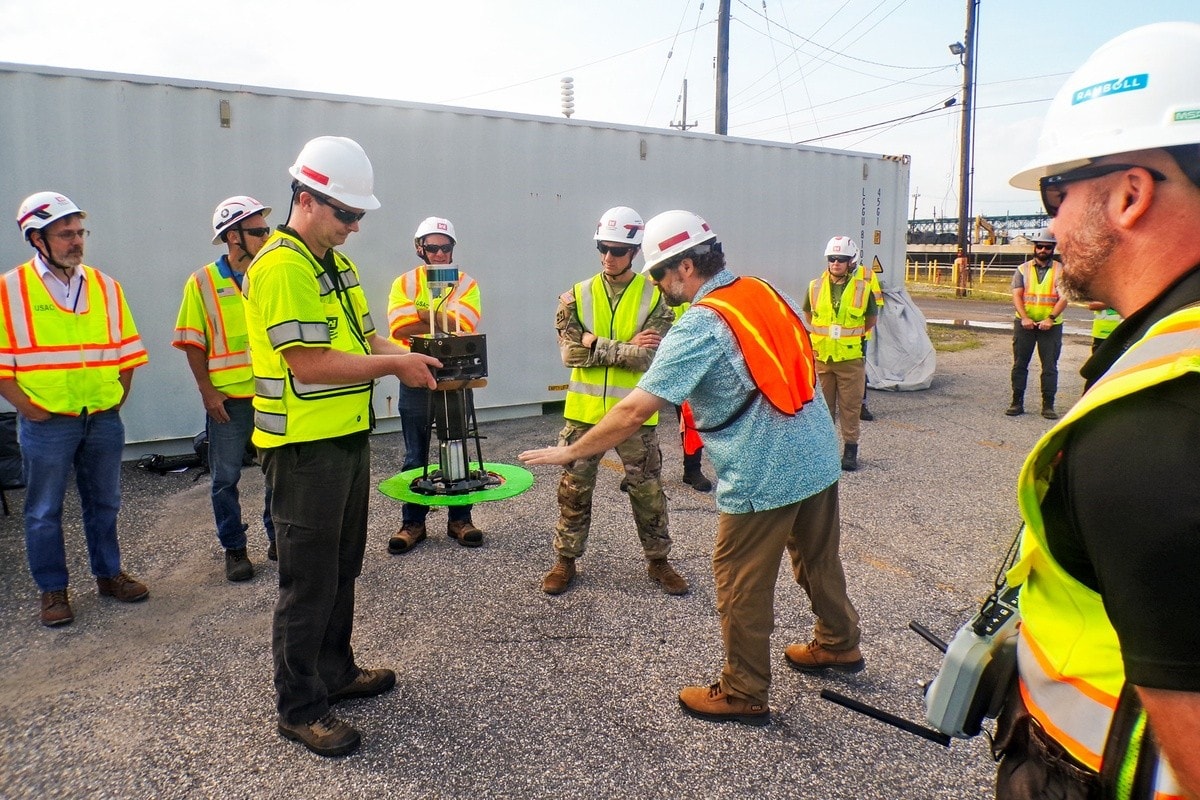
The system, called GemiNaI, was designed in collaboration with the U.S. Department of Energy’s (DOE) Lawrence Berkeley National Laboratory and is being tested over steep slopes, deep excavations and heavily vegetated areas where hand‑held instruments are difficult to use safely and effectively.
“The device these guys are building is providing greater precision and accuracy for scanning radioactivity than anybody has done before from the air,” said Daniel Sirkis, USACE geologist and technical manager for the site. “It appears to have the ability to detect low levels of gamma rays from radioactive materials, determine which elements are emitting them, and where they are located at a pretty high accuracy.”
GemiNaI features twin sodium iodide detectors mounted at a slight angle with an integrated LiDAR sensor that maps the ground while the system is suspended and flown from an industrial drone. Lawrence Berkeley also developed camera‑based software that allows the drone to track visual targets on the payload and automatically adjust its position to reduce and compensate for the pendulum motion that occurs when moving a suspended load.
The new detector is part of a broader effort to keep workers out of the most hazardous conditions at Chambers Works. The site is an active chemical plant where uranium refining for the Manhattan Engineer District and decades of chemical manufacturing have left a complex mix of radiological and chemical hazards.
“We’re here remediating uranium, primarily,” said Lindsay Keller, USACE project manager for the site. “But as you know, DuPont is a facility that has manufactured and stored all types of chemicals for more than 100 years. So, we have a lot of chemical waste here, and that’s a challenge for us.”
Chambers Works is the only FUSRAP project in the Philadelphia District’s area of responsibility and one of 21 active FUSRAP locations nationwide. Deep excavations there can reach 18 feet, and currently the only way to scan excavation bottoms for radiation is to send fully suited personnel in on supplied air, carrying heavy detectors across wet clay.
“This site is one of the most contaminated sites east of the Mississippi,” said Sirkis. “Our biggest concern, the thing that keeps us up at night, is making sure that we protect our workers, we protect the nearby Chemours workers, and we protect the public.”
“We saw enough times where workers would slip and fall,” he added. “We realized we needed to start innovating, not because we wanted to be inventors, but because we needed these tools, and they just did not exist. So, I picked up the phone and called Lawrence Berkeley National Lab.”
According to Sirkis, the suspended GemiNaI detector builds on a series of other innovations that the Chambers Works team has pursued out of necessity. Over the past several years, the team has also worked with other government‑owned, contractor‑operated laboratories to solve problems that conventional tools could not address.
For example, a collaboration with Pacific Northwest National Laboratory has recently led to developing and testing technologies like a Pneumatic Odor Detection Drone (PODD), which has a payload to collect airborne samples of vapor plumes over excavations and waste piles.
“The primary benefit of these technologies is more of a safety benefit where we do not have to send people into an excavation to scan in dangerous conditions,” said Keller. “We can use a drone instead to achieve that.”
The use of innovative technology has contributed to a significant milestone for the Chambers Works project team.
“We’ve had 2,000 workdays without a recordable safety incident,” said Keller. “That means our contractors have been able to work safely in the field for that period of time, which is a major accomplishment.”
That figure equates to nearly a decade of work onsite, about as long as the USACE team has been there since remediation resumed in 2016 after a brief pause. This is largely due to the success of the site remedial action contractor, Sevenson, who has developed some of their own safety innovations.
Keller added that none of this work would be possible without strong partnerships among USACE, DOE, the national laboratories, and site contractors. Under FUSRAP, DOE identifies and evaluates eligible sites associated with the nation’s early atomic energy program, and USACE executes remedial investigation and cleanup before transferring completed locations back to DOE.
“The labs have amazing capabilities that we do not, and we’ve been working together now for a couple of years,” said Keller. “The labs design and develop the payloads. Ramboll, another contractor, flies the drones. They know the site, they know the safety procedures. It is a really nice partnership that we have.”
According to Kyle Kohler, a geologist and certified drone pilot with Ramboll Americas, early GemiNaI testing has been a success and produced lessons about both sensor performance and flight operations.
“Big picture, being able to utilize a drone with a suspended payload, in this case a gamma detector, in hazardous conditions is a game changer,” said Kohler. “Taking the human element out of the work area, to conduct something that we can do with a drone and more autonomously, only benefits the project from a health and safety perspective, but also increases a little bit more of the innovation and technology that’s come along the past couple years.”
As remediation at Chambers Works continues, the combination of innovation, safety focus and strong partnerships will continue to define how the team approaches one of the most challenging FUSRAP cleanups in the country.
Key Facts
- Official source: Army News
- Published: Oct 14, 10:31 AM EDT
- Text source: Army News official source page