
THE APEX TIMES
Fort Drum tour brings local history to life
FORT DRUM, N.Y. (Oct. 13, 2026) -- Community members traveled through thousands of acres in the training area on Oct. 9 to explore generations of North...
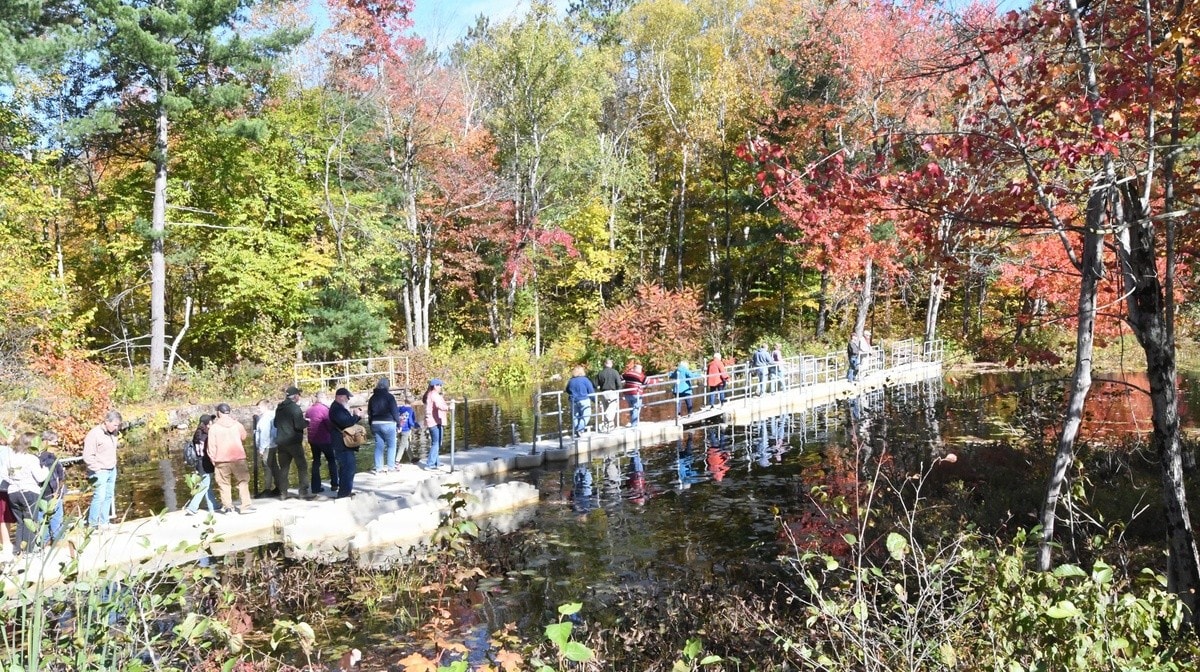
FORT DRUM, N.Y. (Oct. 13, 2026) -- Community members traveled through thousands of acres in the training area on Oct. 9 to explore generations of North Country industry and environmental stewardship during the Fort Drum History Tour.
The tour included stops at Slocum’s Mills, Buck Creek Park (Conservation Pond) and the “Lost Village” of North Wilna. Together, these sites highlighted the area’s complex evolution – from its days as a 19th century industrial hub and thriving farm community to its transformation into a vital military training ground during World War II.
At the ruins of the Lewisburg blast furnace and the flooded Quarry Pond, attendees learned about a booming iron-making industry and the discovery of world-class calcite crystals unearthed from the quarry’s depths. They also paid their respects to the area’s pioneers and veterans, including those from the Civil War, at the Lewisburg Cemetery.
Beyond the historical narrative, the tour emphasized the modern mission of Fort Drum, demonstrating how the installation balances the training needs of the 10th Mountain Division (LI) and visiting units with a proactive commitment to ecological conservation. Visitors learned about ongoing efforts to restore sandplain grasslands, manage forest habitats, and protect miles of rivers and streams that flow through the training area.
Before going on the tour, Asher, a 12-year-old homeschool student, imagined a different kind of Fort Drum.
“I guess when you picture a military base, you almost think it would be a prison, like a heavily-guarded area,” he said. “So, it was kind of cool to see what it actually looks like. I learned quite a bit about the history of Fort Drum and the land around it, and the military. And I like being out in the wilderness.”
For many attendees, the tour offered a glimpse into a history that is often left out of classrooms.
“Growing up here, we aren’t taught about Fort Drum,” said Laura Bolke, a Clayton resident. “The first time I ever heard about the Lost Villages was walking through the Fort Drum museum, and I thought, ‘Why aren’t we being taught this?’ But I love history, and the history here is amazing.”
Bolke also took advantage of the peak fall foliage and photographed the scenic landscapes along the tour route.
“I really enjoyed listening to our tour guide explain how conservation has progressed over the years, and I learned so much,” she said.
Her husband, Kent Bolke, took the day off from his normal duties as 10th Mountain Division and Fort Drum Museum director to attend his first history tour.
“I’ve been to the ranges before, I’ve been to the cemeteries, but I’ve never been on a tour before,” he said. “From start to finish, I thought it was excellent. We had Ray (Rainbolt) on our bus, and he absolutely knocked it out of the park.”
As a member of the Fort Drum Natural Resources Branch, Ray Rainbolt contributed his environmental knowledge to the tour, but said he brushed up on less familiar subject matter beforehand.
“I thought I brought my own personal interest in local and military history, but my tour bus definitely had a heavy environmental flavor to it,” Rainbolt said. “It’s kind of a biased opinion, but natural resources is a part of everything we do. It’s how the communities were first established, and it’s what we train in today.”
Rainbolt noted how attendees exchanged personal stories, which made the excursion far more interactive for everyone.
“Some had been on Fort Drum as a Soldier before, and had stories to tell about their experiences, and others had ancestors who grew up in the area,” he said. “I shared my personal story because my dad was at Camp Drum in the 1950s when he was with the 11th Airborne Division training here.”
The conversations were just as robust on the second bus, according to Marisa Mustizer, Directorate of Public Works tour guide.
“The bus was very interactive with non-stop chatter, which was absolutely wonderful,” she said. “There were a lot of questions that covered a plethora of topics. The tour incorporated a good mix of topics, which many people found appealing.”
Mustizer said she enjoys working with the community and connecting with people, and the tour gave her that opportunity.
“Leading up to the event, I spent a lot of time learning the history and lore of the area,” she said. “Sharing these stories, both of my personal familial lineage and stories that have carried through generations makes the tour more enjoyable and gives more of an opportunity for the community to connect to the presentation.”
Mustizer said her father, who attended the tour, is a lifelong history buff who passed his passion down to her.
“He spent his career as an electrician, working mostly on hydroelectric generators,” she said. “It was truly a joy to share my knowledge, but in many ways this tour tied his personal interests with his professional livelihood. For him, there was a level of nostalgia seeing the various sites that included hydro-powered operations, some of which he once worked on.”
Photos from the Fort Drum History Tour are available.
Key Facts
- Official source: Army News
- Published: Oct 13, 11:25 AM EDT
- Text source: Army News official source page